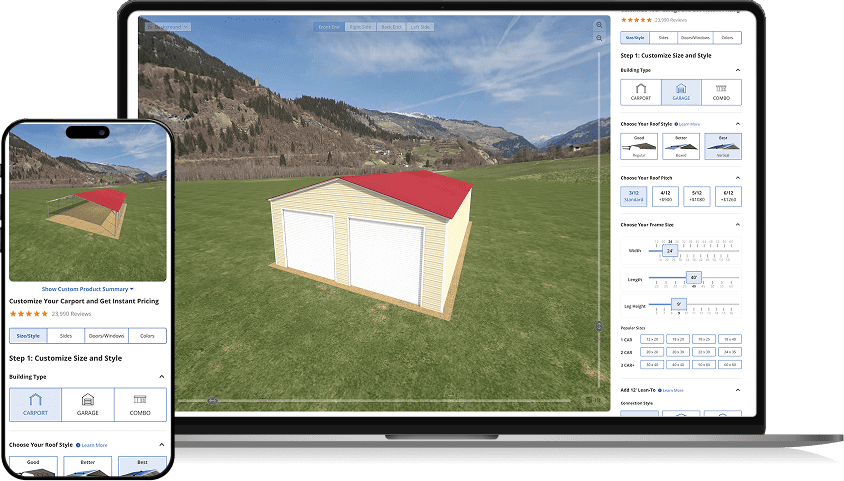


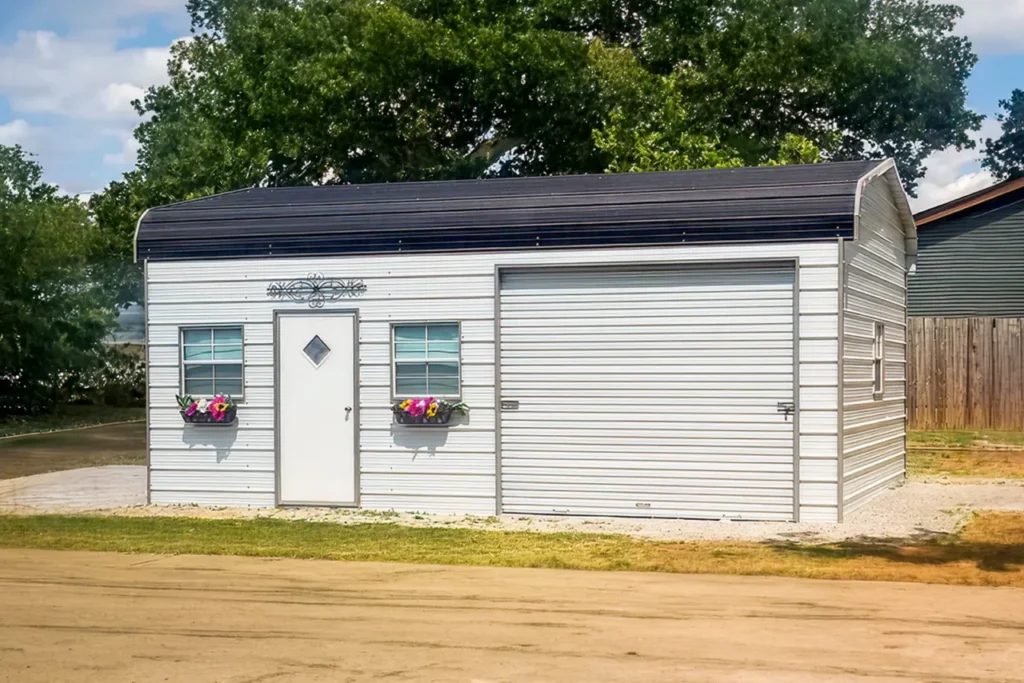
A garage house is a single structure that combines garage bays and living quarters under one roof. The garage and the living area sit either side-by-side on the main floor or are stacked two-story, with the apartment positioned above the bays.
People often build garage houses as primary residences on rural land, as accessory dwelling units (ADUs) for family members, as guest suites, or as combined workshop and home setups for hobbyists who want their tools and their bed in the same building. The structure has to do two jobs at once: protect vehicles and gear, and house people year-round. That dual purpose makes the building shell, the floor plan, and the code path more involved than either project alone.
I’ll walk you through what counts as a garage house (and what doesn’t), four practical garage house plans with square footage, the architectural styles that work well, foundation options, why a tall metal building works as the shell, the residential codes that govern combined dwelling-garage builds, and the insurance and appraisal questions to answer before you order materials.
What a Garage House Is (and What It Isn’t)
Three terms get used interchangeably online: garage house, barndominium, and garage apartment. However, they describe different products with different buyers and different code paths.
| Term | What it is | Best for |
|---|---|---|
| Garage house | Garage-first structure with living quarters added under the same roof. The garage bays drive the building footprint; the living space is sized to fit alongside or above. | Hobbyists, RV owners, and tradespeople who want vehicles and tools attached to the home. Buyers prioritizing garage space first, living area second. |
| Barndominium | Barn-style home where the living area dominates the footprint. The garage or workshop, when included, is a smaller bay attached to a larger residence. | Buyers who want the barn aesthetic and are home-first, not garage-first. |
| Detached garage with apartment | Stand-alone garage building with a one- or two-bedroom apartment above (or beside) the bays. Sometimes called a “garage apartment” or “carriage house.” | An ADU on a property that already has a primary house — rental income, in-law suite, or guest house. |
| Multi-family garage house | A larger garage-house build configured as a small duplex, with two separate living units sharing a garage block. Less common but legal in many ADU-friendly counties. | Income property on rural land, or extended family arrangements with separate kitchens. |
For another look at metal garage builds with finished living quarters, check out our guide to metal garages with living quarters.
Layout Approaches: Side-by-Side or Stacked
Garage houses come in two basic configurations, and the choice drives building height, foundation type, garage entry direction, and code path.
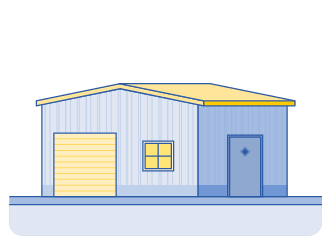 Side-by-side (single main floor) Garage bays and living quarters share a single floor. Wider footprint, lower sidewall, and no stairs. Easiest to permit and the cleanest match for a metal building shell. Front entry, side entry garage, or rear entry garage configurations are all workable depending on how your driveway approaches the building. | 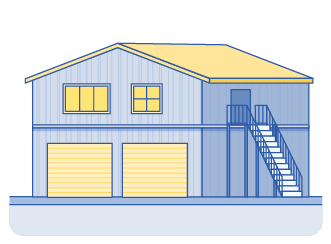 Stacked (two-story) Garage bays on the ground floor, living quarters above. Smaller footprint, taller sidewalls, second-story stairs, and structural support required. Needs at least 18 to 20 ft sidewall height to deliver real ceiling clearance on the upper level after framing the floor. |
The stacked two-story is what most people picture when they say “garage with apartment above.” It’s the right call on a tight lot or where the property has zoning rules that limit footprint but allow vertical building.
Side-by-side is the right call when land is plentiful and a single-story layout simplifies aging in place, accessibility, or future expansion. Garage entry direction (front entry vs. side entry garage vs. rear entry garage) is mostly a curb appeal and driveway-flow decision; talk it through with your contractor before locking the floor plan.
Garage House Floor Plan Ideas
Here are four practical garage house plans, each with square footage and a target use case. These work as starting blueprints you can modify with your home design preferences. Sizes assume a metal building shell, so the open span and tall sidewalls are baked into the footprint.
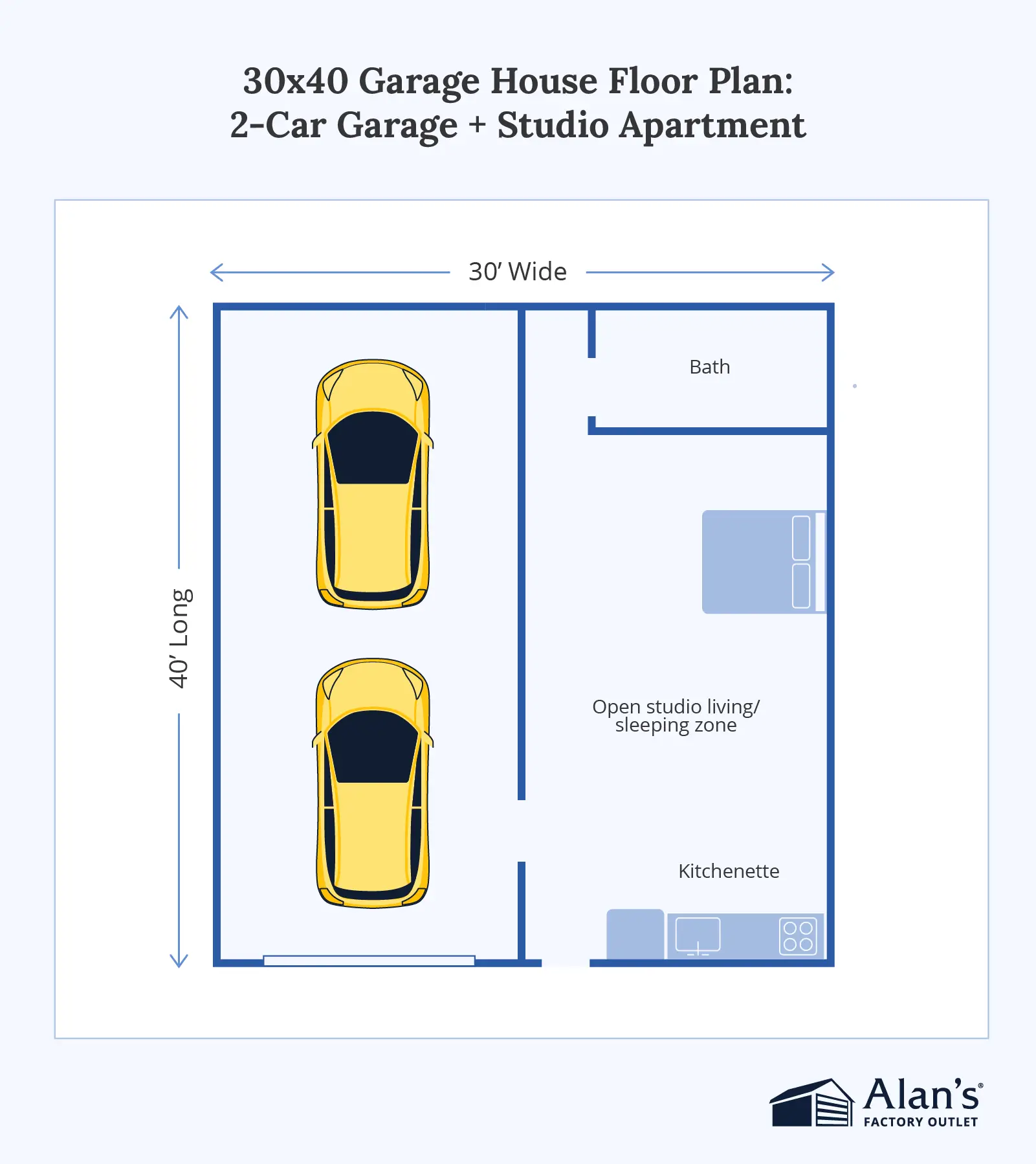
30×40 — 2-Car Garage + Studio Apartment (1,200 Sq Ft, Side-by-Side)
This is the smallest practical garage house. Bayside fits a standard 2-car garage with a narrow workbench wall. The living side holds a studio with a kitchenette, three-piece bath, and a sleep zone separated by a half wall. Single-story, simple slab, easiest permit path. About 360 sq ft of living area inside the 1,200 sq ft footprint.
| Two-car garage bay (24×20 ft active) — workbench along the back wall, two roll-up doors | Studio living/sleeping zone Murphy bed against the long wall, sofa as the living room, small desk |
| Bath + utility 3-piece bath, water heater, washer/dryer stack | Kitchenette + dining Apartment-size fridge, two-burner cooktop, two-seat counter |
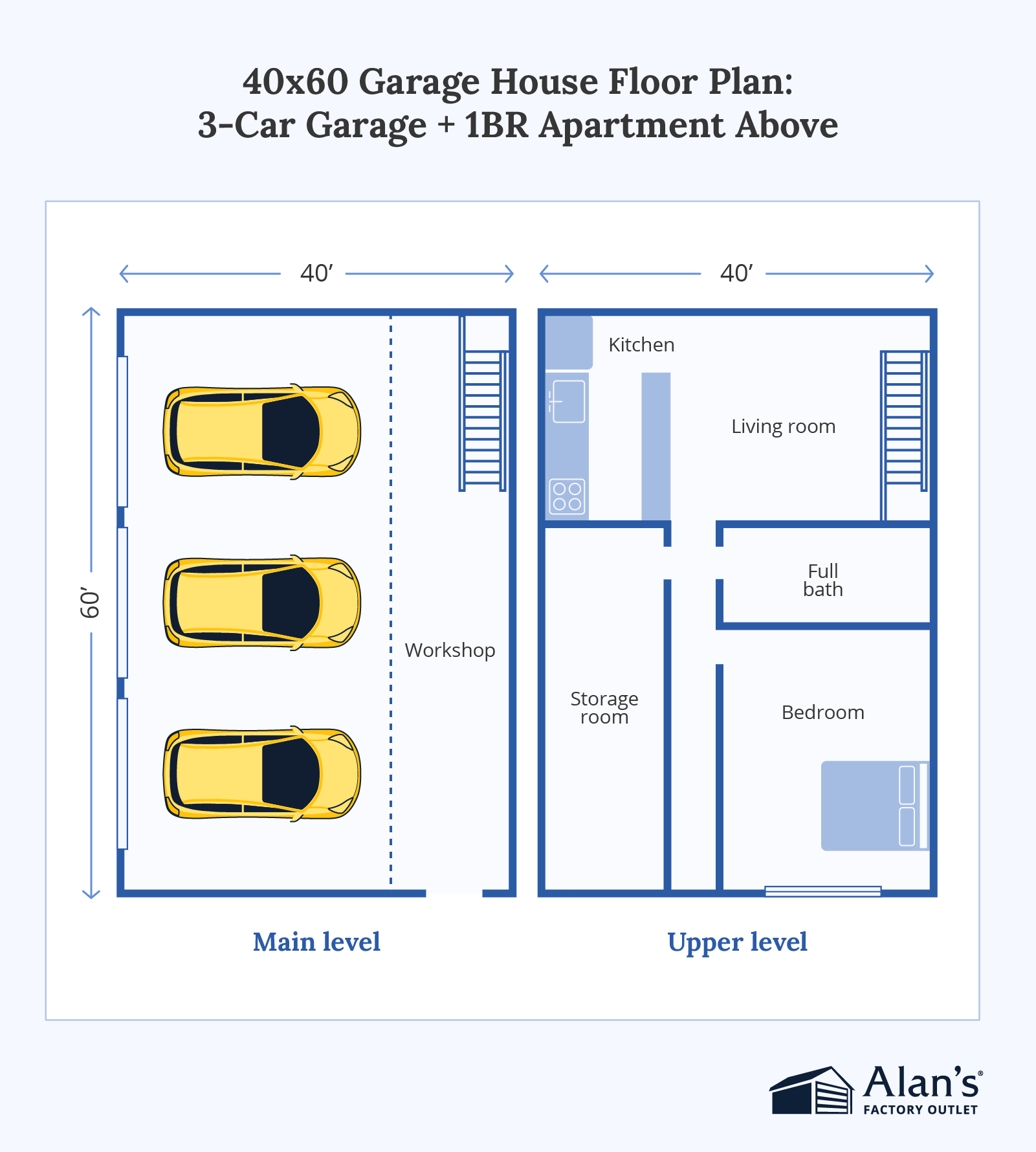
40×60 — 3-Car Garage + One-Bedroom Apartment Above (2,400 Sq Ft, Two-Story)
This two-story plan requires tall sidewalls (18 ft or more) to deliver real ceiling height on the upper level after framing the second floor. The 3-car garage bay holds a daily driver, a project car, and a workshop zone. Upstairs is a real one-bedroom apartment with a separate kitchen, living room, bedroom, and full bath. Total building footprint is 2,400 sq ft across two levels.
| Ground floor (main floor) | 3-car garage with workshop bay — single 16 ft door + standard 9 ft door, or three standard doors. Stairs to upper level along one sidewall. |
| Upper floor | One-bedroom apartment — bedroom, full bath, kitchen with full appliances, living room with windows on the gable end for natural light. Optional bonus room (for storage, etc.) over the garage if the sidewalls clear it. |
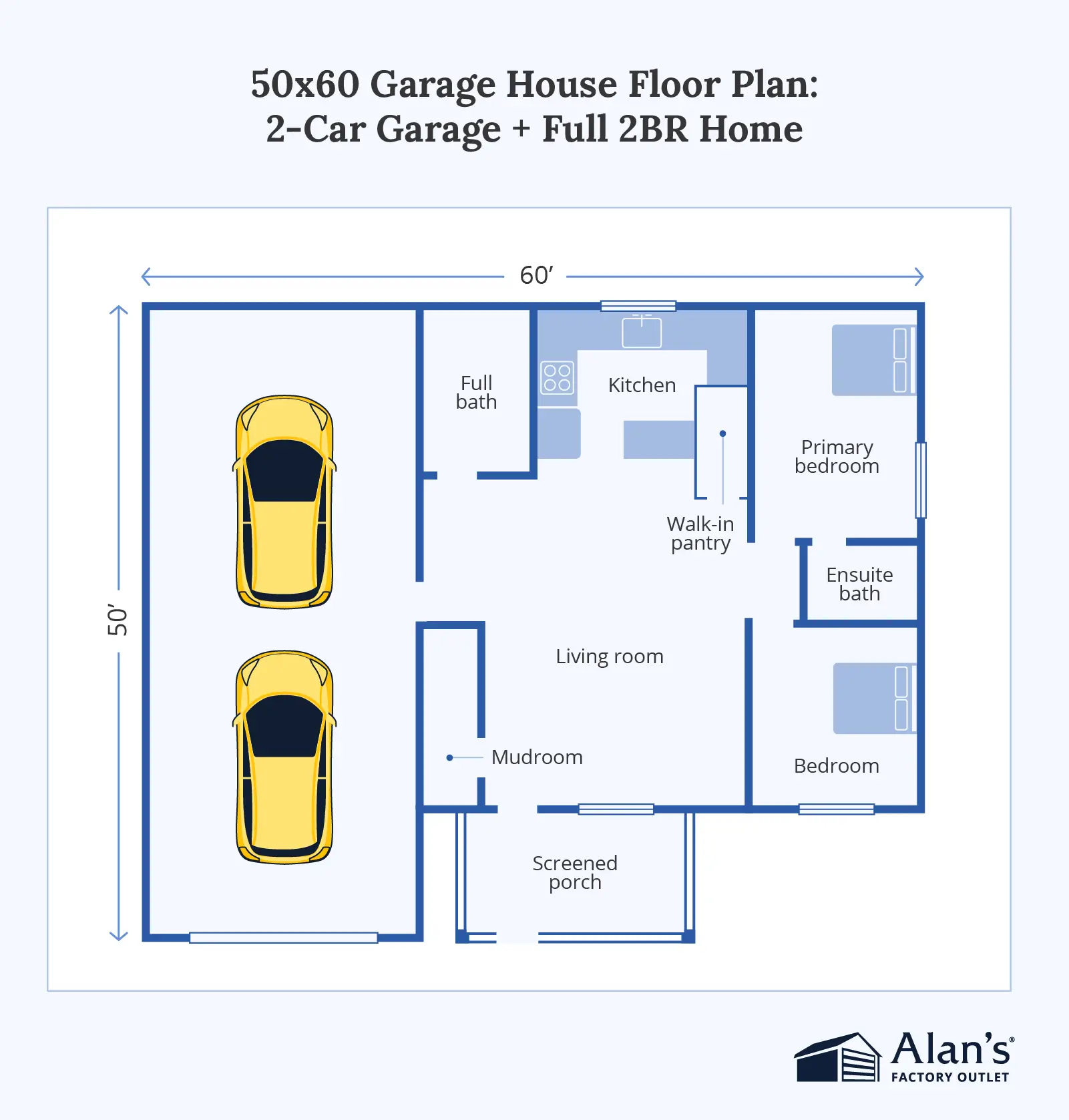
50×60 — 2-Car Garage + Full Two-Bedroom Living Space (3,000 Sq Ft, Side-by-Side)
The most house-like single-story option. Two-car garage on one short side, full two-bedroom home on the other, separated by a fire-rated wall. Front entry to the living wing on the long side; side entry garage where the driveway meets the gable. Works as a primary residence, a long-term in-law suite, or a guest suite with serious garage space attached.
| 2-car garage The 24×30 ft size is wide enough for two vehicles plus storage along the back wall and a side entry door to the living wing | Living + dining Open living room and dining at the long end of the building, big windows or a screened porch on the gable |
| Primary bedroom Queen, walk-in closet, ensuite half bath | Second bedroom or bonus room Twin or full, smaller closet, doubles as office or kid’s room |
| Full bath + mud room Full bath, laundry, mud room transition from garage | Kitchen + pantry Full appliances, island, walk-in pantry |
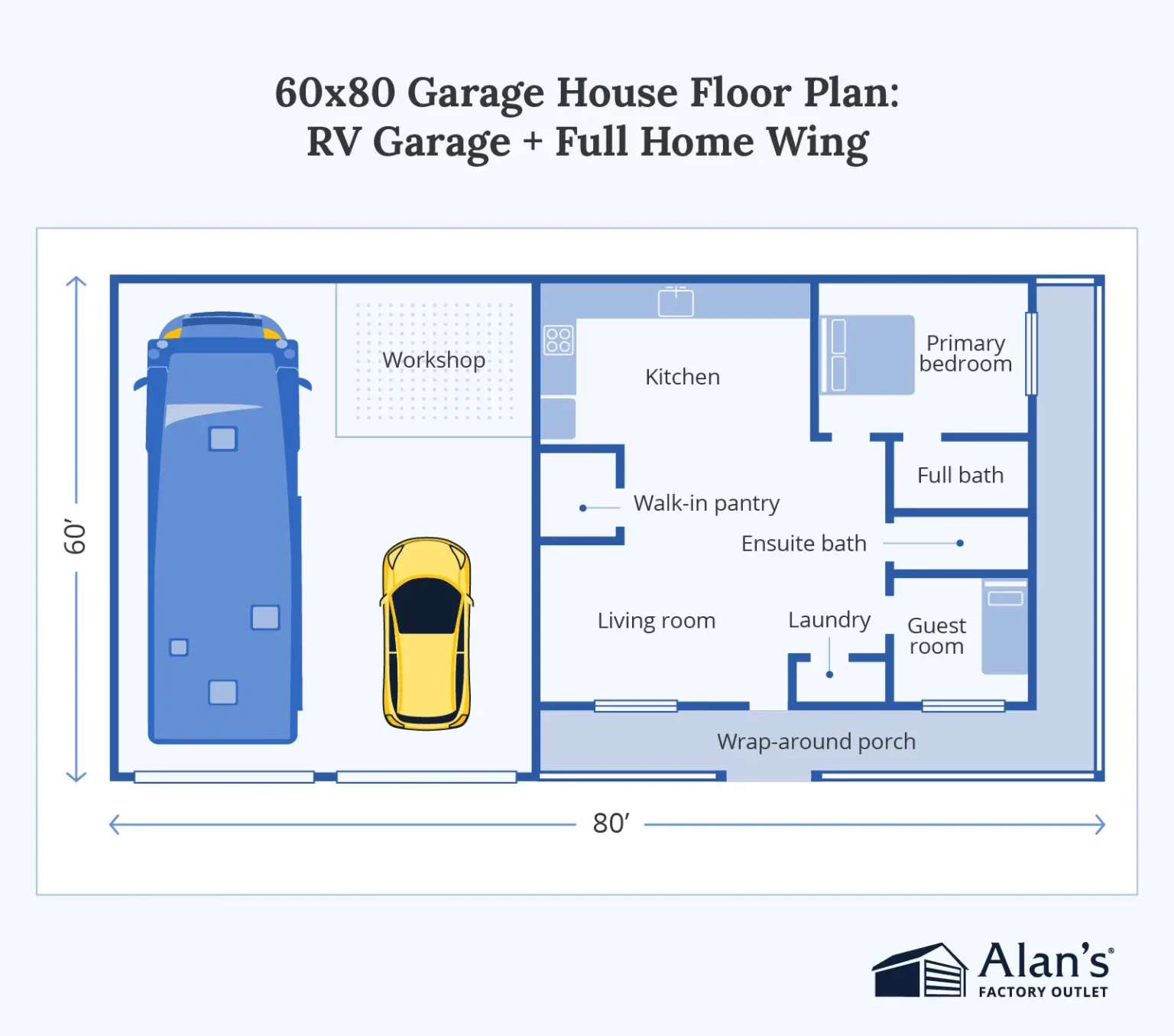
60×80 — RV Garage + Full Home Wing (4,800 Sq Ft, Side-by-Side)
The flagship layout. RV garage on one short side, full two- or three-bedroom home on the other. Sidewall heights run 16 to 20 ft to clear the RV. Common build for retirees who travel half the year and want a small house attached to the rig. A rear-entry garage from a back driveway keeps the front porch and living wing facing the road.
| Primary suite Queen or king, walk-in closet, full ensuite bath | Guest suite or bonus room Second bedroom with closet, optional half bath | RV garage (20×40 ft, 14 to 16 ft door) — RV parking with hookups (50A power, fresh water, sewer dump), plus a workshop zone and a tandem garage bay for a tow vehicle |
| Mud room + laundry Boot bench, washer/dryer, transition from RV garage | Kitchen + pantry Full appliances, island seating, walk-in pantry | Open living and dining Big-window living room area on the gable, optional front porch or wrap-around porch on the long side |
Architectural Styles That Work for Garage Houses
A metal building shell is structural; the architectural style is what you wrap on top. Most garage house buyers pick from a handful of looks based on regional taste and the rest of the property:
- Modern farmhouse. The most popular finish for new garage house plans. White or two-tone metal panels, board-and-batten accents, black window frames, a wrap-around porch, or front porch on the gable end. Clean and current without being trendy.
- Craftsman. Tapered porch columns, exposed rafter tails, a low-pitch front porch, earthy color palette. Pairs well with the side-by-side single main floor configuration and reads as residential rather than industrial.
- Bungalow. Compact one-story silhouette with a front porch and pitched roof. The 30×40 studio and 50×60 two-bedroom plans translate naturally to a bungalow elevation.
- French country. Stone or stucco accents on the gable, hipped or steeply pitched roof, decorative shutters. Works on a 60×80 with a porte-cochère over the front entry as a covered approach.
- Modern garage. Clean horizontal lines, dark metal panels, large overhead glass garage doors, minimal trim. The right look for a contemporary home or a high-end car collector’s build.
None of these change the structural shell; they’re applied as finishes, trim, and roof style choices on top of the same metal building. Pick the style that matches the rest of your property, then bring it to your contractor along with the home plans.
Foundation Options for a Garage House
Three foundation types cover most garage house builds, and the choice depends on terrain, climate, and whether you want extra living area underneath.
- Concrete slab on grade. The default for a metal building. A 4 to 6 inch reinforced slab on a compacted gravel base. Cheapest, fastest, and the right call on flat ground.
- Crawlspace. A 24 to 36 inch raised foundation with vented or conditioned space underneath the living wing. Common in humid Southeast climates where ground moisture is a long-term concern. Adds cost and a vapor management plan.
- Walkout basement (or daylight basement). If your lot slopes, a walkout basement can add a finished floor below the main floor without dramatically increasing the build cost. A daylight basement (windows on the downhill side) doubles as additional living area or storage. This is the foundation choice that most often pushes a garage house total square footage past 4,000 sq ft.
Get a foundation contractor and a structural engineer to spec the foundation to your specific site, soil, and frost depth before ordering the metal building shell.
Why a Metal Building Is the Right Shell
Three structural needs make garage houses a strong fit for a metal building:
- Tall sidewalls. Stacked two-story layouts need 18 to 20 ft sidewalls to clear the upper-level ceiling. RV garages need 14 to 16 ft door heights. Metal buildings deliver these heights as standard offerings.
- Wide, post-free spans. Garage bays need open interior spans for vehicles to maneuver, and the living wing needs flexibility for interior partition walls. An engineered metal building handles both without internal columns in the bay.
- Sized to your layout, not a stock plan. A metal building is engineered to your footprint (30×40, 40×60, 50×60, or 60×80) instead of forcing the layout to fit a residential builder’s standard envelope. Bring your blueprints; the contractor adjusts the shell.
For a basis, browse Alan’s Factory Outlet’s metal garages for footprints, sidewall heights, and roof styles.
Building Codes: The Fire Separation Rule
The single biggest code item that distinguishes a garage house from a regular metal garage is the fire-rated wall between the garage bay and the living quarters. The IRC R302.6 dwelling-garage fire separation rule requires:
- 5/8-inch Type X gypsum board (or equivalent) on the garage side of any wall shared with a habitable room.
- Garages beneath habitable space need the same 5/8-inch Type X gypsum on the ceiling — this is what catches stacked two-story garage house builds.
- Doors between the garage and the living wing have to be solid wood at least 1-3/8 inches thick, solid or honeycomb-core steel of the same thickness, or 20-minute fire-rated. No hollow-core doors.
Beyond fire separation, the living wing has to meet the same residential code path as any small house with a minimum ceiling height, egress windows in sleeping rooms, hard-wired smoke alarms, and a heat source capable of maintaining 68°F. IRC R305 covers ceiling heights for habitable rooms.
Zoning is the other half of the problem. Many counties cap how much of a property’s primary structure can be garage versus living space. Some require a primary house to exist before they’ll permit a garage with a full ADU above. Some allow multi-family or duplex configurations as garage houses; others don’t. Pull the rules for your parcel before you size the building.
Additional Considerations
Combined garage-dwelling buildings are nonstandard from the perspective of the people who insure, appraise, and finance them, which means a few extra phone calls during planning:
- Insurance. A garage house typically requires a dwelling policy (for the living quarters) layered with an ancillary or detached structure policy (for the garage portion). Some insurers don’t write hybrid policies on metal buildings used as primary residences. Get quotes from two or three carriers before committing — your local independent agent will know which carriers are friendly.
- Appraisal. Comparable sales for metal garage houses are still rare in many markets, which makes appraisal harder than for traditional stick-built homes. Plan for the appraiser to ask questions, and document the build (permits, code inspections, materials specs) so the file is complete.
- Resale. A well-finished garage house holds value as an ADU on a multi-acre rural lot, where buyers value the garage space directly. In dense suburban markets, the resale pool is smaller. If resale matters, design the living wing to function as a stand-alone dwelling (full kitchen, full bath, and separate entry) so the next owner can use it as a rental, in-law suite, or duplex unit without renovating.
None of this is a reason not to build. It’s a reason to talk to your insurer, lender, and county appraiser early in the design process, not after the slab is poured.
What Drives the Cost of a Garage House
Total cost depends on size, finish level, climate, and how much of the build you DIY. Plan around the four major costs below, then get itemized quotes from local trades and your shell manufacturer.
| Cost aspect | What you’re paying for | What impacts the number |
|---|---|---|
| Metal building shell | Steel frame and panels, doors (overhead and walk-through), windows, your chosen roof style, and the engineered span and sidewall height. | Footprint, sidewall height (16 to 20 ft costs more than standard 8 to 12 ft), number of overhead doors, and any custom reinforcements. |
| Living wing finish | Insulation, drywall, partition framing, flooring, kitchen, baths, fixtures, and trim — all the finishing that turns a portion of the shell into livable space. | Square feet of living area, finish grade (basic vs. high-end), and whether the living wing is single-story or includes a stacked apartment. |
| Mechanicals | Electrical service and subpanels, plumbing, water heater, HVAC sized to the living wing, and the fire-rated separation between garage and dwelling. | Distance from existing utility connections, well/septic vs. municipal, and whether the garage bay needs its own subpanel for tools or RV hookups. |
| Garage bay equipment | Garage doors and openers, lighting, workshop benches and storage, RV hookups (50A power, water, dump) if applicable. | Number of bays, door size (RV-height adds cost), and the work setup inside the bay. |
Get itemized quotes from local trades for each bucket before you order the shell. Numbers shift meaningfully by region.
How to Plan Your Garage House Build
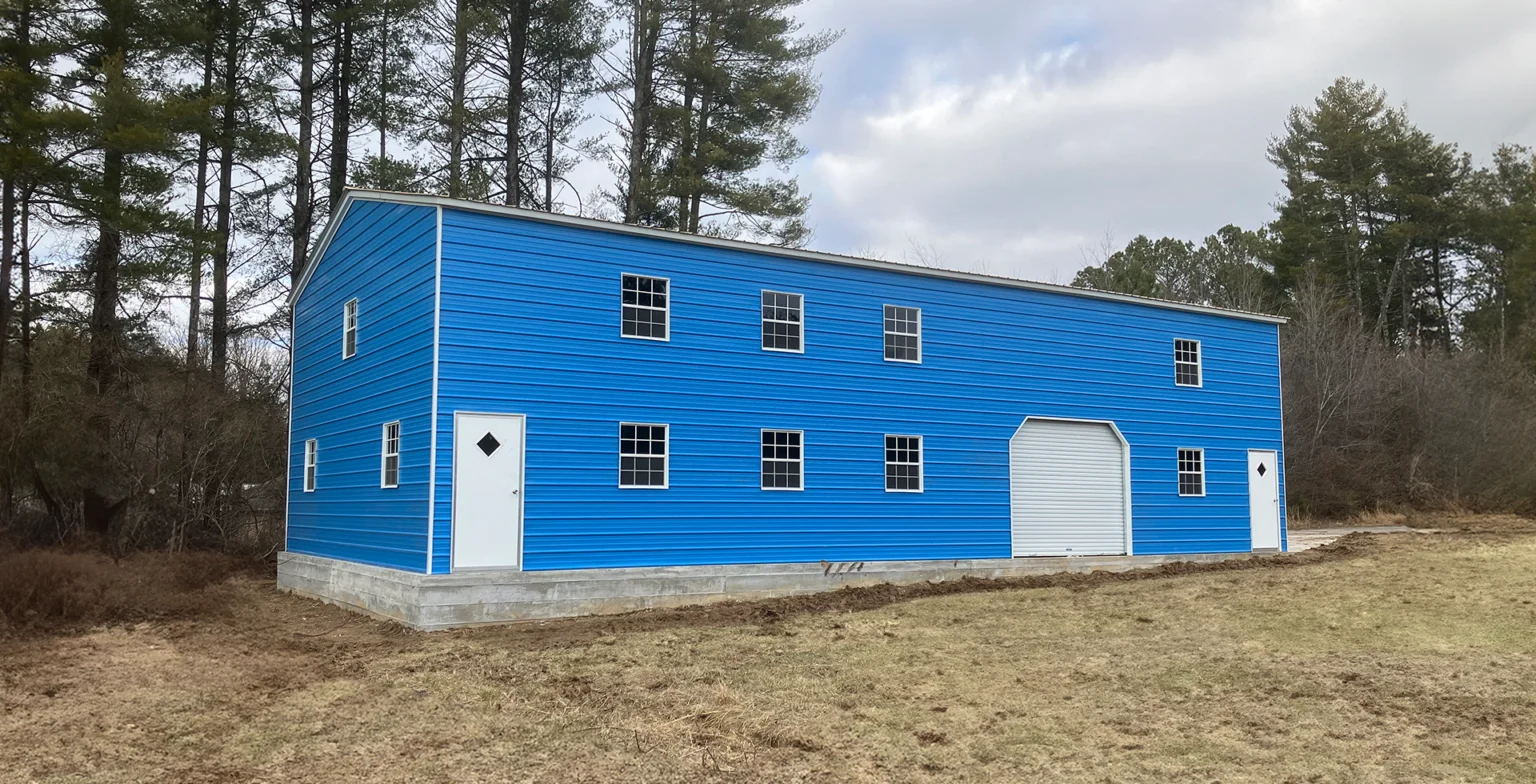
Start with the bay, not the apartment. Pick the number and size of garage bays you actually need (2-car garage, 3-car garage, or RV-height), then size the metal building to deliver the bay plus the living footprint.
Sketch new plans or pull existing car garage plans that match your scale. Confirm your county’s setback and ADU rules. Pull the IRC fire-separation requirements so the wall between the garage and the living wing is spec’d into the design. Get insurance and lending quotes. Then order the shell.
To start sizing, browse Alan’s Factory Outlet’s metal garages for footprints and sidewall heights that match the layouts above.

Garage House FAQs
The questions below come up most often during the planning phase.
Can you live in a garage house?
Yes, as long as the living quarters meet residential building codes (minimum ceiling height, egress windows, smoke alarms, and HVAC) and the wall between the garage and the living wing meets IRC R302.6 fire-separation requirements. Local zoning has to allow a metal building as a primary residence or ADU. That’s the call to make to your county building department before you order materials.
How much does a garage house cost?
It varies meaningfully by size, finish level, climate, and region. The four cost buckets to plan around are the metal building shell, the living wing finish, the mechanicals (HVAC, plumbing, electrical), and the garage bay equipment. Get itemized quotes from local trades for each bucket.
Do you need special permits for a garage with living quarters?
Yes. A combined garage-dwelling structure goes through a residential permit path that’s more involved than a regular detached garage. Plans typically need to show the IRC R302.6 fire-rated wall and ceiling between the garage and the living wing, the egress windows in any sleeping rooms, and HVAC and electrical loads sized to the dwelling. Some counties also require an ADU-specific approval if the garage house is on a property with an existing primary residence.
What is a garage house called?
It depends on which part of the structure dominates. A garage-first build with attached living quarters is a “garage house.” A barn-style home with garage bays attached is a “barndominium.” A stand-alone garage with a one- or two-bedroom unit above the bays is a “garage apartment” or “carriage house.”
A small house with a tuck-under garage is sometimes listed as a “shop house” or “small house with garage.” Configurations with two separate dwelling units are duplex or multi-family garage houses. The terms aren’t interchangeable in real estate listings or insurance applications, so use the one that matches your actual build.
What are the disadvantages of garage apartments?
Three real ones. First, insurance and appraisal can be harder for nonstandard dwelling-garage combos than for traditional homes, so plan extra time for both. Second, sound and exhaust transfer between the garage bay and the living quarters needs deliberate insulation and ventilation; an unsealed wall lets fumes and noise into the apartment. Third, resale value depends heavily on the local market. In rural areas where buyers want garage space, garage houses hold value well; in dense suburban markets, the buyer pool is smaller.