


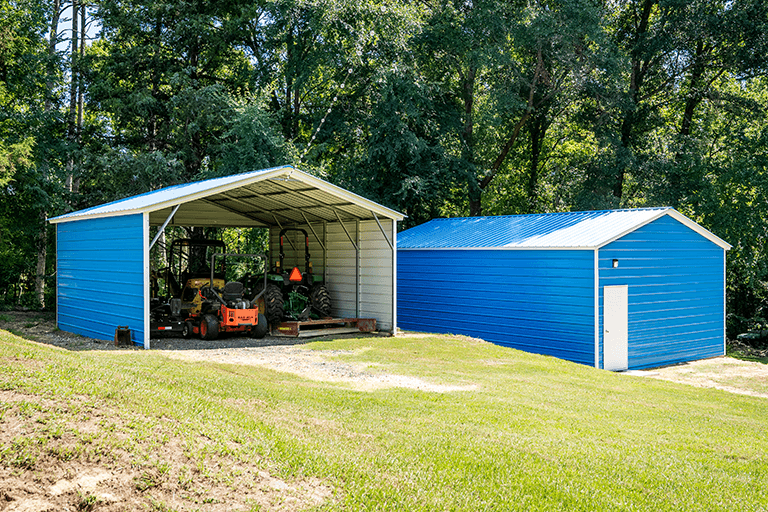
If your tractor costs more than your car, it probably shouldn’t be the one stuck outside. Luckily, a metal tractor shed can protect your equipment investment from UV damage, rust, bird droppings, and weather year-round, with almost no upkeep on your end.
In this article, we’ll show you everything you need to choose the right tractor shed, including sizing options, door specs, design choices, and how metal equipment storage buildings compare to wood outdoor storage solutions.
Why You Should Consider a Tractor Shed
A tractor storage shed is built to protect large, high-value machinery like tractors, mowers, ATVs, and implements. Compared to a garden shed, it is made for scale, with taller clearances, wider openings, and floors that can handle higher weights.
Here’s what proper outdoor storage in a metal tractor shed prevents:
 UV damage Lengthy sun exposure fades paint, cracks rubber hoses and seals, and weakens plastic components on tractors and ATVs. |  Rust and corrosion Rain and humidity attack exposed metal on implements, mower decks, and hydraulic components (and repairs add up fast). |
 Mechanical wear Hot summers and cold winters are hard on equipment left in the open. Fluids break down, seals dry out, and engine life shortens. |  Pest damage Rodents find unprotected cab interiors irresistible. They nest in seat cushions, chew through wiring, and cause repair bills that are entirely avoidable. |
How to Size a Tractor Shed for Your Equipment
Tractors rarely park alone. There’s usually a loader on the front, something on the three-point hitch, and a bucket or set of forks taking up a corner. Before you know it, you need twice the space you planned for.
Size for the full picture: room to walk around the equipment, store attachments, and take on another machine someday without immediately running out of room.
| Tractor Shed Size Guide by Equipment Type and Model | |||
|---|---|---|---|
| Tractor size | Horsepower range | Example model | Recommended shed size (feet) |
| Subcompact | Under 25 HP | John Deere 1025R | 12×20 |
| Compact | 25–50 HP | Kubota L3902 | 14×24 |
| Mid-size with loader | 50–100 HP | John Deere 5075E | 16×30 |
| Large utility | 100–175 HP | Case IH Farmall 120A | 20×40 |
| Large row crop/combine | 175 HP+ | John Deere 8R | 30×60 |
All dimensions account for attachments and maneuvering space, not just the tractor body. When in doubt, go one size up.
Door Sizing: A Huge Tractor Shed Mistake
You can build the perfect equipment shed and still get it wrong at the door. It’s one of the most common (and costly) sizing mistakes rural property owners make. A door that’s technically tall enough can still catch a loader arm or scrape a bucket if it isn’t wide enough to accommodate the full turning arc.
Here’s a good baseline:
- Compact tractors. A minimum 10-foot-wide garage door gives enough clearance for straight-in entry with a small machine and basic attachments.
- Mid-size tractors with a loader. Plan for 12–14 feet wide to clear the loader bucket and allow a natural turning radius without constant repositioning.
- Large equipment and combines. Go 24 feet wide or wider. Headers, wide-body combines, and large implements leave zero margin for error at a narrower opening.
Critical Design Elements of a Metal Tractor Shed
The structural components inside the walls and roof of a metal structure determine how well your tractor shed handles wind, snow, and time. Here are some terms worth knowing before you buy:
 Purlins Horizontal supports that run along the roof between rafters. They hold the roofing panels in place and add rigidity to the overall structure, which matters most under heavy snow loads. |  Girts Horizontal members that span between wall columns. Girts reinforce wall panels and help the building resist lateral wind loads. |
 Rafters The primary sloped framing members that give the roof its shape and carry the load down to the walls and foundation. |  Metal roof styles The roof profile affects both drainage and durability. Alan’s Factory Outlet offers three styles: regular, boxed-eave, and vertical. Vertical roofs provide the best protection by allowing snow and debris to slide off easily. |
Prefab vs. DIY Tractor Sheds
The DIY shed build looks great on paper. You control the design, you work on your own schedule, and the up-front material cost can look lower than a prefab quote. But how does it compare to a prefab build? Let’s take a look.
| Prefab vs. DIY Tractor Shed Comparison | ||
|---|---|---|
| Factor | Prefab metal building | DIY shed build |
| Up-front cost | Higher initial quote, but all-in pricing | Lower material cost, but labor and waste add up |
| Time to complete | Days to weeks | Weeks to months |
| Tools required | Minimal; installation handled professionally | Extensive; framing, roofing, and finishing tools needed |
| Structural consistency | Engineered to spec, consistent every time | Varies by builder skill and material quality |
| Code compliance | Pre-engineered to meet wind and snow load specs | Builder’s responsibility to research and meet |
| Material waste | Minimal; components arrive pre-cut | Common; cutting and fitting generates significant waste |
| Best for | Most farmers who want a finished structure fast | Experienced builders with time and tools |
For most farmers, the choice is clear. A prefab metal building gives you a finished structure faster and with less risk than a DIY build. However, if you have strong construction experience (and time to spare), a DIY approach can work, especially for a smaller tool shed or carport addition where the scope is manageable.
Common Tractor Shed Mistakes to Avoid
Good planning saves money. Poor planning costs it (sometimes twice) when you end up retrofitting a building that doesn’t work. Here are the most common mistakes farmers make with tractor sheds:
 Undersizing the building Picking dimensions based on the tractor alone ignores implements, movement space, and future equipment. A shed that fits today’s machine may not fit next year’s. |  Choosing garage doors that are too narrow Many equipment sheds are tall enough but fail on width. A loader bucket swings wide on entry, so don’t forget to account for it. |
 Ignoring equipment attachments Loaders, mowers, and implements significantly increase the clearance and turning space you need. Size the shed for your full working footprint, not just the tractor body. |  Poor site drainage Building on low or uneven ground invites water pooling around the foundation. Over time, that moisture causes structural problems and makes the shed floor unusable after rain. |
Protect Your Equipment With the Right Tractor Shed
Your equipment is one of the biggest investments in your property. A well-designed tractor shed keeps it protected, extends its working life, and makes daily farm operations so much easier.
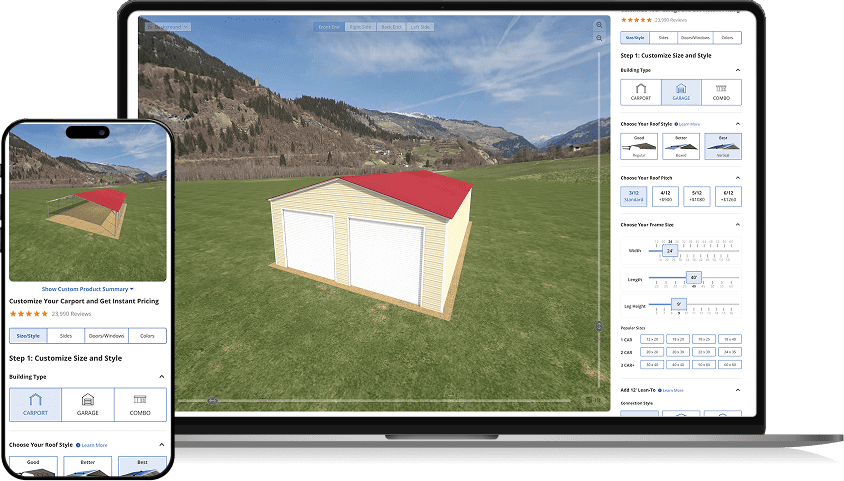
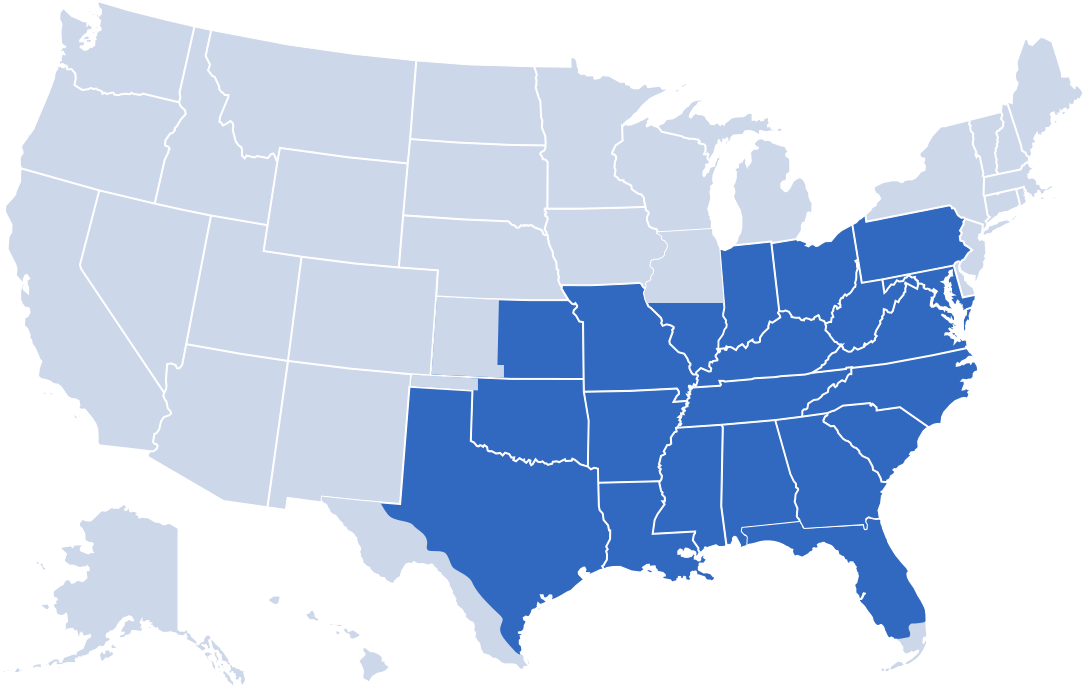
Ready to spec out a custom metal tractor shed for your property? Design yours at Alan’s Factory Outlet and get free delivery and installation in 21 states.
FAQ About Tractor Sheds
Got questions before you buy? Here are answers to the most common questions farmers ask when planning a tractor shed.
Do you need a permit for a tractor shed?
Rules vary significantly by county and state. Size thresholds often apply, meaning a smaller outdoor storage structure may be exempt, while a larger one requires a permit. Before you build, check your local zoning requirements.
What foundation does a tractor shed need?
For most metal tractor sheds, a gravel pad foundation is sufficient. It provides good drainage, prevents water from pooling under the structure, and gives anchors a stable base. Larger or permanent structures may benefit from a concrete foundation, particularly if you plan to run heavy machinery in and out daily or if local regulations require it for your building specs.
When in doubt, check with your building supplier and local code requirements before pouring anything permanent.
Can you add electricity to a metal tractor shed?
Yes. A metal tractor shed can absolutely support a full electrical system for lighting, power tools, battery charging, and more. Steel buildings are straightforward to wire, and many farmers add outlets, overhead lighting, and circuits for welders or compressors. Simply planning ahead and deciding where you want outlets, switches, and access points during the design phase saves time and money.