

The concrete slab is the single most important decision homeowners make before a metal building shows up on the truck. The slab carries every load above it, anchors the building, controls moisture, and sets the floor for the next 40 to 60 years. It’s also a project cost most buyers underestimate when budgeting for a metal carport, garage, or shed because the slab is a separate trade from the building itself, with its own contractors, its own concrete mix, and its own per-square-foot pricing.
I’ll break down concrete slab cost by thickness, slab size, and the factors that move the number, including site prep, reinforcement, decorative finishes, and regional labor rates. Use it alongside our concrete slab calculator to estimate your job before you call a concrete contractor for quotes.
Average Concrete Slab Cost per Square Foot
Concrete slab pricing scales with three things: slab thickness, reinforcement, and finish type. The cost ranges below come from 2025–2026 industry cost data and reflect installed cost (materials, labor costs, and basic site preparation).
| Slab type | Cost per sq. ft. | What’s included |
|---|---|---|
| Basic 4-inch slab | $5.35 | 4 inches thick, wire mesh reinforcement, gravel base, broom finish. Standard for sheds, carports, and small backyard residential projects. |
| Reinforced 6-inch slab | $6–$12 | 6 inches thick, rebar reinforcement on a grid, vapor barrier, deeper gravel base. Standard for garage floors and larger metal buildings. |
| Heated slab | $6–$20 | 4 to 6 inch slab with hydronic radiant heat tubing embedded before the pour. Adds a boiler or water heater feed and a manifold. |
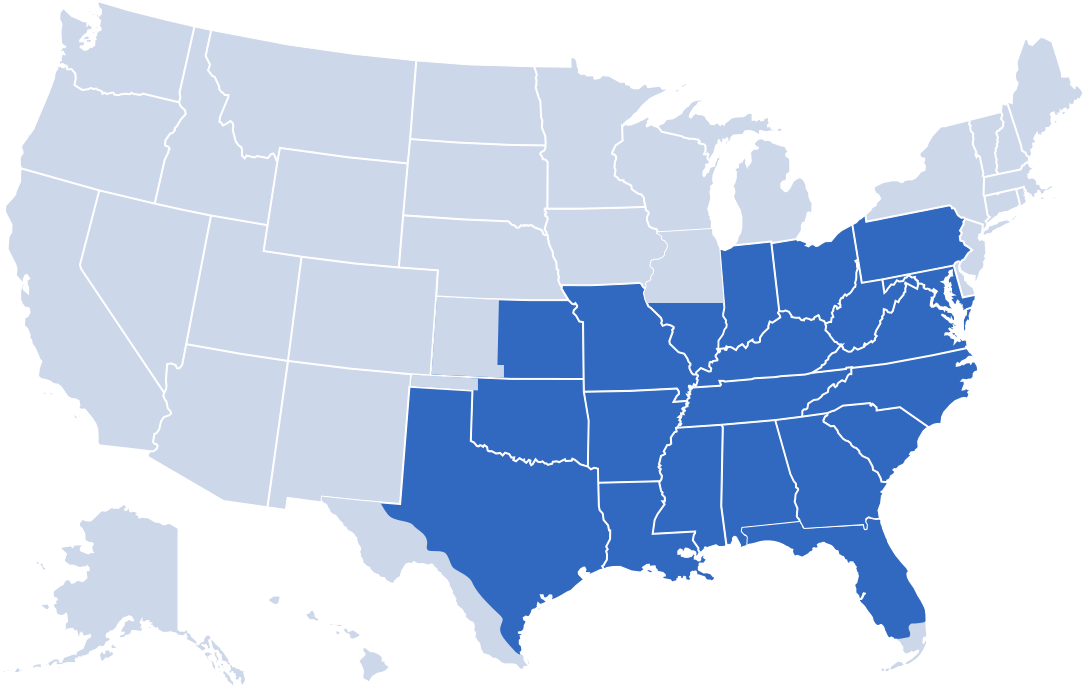
Labor alone runs $2 to $3 per square foot to pour a slab, covering forms, delivery, mixing, and the pour itself. Coastal and high-cost-of-living markets push prices toward the top of every cost range; rural Southeast markets typically come in at the bottom. Labor rates are the single biggest regional swing.
Types of Concrete Slabs and Where Each Fits
Different slab foundations serve different jobs, and matching the slab type to the project keeps the budget honest:
- Slab on grade (slab foundation). A single concrete pad poured directly on a prepared base, with no basement or crawlspace below. The default for metal buildings, garages, carports, and most residential projects.
- Monolithic slab. Slab and footings poured at the same time as one continuous piece of reinforced concrete. Faster and cheaper than a separate footing pour, common for sheds, carports, and small garages.
- Slab with stem walls. Footings and short stem walls are poured first; the slab pours on top inside the walls. More forgiving on uneven sites, used on larger garages and shop buildings.
- Heated slab. Any of the above with hydronic radiant heat tubing embedded before the pour. The right call for workshops, garage floors that double as living space, or any metal building used year-round in a cold climate.
For a deeper walk-through of pouring concrete on each of these slab types, see our how to pour a concrete slab guide.
Concrete Slab Cost by Common Metal Building Size
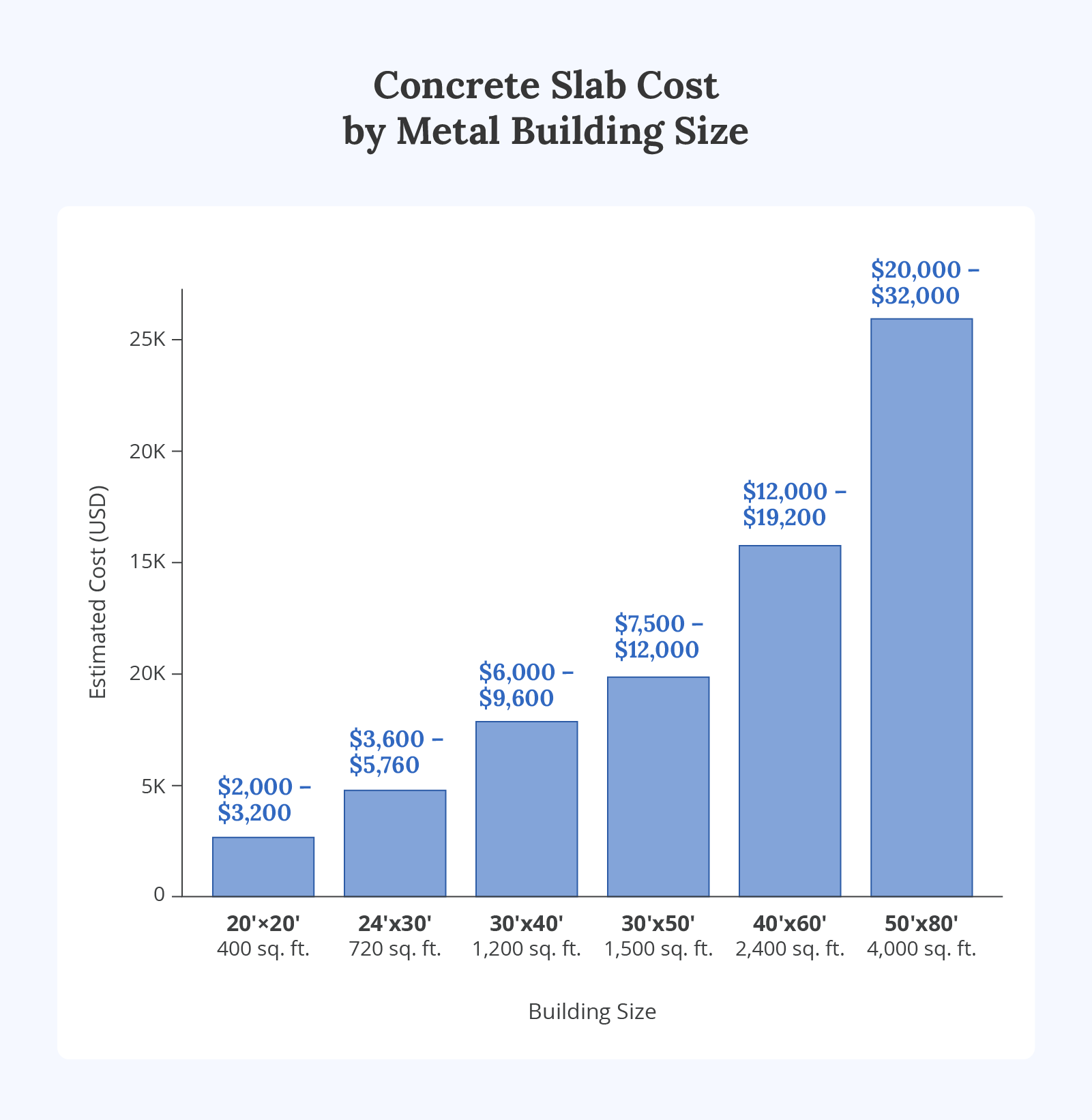
The table below shows the total cost range for a basic 4-inch slab at $5–$8 per square foot, sized to common metal building footprints. Use these as planning estimates, then get quotes from at least three local concrete contractors before committing.
| Building size | Square footage | Basic 4″ slab total | Best for |
|---|---|---|---|
| 20’×20′ | 400 sq. ft. | $2,000 – $3,200 | Single carport, small storage shed foundation |
| 24’×30′ | 720 sq. ft. | $3,600 – $5,760 | Two-car garage, small workshop |
| 30’×40′ | 1,200 sq. ft. | $6,000 – $9,600 | Three-car garage, mid-size workshop |
| 30’×50′ | 1,500 sq. ft. | $7,500 – $12,000 | RV garage, large workshop |
| 40’×60′ | 2,400 sq. ft. | $12,000 – $19,200 | Commercial garage, full workshop, multi-bay storage |
| 50’×80′ | 4,000 sq. ft. | $20,000 – $32,000 | Large commercial or multi-vehicle build |
For a 6-inch reinforced slab, multiply the per-square-foot range by your footprint. A 30×40 reinforced slab at $7–$12 per square foot lands at $8,400 to $14,400 — meaningfully more than the basic 4-inch option, but the right call if you’re parking vehicles or rolling heavy equipment over it. Thicker slabs at 8 inches push costs higher again.
What Drives the Cost of a Concrete Slab
Six factors move the per-square-foot number up or down. Most are decisions made in conversation with the concrete contractor, but it pays to understand them before the quote.
- Slab thickness. Most metal buildings sit on a 4-inch or 6-inch slab. A 4-inch slab is fine for sheds, carports, and lightly loaded floors. A 6-inch slab is the standard for garage floors where vehicles will park or drive across the surface. Heavy-equipment workshops, commercial concrete floors, and floors that will see forklifts go to 8 inches with engineered rebar.
- Reinforcement. Wire mesh is the budget option and works for residential projects. A rebar grid in reinforced concrete is standard for any slab where the load is substantial — vehicles, equipment, heavy storage. Adding rebar to a slab typically pushes the per-square-foot cost up by $1–$2.
- Site prep. The slab is only as stable as the base under it. Grading the pad to the right elevation and slope, laying 4–6 inches of compacted aggregate or crushed stone gravel base, and setting forms. On a flat job site this might be a half-day of work; on a sloped or rocky site it can double the project cost.
- Vapor barrier and additives. A 6-mil polyethylene vapor barrier under the slab is standard practice and adds maybe $0.10 per square foot. Concrete additives like fiber reinforcement, accelerators, air entrainment for freeze-thaw, and high-strength mix designs add small per-yard costs that show up in the final invoice.
- Concrete grade and mix. Standard residential concrete is mixed to around 3,000–4,000 psi. High-strength concrete (5,000 psi or higher) costs more per cubic yard but holds up better under heavy loads. Match the concrete grade to what the slab will carry, not to a default.
- Regional labor rates. Concrete delivery is priced per cubic yard and varies by how far the truck has to drive. Labor rates in major coastal metros run double rural Southeast labor. Bake regional variation into your quotes.
The bag of “concrete” your contractor pours is actually a mix of a few things, and the proportions shape the slab’s durability and cost.
 Cement The binder that holds everything together. Most residential pours use Type I or Type I/II Portland cement. |  Aggregate Sand (fine aggregate) and gravel or crushed stone (coarse aggregate). Aggregate is the bulk of the volume and the cheapest input — it’s why a thicker slab doesn’t cost proportionally more in materials than a thin one. |
 Water Triggers the chemical cure. The water-to-cement ratio drives final strength, so good contractors don’t over-water a mix to make it easier to work. |  Additives Optional ingredients that change behavior: fiber for crack resistance, accelerators for cold-weather pours, retarders for hot-weather pours, air entrainment for freeze-thaw climates, and water reducers for high-strength mixes. Each adds a small amount per cubic yard. |
Concrete grade is the simplest way to summarize the mix: 2,500 to 3,000 psi covers sidewalks and walkways, and 3,000 to 4,000 psi handles residential garage floors and driveways. Workshops that see heavy equipment or harsh freeze-thaw climates may call for a higher-strength mix. Ask your contractor what grade they’re quoting and confirm it matches the load.
Concrete Slab Specs for Metal Buildings
A slab for a metal building has to do four jobs that a generic concrete patio or walkway slab doesn’t. Get these right with your concrete contractor before the pour:
- Anchor bolt placement. Most metal buildings anchor to the slab with bolts cast in place during the pour or with wedge anchors driven after the slab cures. Cast-in-place is stronger and cleaner, but the bolts have to be set in the exact pattern your building manufacturer specifies. Get the anchor template from the building manufacturer before the pour and hand it directly to the on-site concrete contractor.
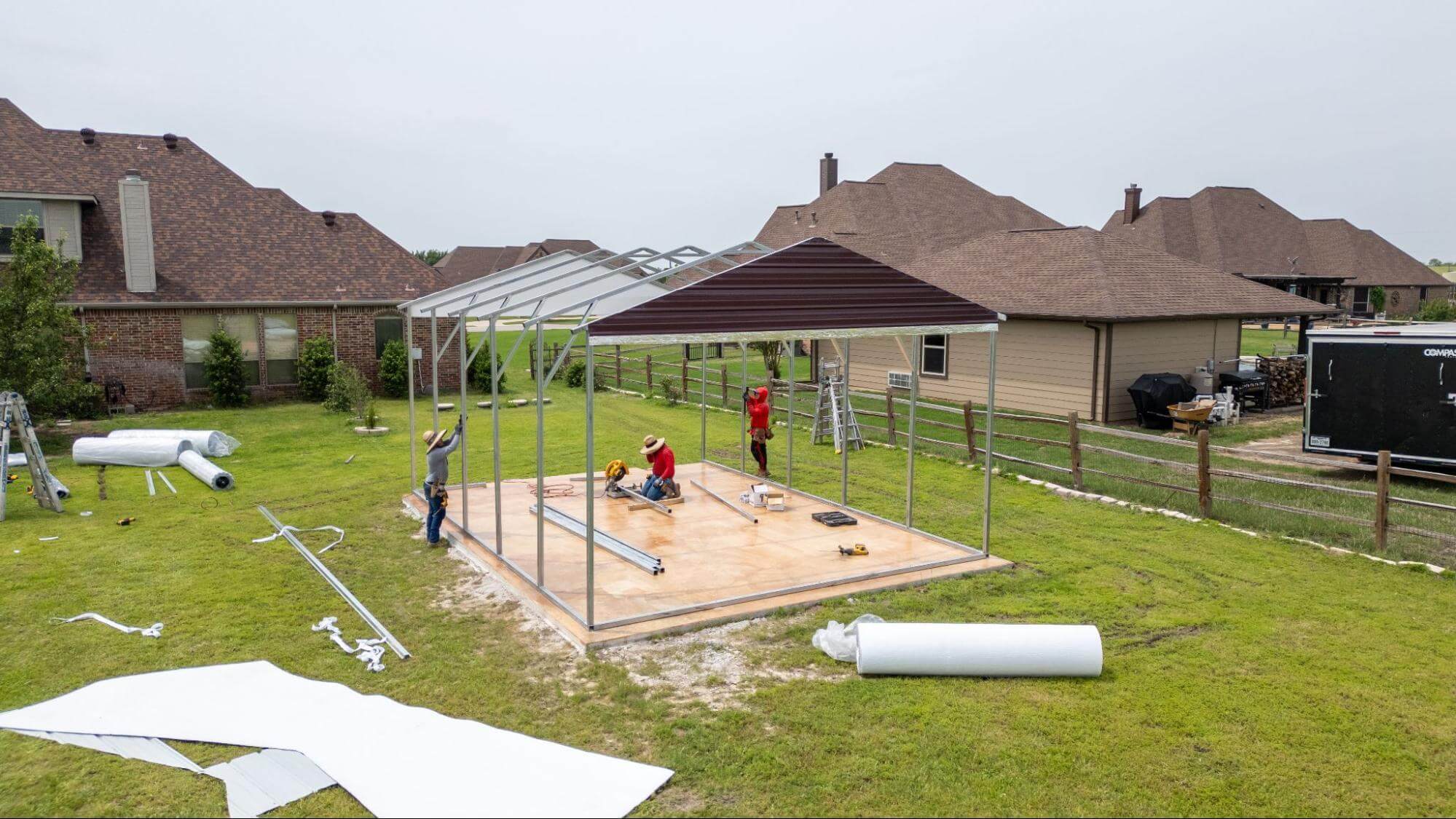
- Slab dimensions vs. building dimensions. The slab usually matches the building footprint exactly, with no overhang. A 24×30 building sits on a 24×30 slab. Some contractors recommend pouring the slab one or two inches larger on each side for tolerance. Confirm with your building manufacturer before deciding on slab size.
- Slope and drainage. A garage or shed slab is typically poured with a small slope (about 1/8 inch per foot) toward the door so water flows out instead of pooling inside. The contractor sets this slope when forming the pad. Mention it before the pour, not after.
- Vapor barrier. A 6-mil polyethylene sheet between the gravel base and the wet concrete keeps ground moisture out of the finished slab. It’s cheap insurance against efflorescence on the surface and rust on anchor bolts and stored equipment.
Local building codes also dictate slab specs in some jurisdictions, so pull the requirements for your county before drawing the plans.
Decorative Finishes and Resurfacing Options
The basic broom finish is the standard for garage floors, shed foundations, and any slab that will sit under a metal building. But if the slab will be visible (an open carport, an outdoor concrete patio under a roof extension, or a workshop floor that doubles as a showroom), these are upgrades worth knowing about:
 Broom finish The default. Texture provides grip; cost is included in the base slab. | 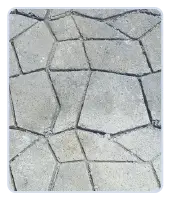 Stamped concrete The slab is stamped while still wet to mimic stone, brick, or wood plank. Adds $5–$15 per square foot. Common on a high-end concrete patio or front walkway. |  Exposed aggregate The top layer of cement is washed away to expose the gravel beneath. Durable, slip-resistant, and a visual upgrade that doesn’t require stamping. |
 Stained or integrally colored concrete Decorative concrete with color baked into the mix or applied after curing. Common on showroom-style garage floors. |  Polished concrete Industrial-style finish with a glossy surface. Used in modern garages and workshops where the slab itself is the floor. |
A penetrating or topical sealer applied after curing protects against stains, salt, and oil. This is always recommended on garage floors and concrete driveway slabs in cold climates.
For older slabs that have cracked or stained, resurfacing is a separate project: a new thin layer of cementitious overlay over the existing slab. It’s cheaper than tearing out and re-pouring, and a good way to give a tired floor a clean look.
DIY or Hire a Concrete Contractor?
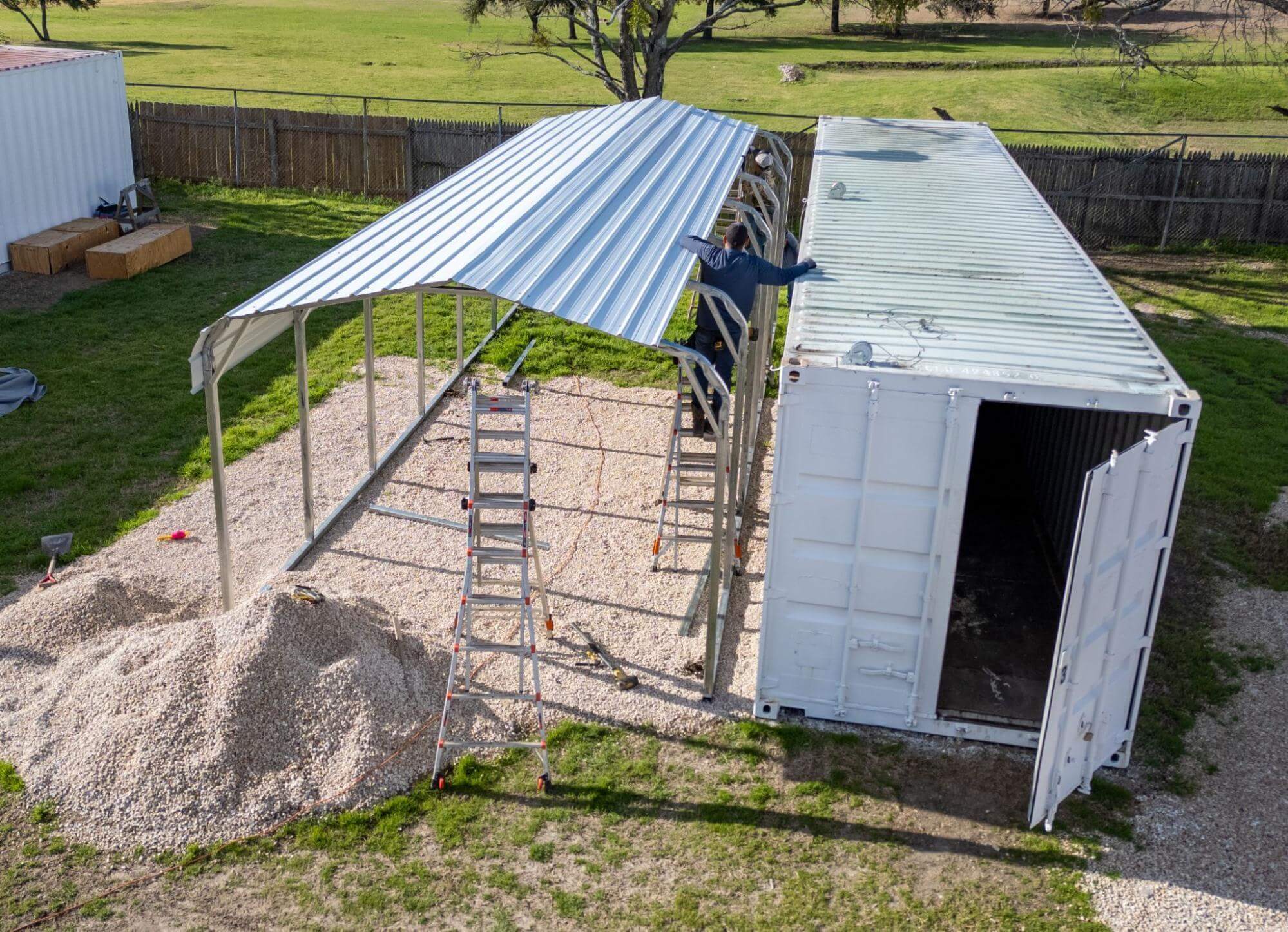
For small slabs (a shed pad, a single concrete patio, a section of walkway), a competent DIY homeowner can pour with bagged or short-load concrete and save the labor cost. For anything over about 200 square feet, hiring a concrete contractor is almost always the right call. This is true for three reasons:
- Volume. A 30×40 slab takes around 14–15 cubic yards of concrete delivered ready-mix. That’s beyond what a DIY pour can handle in the working window before the mix sets.
- Forming and finishing. Setting forms, screeding, floating, and finishing a large slab is real labor. A two- or three-person professional crew finishes a slab the right way in hours; a DIY crew can ruin a pour by under-finishing the surface.
- Liability. A slab failure under a metal building is expensive to fix. A licensed concrete contractor stands behind the pour, which matters for insurance and resale.
How to Estimate Your Concrete Slab Cost
Here are three steps to a real number for your project:
- Run the basic estimate. Use our concrete slab calculator to get an instant per-cubic-yard and total cost based on your slab size and thickness. This gets you to a working budget in about 30 seconds.
- Get three local quotes. Concrete is a regional trade, and per-yard rates swing meaningfully by zip code. Get itemized quotes from three local concrete contractors. Ask each one to break out site preparation, materials, reinforcement, and labor as separate line items so you can compare apples to apples.
- Confirm the slab matches your building. Before you sign with a concrete contractor, confirm the slab dimensions, thickness, and anchor bolt pattern match what your metal building manufacturer requires. A slab that’s a half-inch off in one direction can cost a day of installation work to correct.
Plan the Slab Before You Order the Building
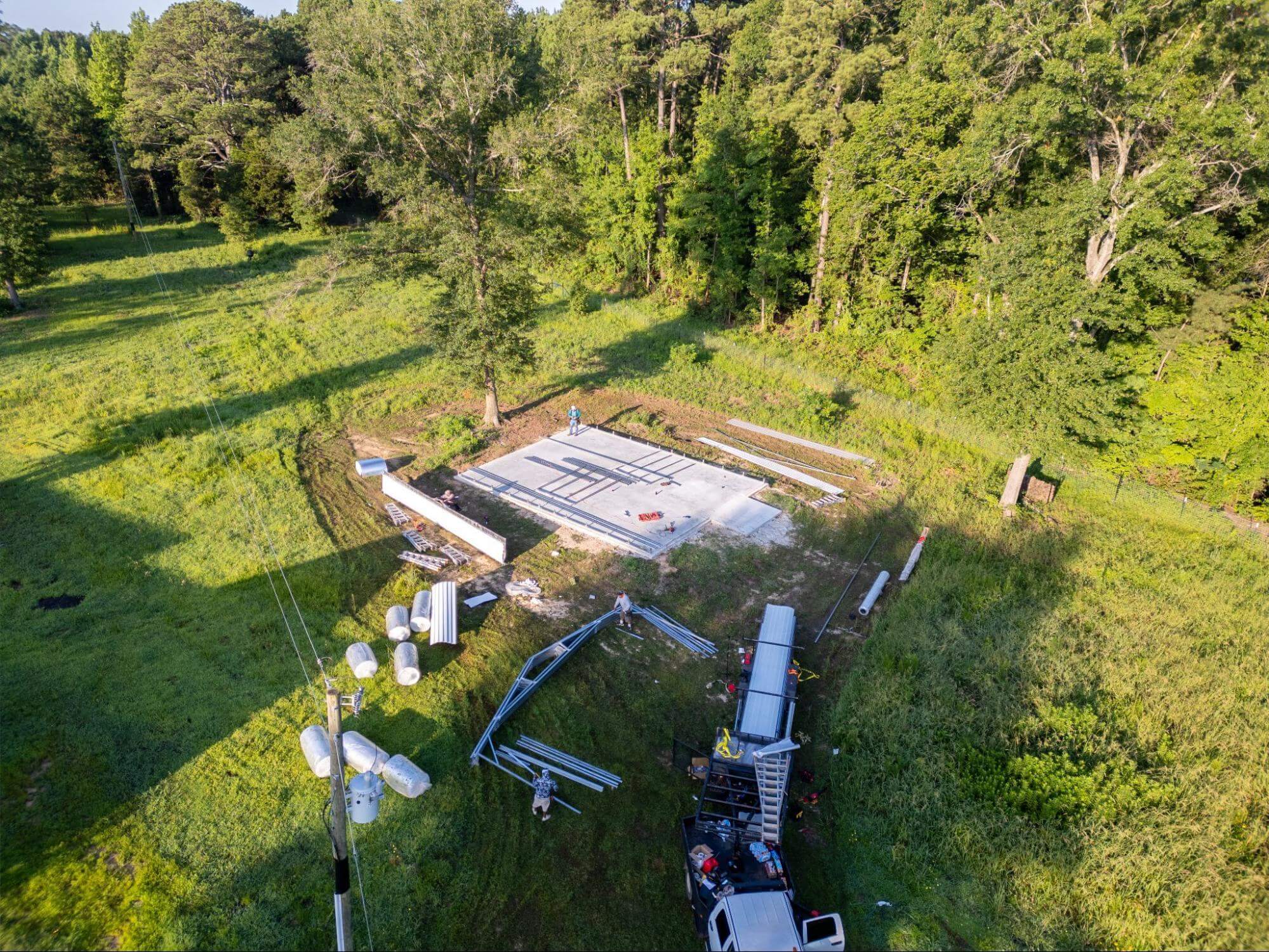
The cleanest project sequence is to spec the metal building first, get the anchor template and footprint dimensions from the manufacturer, then bring those to the concrete contractor. The slab gets poured, cures for the recommended window (typically 7 days for foot traffic, 28 days for full strength), and the building lands on a finished, code-compliant pad.
Lock the building footprint first, then bring the exact slab dimensions and anchor bolt template to your concrete contractor for an itemized quote. Browse Alan’s Factory Outlet’s metal buildings to find the size and roof style that fits your slab plan.
Concrete Slab Cost FAQs
The questions below come up most often during planning.
How much does a 30×40 concrete slab cost?
A basic 4-inch 30×40 slab (1,200 sq. ft.) runs $6,000 to $9,600 at the typical $5–$8 per square foot range. A 6-inch reinforced slab at the same size runs $8,400 to $14,400. Heated radiant slabs land between $12,000 and $30,000. All three figures exclude site prep on rough or sloped ground.
How thick should a concrete slab be for a metal building?
Four inches is the minimum for a shed or carport floor. Six inches with rebar reinforcement is standard for a metal garage where vehicles park or drive. Eight inches with engineered rebar is the call for workshops with heavy equipment, RV bays, or commercial buildings.
Do I need a concrete slab for a carport?
A carport can sit on a concrete slab, an asphalt pad, a gravel base, or compacted dirt. A concrete slab is the most durable option and the only one that anchors the carport rigidly enough for high-wind areas. For a permanent carport on flat ground, a 4-inch slab is the standard recommendation. For a temporary or budget carport on level ground, a compacted gravel base also works.
How much does it cost to pour a 20×20 slab of concrete?
A basic 4-inch 20×20 slab (400 sq. ft.) runs $2,000 to $3,200 at $5–$8 per square foot. A 6-inch reinforced version of the same slab is closer to $2,800 to $4,800. Add site prep on top if the lot needs grading or the gravel base goes deeper than 4 inches.
Is it cheaper to mix concrete or buy it?
For any slab over about 50 square feet, ready-mix delivery from a concrete plant is cheaper and faster than bag-mixing on site. Bag mix runs a higher price per cubic yard and requires hours of labor to mix and pour by hand. Save the bag-mix DIY approach for fence posts, small footings, and patchwork — not for the slab under a metal building.