

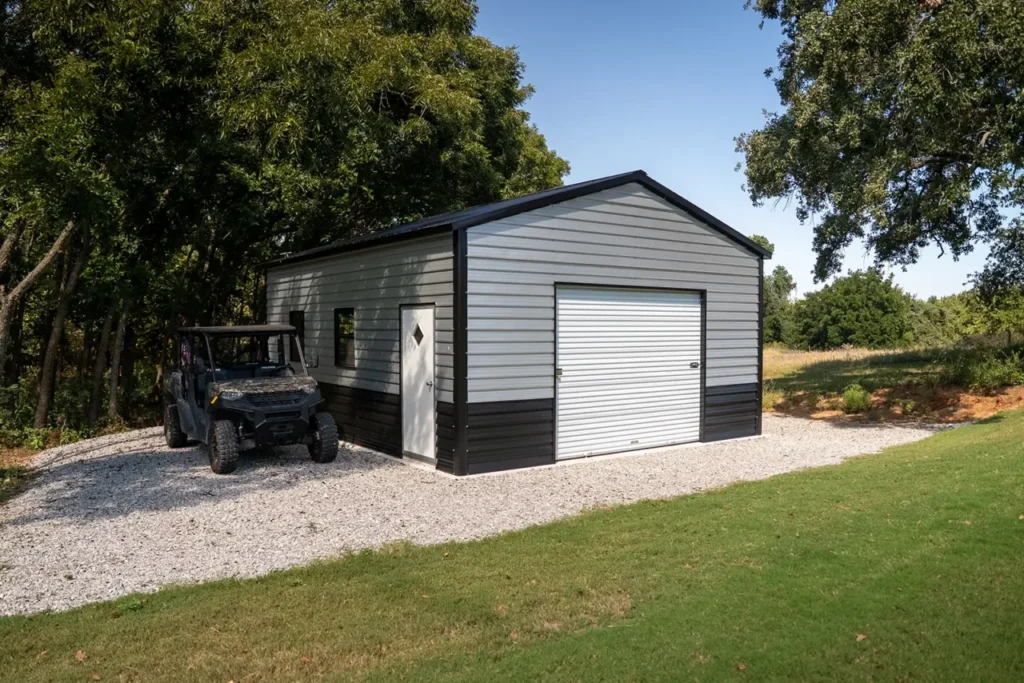
If your driveway runs along the side of your house (or you’re on a corner lot with limited frontage), a side-entry metal garage might be exactly what you need. Also called a side-load garage, it’s simply a garage where the door opens from the side rather than facing the street. That single design change keeps the front of the house cleaner, gives you more usable driveway space, and often makes entry easier, depending on how your lot is laid out.
It’s also worth thinking about what that means for your home’s value. A 2025 survey found that homebuyers are willing to increase their offers by an average of $9,195 for homes with strong curb appeal. A side-entry metal building works in your favor there.
In this article, we’ll cover how side-entry and side-load garage designs work, what type of home they’re best suited for, and what to look for when choosing one.
Side Entry vs. Front Entry vs. Rear Entry Garage Layouts
Most people are used to the front-entry garage; it’s the standard setup where the doors face the street, right next to the front door. But there are actually three garage layouts worth knowing before you decide what’s right for your property: front entry, side entry, and rear entry. Here’s how they compare:
| Garage Layouts | |||
|---|---|---|---|
| Feature | Front-entry garage | Side-entry garage | Rear-entry garage |
| Curb appeal | Garage doors dominate up to 30% of the home’s front facade | Doors hidden from the street; front yard and landscaping take center stage | No visible doors from the front at all; maximum front elevation |
| Best use case | Suburban lots, tight subdivisions, standard home design | Corner lots, wider rural or suburban lots, homes where the front door and front porch are the focal point | Properties with alley access, barndominiums, detached garage setups on large acreage |
| Accessibility | Easy straight-in parking; no turning required | Requires a wider turn; most vehicles manage fine, though trailers need planning | Convenient with alley access; less so without it |
| Impact on home design | Limits what you can do with the front of the house | Lets landscaping, windows, and the front door shine | Gives architects the most freedom with the home’s exterior |
Recommended Sizes and Layouts for Side Entry Garages
When it comes to a side-entry metal building, dimensions determine how well the layout works for your driveway, your vehicles, and your daily routine. A garage that’s the right size on paper can still feel cramped if the orientation doesn’t match your lot. Here are the dimensions to look for.
30×24 Side-Entry Garage
A 30×24 gives you 720 square footage with the 30-foot dimension running parallel to the street. That wider front-facing wall is what allows the door to open from the side without eating into your setback or forcing an awkward turning angle.
For a two-car garage, this layout works well; both vehicles enter from the side, and there’s enough depth (24 feet) to comfortably clear the front of most trucks or SUVs. If you want to add an RV garage bay, a 30×24 gets tight, but a lean-to addition along the back or side wall can extend usable storage without changing the footprint that faces the street.
24×30 Side-Entry Garage
Flip those numbers, and you get the same 720 sq ft, but now the 24-foot wall faces the street, and the building runs 30 feet deep. This is actually a more practical setup for narrower lots because the smaller street-facing wall takes up less frontage while the extra depth gives you more room to work with inside.
A two-car garage in this configuration fits best with a tandem-style layout, where vehicles park one behind the other. It’s not ideal for everyone, but on a tighter property it can be the difference between making a side-entry design work or defaulting to a front entry.
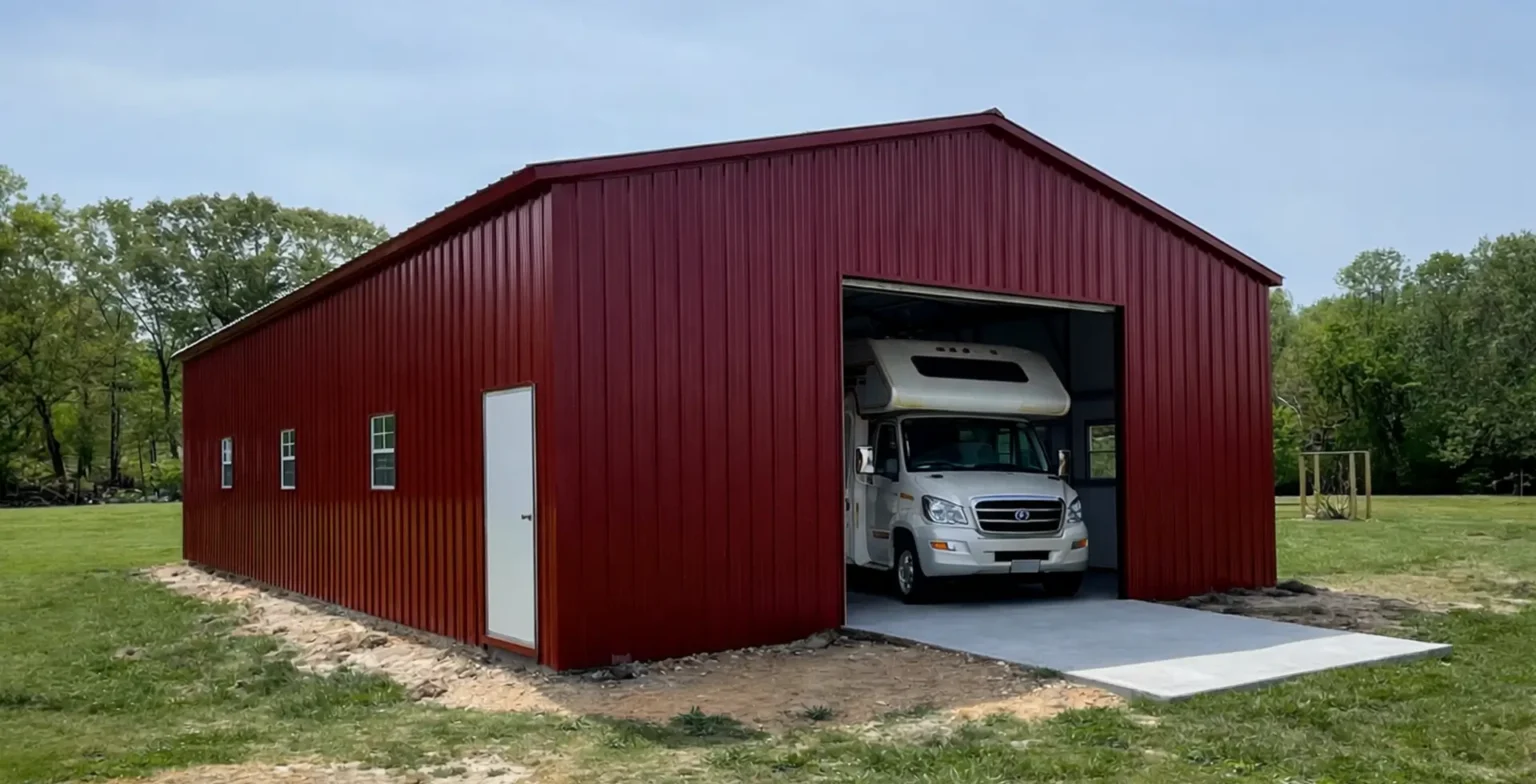
An RV garage variant is also more achievable here, since the 30-foot depth can handle most Class B and smaller Class C motorhomes. A lean-to running along the longer sidewall adds workshop or equipment storage without widening the building’s street profile.
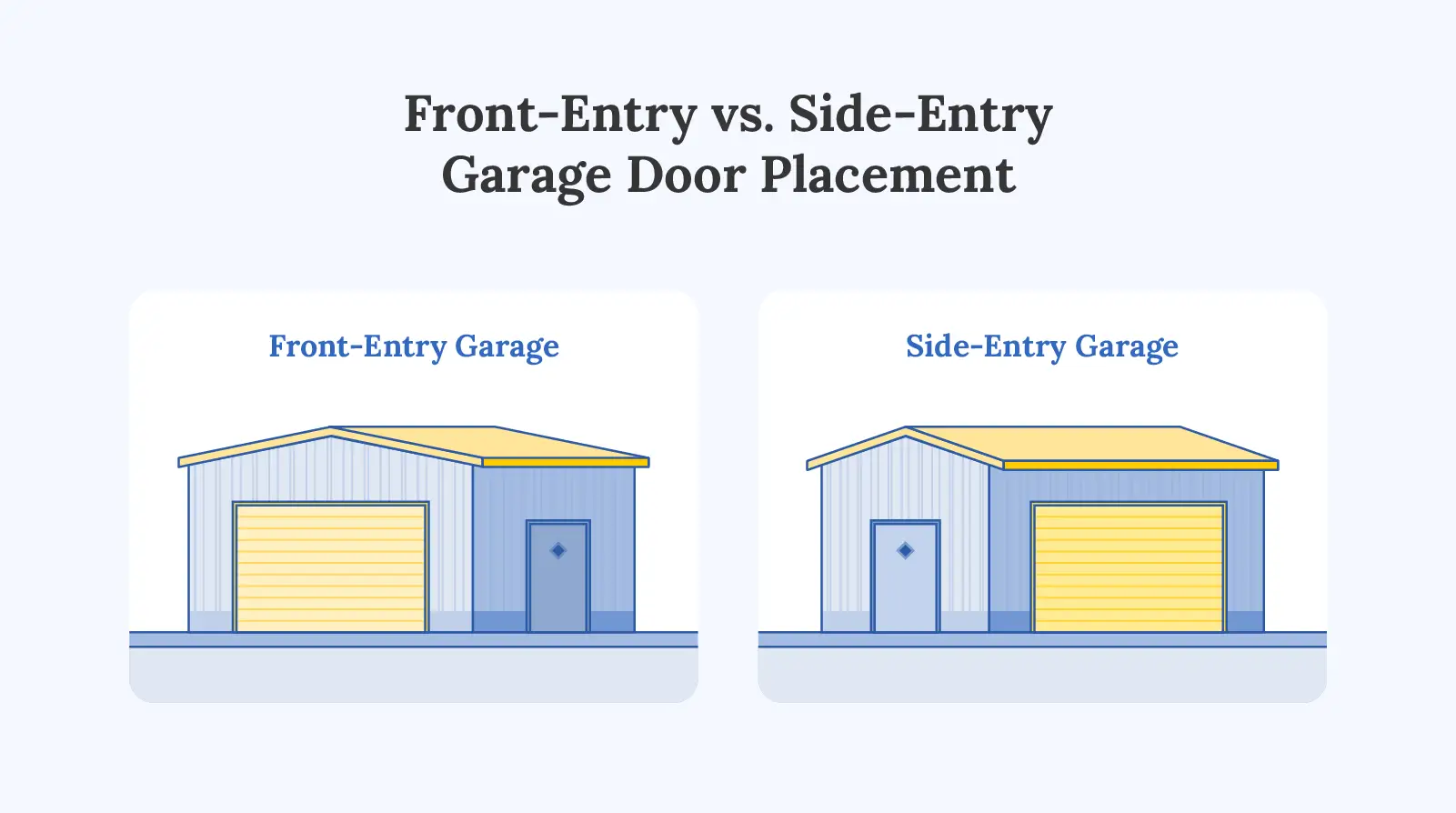
Front-Entry vs. Side-Entry Garage Door Placement
With a standard front-entry garage, the opening faces the street, and you pull straight in. A car side entry garage has doors cut into the sidewall of the building rather than the front.
| Factor | Front-entry garage | Side-entry garage |
|---|---|---|
| Driveway path | The driveway leads straight from the street to the garage door, perpendicular to the house. | Vehicles come in from the side, usually along a driveway that runs parallel to the house. |
| Turning required | Pull straight in without turning, which works well on narrow lots and tight subdivisions. | You turn into the bay rather than pulling straight in, which takes a little more room but becomes second nature quickly. |
| Impact on neighbors | Headlights and door noise face the street and any homes directly across from your driveway. | Headlights and door noise face the side yard instead of the street or a neighbor’s window. |
| Exit flow | Exiting often requires backing out into the street unless you have a turnaround area. | If the driveway wraps around from the front, you get a clean path from street to garage without any awkward backing out. |
Driveway Design, Turning Radius, and Access Requirements
As a general rule, you want at least 30 to 35 feet of clear turning width from the edge of your driveway to the opposite side of the garage opening. On a narrow lot size, that number can be hard to hit, which is why side-entry layouts work best on wider or corner properties.
Here are some vehicle-specific considerations:
 Standard sedans and smaller SUVs These are the easiest to work with. Most can navigate a side-entry driveway comfortably with around 20 to 24 feet of space, though more room always helps. |  Full-size trucks and large SUVs You’ll want closer to 30 feet of turning clearance. The longer the wheelbase, the wider the arc needed to enter cleanly without overcorrecting. |
 Trucks with trailers Detaching the trailer before pulling in is often the simplest solution unless your driveway is specifically designed with a wider swing in mind. |  RVs and oversized vehicles These need purpose-built access: a longer, straighter approach or a pull-through configuration works far better than a tight side-entry turn. |
Interior Layout Considerations for Side Entry Garages
Because the door opens from the side rather than the front, the interior of a side-entry garage has a naturally different flow than a standard layout.
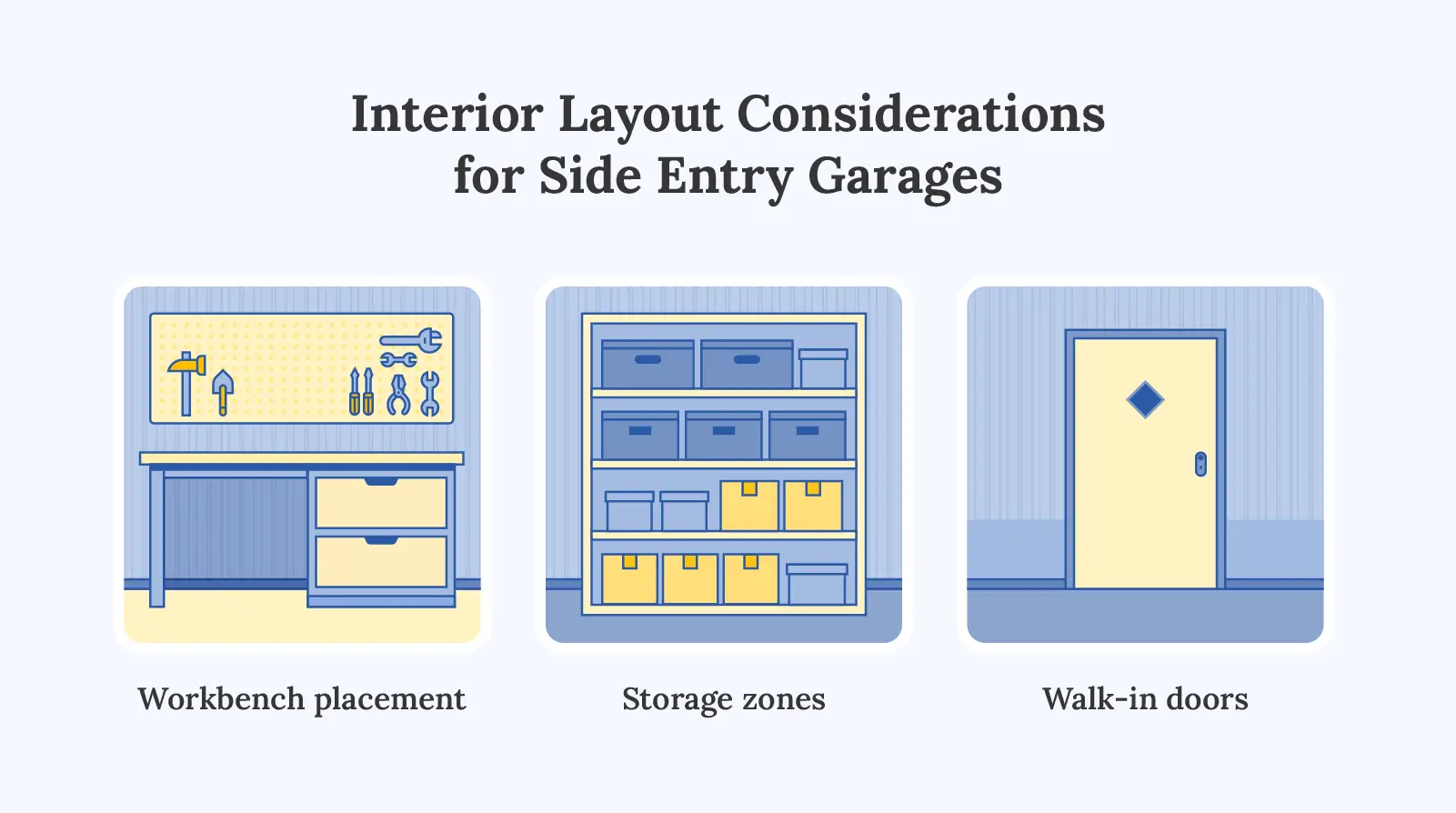
Here are some design ideas to keep in mind:
- Workbench placement. The front-facing wall is a natural spot for a workbench since it’s uninterrupted by a door opening. You get a long, dedicated surface without working around the entry point.
- Storage zones. Wall-mounted shelving and overhead storage work well along the street-facing wall and the wall opposite the door. The side-entry configuration keeps those walls clear, so storage doesn’t compete with access.
- Walk-in doors. A walk-in door on the front wall or connecting directly into the home keeps foot traffic separate from vehicle access.
Beyond the garage itself, the side-entry layout opens up some interesting options for the space above and around it. A two-story configuration can add a bonus room, home office, or split bedrooms above the main floor without affecting the garage below.
If the garage connects to the house, a mud room at the entry point keeps dirt and gear contained before you step into the living space. Some builds also incorporate a walk-in pantry or butler’s pantry along the connecting wall, especially when the garage sits adjacent to the kitchen.
For properties where the garage is set back slightly from the house, a breezeway is worth considering. It keeps the structures connected without fully attaching them, which can work well for ventilation, aesthetics, and separating workshop noise from the main living area.
Design Your Side-Entry Garage
Every lot is different, and the right side-entry garage comes down to your specific dimensions, how you use the space, and what you want the front of your home to look like. Whether you’re working with a corner lot, a wider suburban property, or open rural acreage, a metal building can be configured to fit.
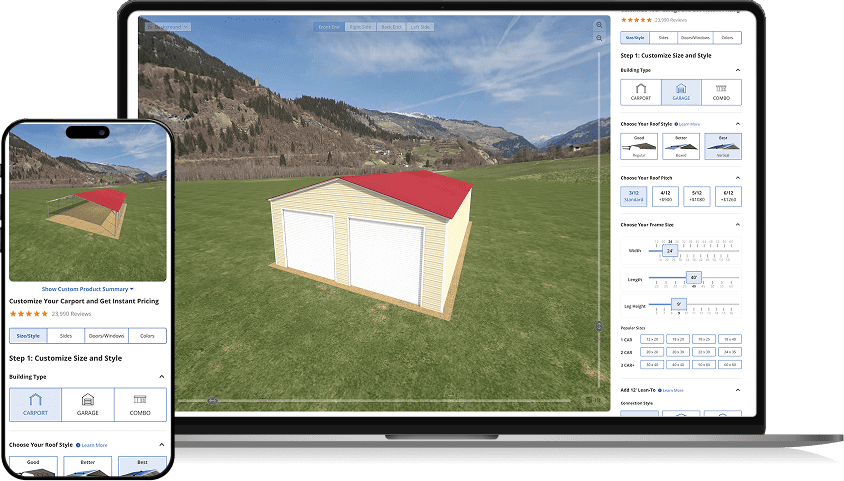
If you’re looking to build a customized side-entry garage, use Alan’s Factory Outlet’s 3D Carport & Metal Garage Builder to design your structure and choose your dimensions, colors, and roof style to see exactly what it’ll look like before you buy.