


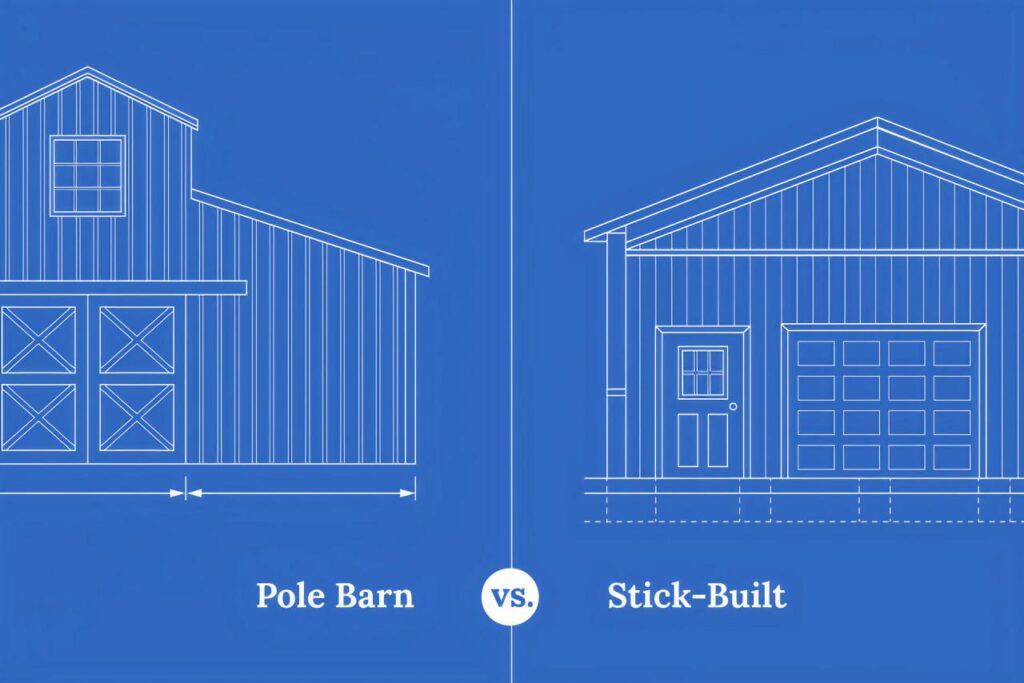
Choosing between a pole barn and a stick-built structure can shape the success of your entire building project. Each building method uses a different structural system, foundation approach, and construction timeline. Those differences affect pricing, durability, and long-term performance.
A pole barn uses post-frame construction. Large posts anchor into the ground or onto a slab, supporting the roof and walls without traditional load-bearing interior framing. A stick-built building, sometimes called stick-frame construction, relies on closely spaced studs forming a stick frame, typically supported by a continuous foundation.
Both types of construction serve garages and barns well. The right fit depends on your goals. Some property owners focus on lowering pricing and shortening construction time. Others prioritize interior finishes and residential-style design. In this guide, we compare building methods, lifespan, site preparation, energy efficiency, and overall cost-effective performance to help rural and suburban property owners choose the right structure for their needs.
| Pole Barn vs. Stick-Built Structures | ||
|---|---|---|
| Factor | Pole barn construction | Stick-built construction |
| Foundation type | Posts set in the ground or anchored to a concrete slab | Continuous foundation or basement with perimeter footings |
| Structural system | Post-frame construction using widely spaced posts | Stud-based framing with load-bearing walls |
| Cost | Often more cost-effective due to fewer materials and faster builds | Typically higher cost due to labor, framing density, and foundation work |
| Lifespan | Long lifespan with proper maintenance and site drainage | Long lifespan when protected from moisture and shifting foundations |
| Construction process | Faster assembly with simplified framing and fewer components | Longer build timeline with multiple framing and finishing stages |
| Interior finishes | May require added framing for drywall and detailed interior finishes | Easily supports drywall, insulation, and residential-style finishes |
| Energy efficiency | Energy efficient with proper insulation, though may require added framing for full wall coverage | Standard stud spacing makes insulating and air sealing more straightforward |
Key Differences in Construction Method
Every construction method supports weight and transfers loads in a different way. That structural path from roof to foundation affects stability, site preparation, and how a building performs under wind and snow loads. It also influences how local building codes apply to your building project. The sections below break down how each type of construction works and what that means for strength, flexibility, and long-term performance.
Pole Barn Framing and Post-Frame Construction
Pole barn framing uses large vertical posts as the primary structural support. Builders either set these posts directly into the ground or anchor them to a concrete slab. Horizontal girts attach to the posts, and roof framing spans across the top to create the structure’s upper support system.
This post-frame construction design supports sidewalls without traditional load-bearing walls. The posts carry vertical loads directly into the ground or slab, while the roof system distributes weight across the frame to handle snow loads. Because pole buildings use fewer materials than dense stud framing, crews often complete site preparation and on-site assembly faster.
Pole barn buildings work well for open interiors and wide spans. However, post-frame buildings may require extra planning in areas with poor soil drainage or shifting ground. Adding complex interior walls can also require supplemental framing since the structure does not rely on interior load-bearing walls for support.
Stick-Built Structures
Stick-built structures rely on closely spaced studs forming exterior and interior load-bearing walls. In a typical stick-frame building, builders anchor the wall system to a continuous foundation or basement. The studs transfer roof and wall loads down through the framing and into the foundation.
Stick-frame construction follows a step-by-step construction process. Crews pour the concrete foundation, frame the walls and roof structure, install sheathing, and then complete drywall and interior finishes. This approach mirrors residential homebuilding, making stick-built buildings easier to customize with finished interior walls.
Still, challenges can arise during long on-site builds. Common stick-built problems include:
- Moisture exposure. Exposed lumber can absorb water during construction, increasing the risk of mold, rot, or long-term structural issues.
- Warping studs. Studs may twist, shrink, or bow over time, affecting wall alignment and interior finishes.
- Higher labor demands. Framing dense load-bearing walls and completing detailed interior work requires more time and skilled labor.
- Code-driven adjustments. Meeting building codes and accounting for snow loads can require closer stud spacing and deeper foundation work, extending the timeline of a building project.
Cost and Pricing Comparison
Several factors shape pricing for any garage or barn, including:
- Building method. The structural system determines how much framing, bracing, and foundation work the project requires.
- Material volume. Using fewer materials often lowers up-front costs and simplifies logistics.
- Labor demands. More framing members and detailed finish work increase on-site labor time.
- Foundation requirements. A full concrete foundation typically requires more excavation and forming than setting posts or pouring a simple concrete slab.
Pole barns often rank as a more cost-effective solution because post-frame systems use fewer materials and reduce construction time. Setting posts and installing exterior panels typically moves faster than framing dense wall systems. Faster builds translate into meaningful cost savings, especially for large structures.
Stick-built projects may involve higher costs due to extensive framing, detailed interior finishes, and continuous concrete foundation work. Adding drywall, finished ceilings, and residential-style features also increases labor hours. For property owners prioritizing speed and structural simplicity, post-frame construction often offers a practical financial advantage.
Ready to move forward with your building project? Explore customizable metal garages, barns, and carports at Alan’s Factory Outlet and request a free quote tailored to your property, layout, and budget.

See Why 100,000+ Customers Choose Alan’s Factory Outlet
Every person that I talk to on the phone was great! The installation crew was wonderful! I am very pleased with the overall purchase, Thank you,
Your personal design tools and tabs are perfect. You have made this and invaluable experience. Thank you so much!
The online metal carport configurator on this site is incredible. The level of detail and modularity is outstanding, and I don't know of any other retailer that can compete. Every price is clearly defined, which gave me total peace of mind and made the entire buying process incredibly easy!
Amazing website, great color options, very competitive pricing, simple and easy ordering, building, and plan delivery, phone operator picked up quickly and is locally based. Totally blown away, wouldn't have a workshop without them.
Ease of designing our building, clear listing of options. Easy adding or changing options. Also ease of viewing our building from various angles.
I believe Alan's allow for the best bang for the almighty $$$!!! Believe this is my 3rd purchase from them!
I checked around with others, You Site easy to navigate and make changes if necessary. So far so good A+A+A+
Love the build your carport app and called to ask a few questions and the lady answering the phone was very helpful.
Super easy to design the carport and choose my options. Am certain that delivery and installation will be the same.
Although. it took longer for the actual delivery of our carport and build than we anticipated, when it did happen, it was quick and professional and we are thrilled. Highly recommend!!
This is my second building I have ordered. The first building has performed superbly. The crew that put it up was efficient and did a great job.
How likely to use again? well this is the second time to use them and also planning a third in the future. Can't beat the price, no worrying about getting materials or delivery just prep site and they do the rest.
Quick and easy to build. It's great to see the prices adjust for each upgrade chosen as well.
The web site is very easy to use. I went through designing a carport several times and it's very easy to use. I also called several times with a bunch of questions and each woman I spoke with was extremely helpful.
I was impressed with the customer service call last week and decided to complete the purchase online.
It was very user friendly and organized. Pricing was offered for every feature added and the sum total was visible the entire time. The 360 degree visual of selections was great. Each feature had a brief description. Other companies should take note. I have not seen this anywhere else
Website is very user friendly. Customer service answered all questions regarding customization (thanks Karen). The entire process was quick.
It is easy to navigate and I can see the carport the way I wanted to look because of the 3D viewing.
You have the only site for metal buildings that i could find that actually makes the process easy! Thank you for that!
The 3D design tools and the customization options really made Alan's the best choice. So many of the competition did not offer the size garage I wanted.
Durability, Lifespan, and Maintenance
Durability depends on climate, materials, and proper installation. Both pole barn buildings and stick-built construction can last for decades when built to local building codes and maintained properly.
Stick-built construction relies heavily on dimensional lumber. With proper moisture control and ventilation, these buildings achieve a long lifespan. However, wood framing can face risks from pests, rot, and long-term exposure to humidity. Snow loads also place consistent pressure on roof systems, making proper engineering essential.
Pole barn buildings distribute weight through widely spaced posts. This design performs well under snow loads when engineered correctly. Still, disadvantages of post and beam framing include potential ground-level moisture exposure and long-term post movement in unstable soil. Some disadvantages of a pole barn also involve added reinforcement when enclosing and finishing interiors.
Maintenance varies by design. Wood siding and trim require periodic inspection and sealing. Proper drainage around posts or foundations protects structural components. With routine upkeep, both post-frame buildings and stick-built options deliver reliable performance over time.
Use-Case Scenarios: When Each Building Method Makes Sense
Choosing the right structure depends on your intended use, budget, and long-term goals. The sections below outline where each building method fits best.
When a Stick-Built Garage or Barn Is Preferable
Stick-built buildings often make sense when design flexibility and finished space matter most. A stick-frame building supports detailed customization but may come with a higher cost due to added labor and materials.
Stick-built construction is often the better fit in these scenarios:
- Matching a primary residence. Homeowners often choose stick-built buildings to mirror the siding, rooflines, and architectural details of an existing house.
- Adding a basement. A continuous foundation makes incorporating a basement or lower-level storage more straightforward.
- Meeting strict building codes. Some municipalities favor or require framing methods that closely resemble residential construction.
- Creating a finished living space. Adding insulation, drywall, and high-end interior finishes works naturally within a stud-based wall system.
- Building a barndominium-style layout. Converting part of a garage or barn into a conditioned living space often aligns well with stick framing.
When a Pole Barn or Post Frame Building Is Enough
Pole barn construction often works best for functional structures where speed and efficiency matter. Many rural property owners choose pole buildings for practical outbuildings and agricultural buildings.
Post-frame buildings are often ideal in these situations:
- Storing equipment or vehicles. Open interiors make it easy to park tractors, trailers, and RVs without interior obstructions.
- Supporting agricultural buildings. Farms frequently rely on pole buildings for hay storage, livestock shelter, and general utility use.
- Building cost-effective workshops. Reduced framing and faster construction time support cost savings on straightforward projects.
- Simplifying site preparation. Setting posts directly into the ground can reduce excavation compared to a full perimeter foundation.
- Adding commercial buildings in rural areas. Small service shops and storage facilities often benefit from efficient post-frame construction.
How Our Metal Building Options Compare to Pole Barn and Stick-Built
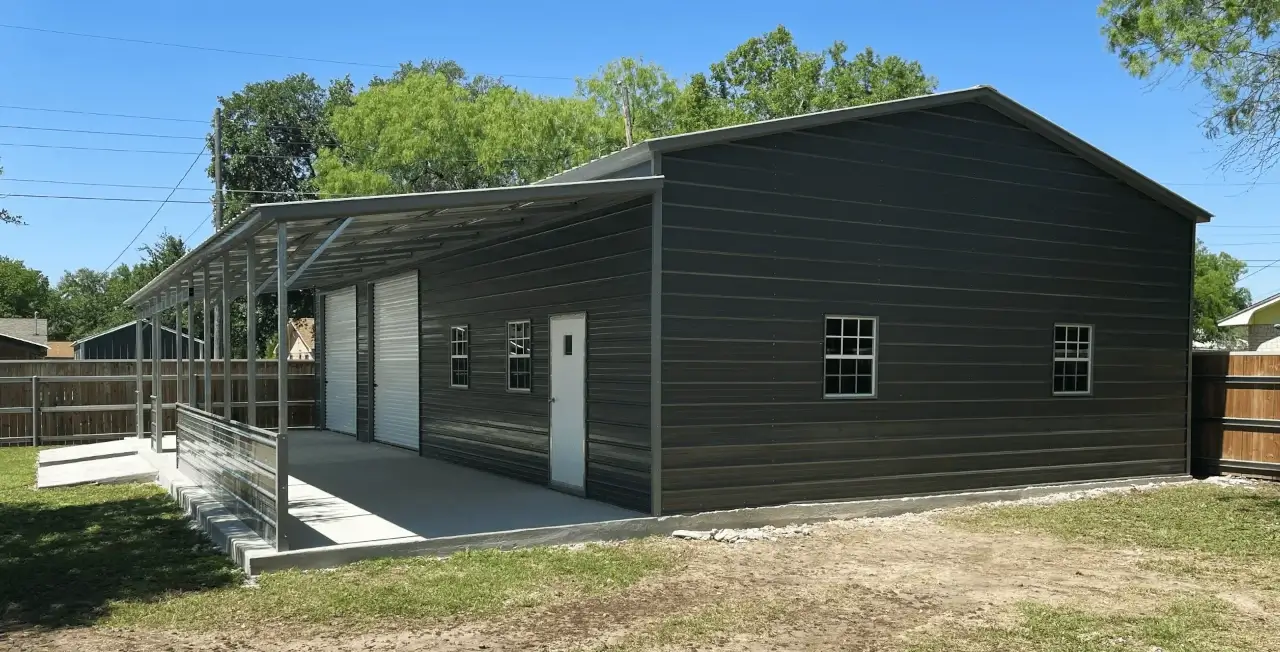
A metal building from Alan’s Factory Outlet blends the straightforward installation style of post framing with enhanced durability over traditional wood framing. Steel components resist moisture, pests, and warping. That reduces long-term maintenance concerns common in wood structures.
This building method uses fewer materials than dense stud framing while maintaining structural strength. Crews assemble components efficiently on-site, supporting shorter construction time without sacrificing performance.
Key advantages of choosing a metal structure include:
- Stronger long-term durability. Steel framing resists rot, insects, and moisture damage better than traditional wood systems.
- Faster construction time. Pre-engineered components streamline on-site assembly and reduce build delays.
- Fewer materials. Simplified framing lowers material volume compared to dense stud walls.
- Lower maintenance needs. Steel panels and framing require less ongoing upkeep than exposed wood.
- Cost-effective performance. Efficient installation and reduced maintenance contribute to long-term value.
Design Your Garage or Barn With Our 3D Builder
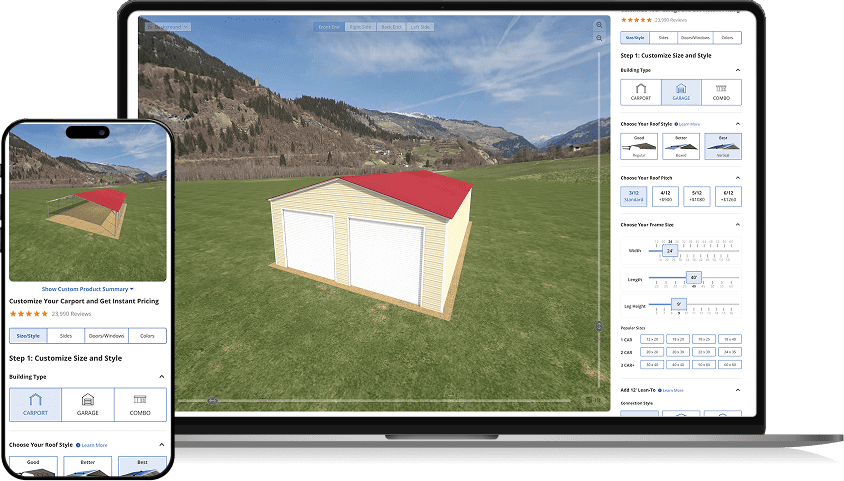
Planning a new metal building becomes easier with interactive tools. You can configure dimensions, roof style, doors, and layout details before moving forward with your building project.
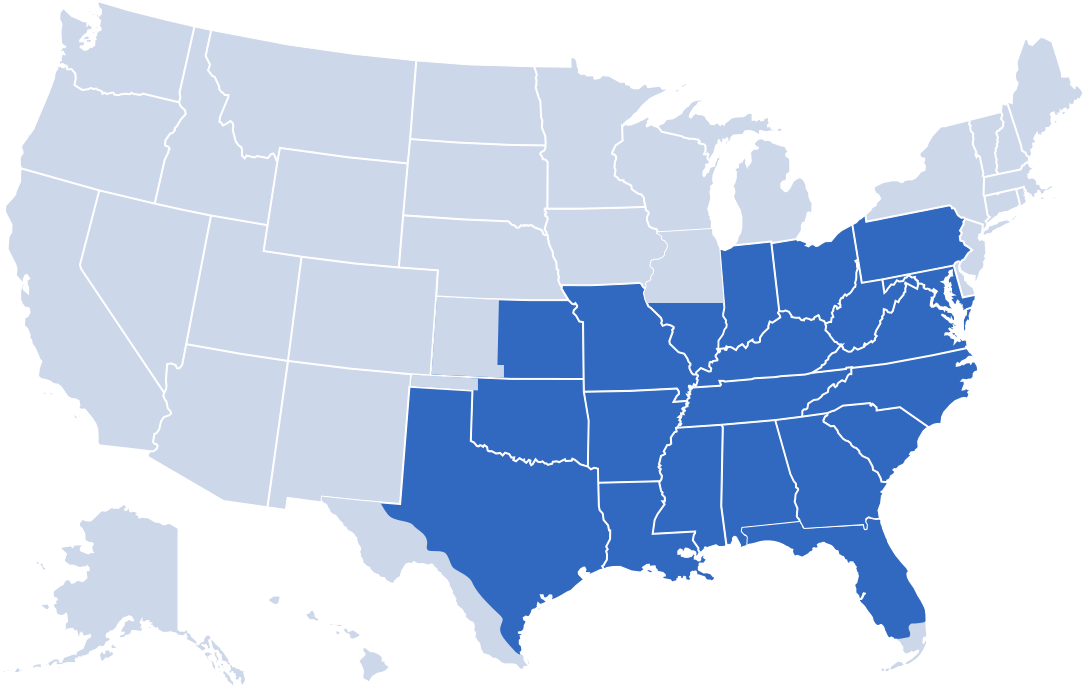
Explore our 3D Carport & Metal Garage Builder to design a structure that fits your needs. Alan’s Factory Outlet provides free delivery and installation within its 21-state service area, helping streamline on-site assembly and reducing overall construction time. Thoughtful planning today supports long-term durability and dependable performance for years to come.