


Storage space in a home can run out fast, and the effects of this go well beyond a cluttered closet. Alan’s Factory Outlet surveyed more than 1,000 U.S. adults to find out how storage stress impacts daily life. We also built a Storage Stress Index for 196 American cities (based on data from the U.S. Census Bureau and Zillow) to identify which cities are most in need of storage solutions.
Key Takeaways
- 52% of Americans who lack storage have considered moving to a new home just for more space, and 48% of this group plan to move within 2 years.
- Women are more likely than men to avoid inviting guests over (34% vs. 21%), hosting family gatherings (30% vs. 17%), and making large purchases (30% vs. 19%) due to clutter.
- 9 in 10 who lack storage would choose an at-home solution over renting off-site.
- The most storage-stressed Americans live in New York City, Honolulu, and Milwaukee.
- 7 of the 10 least storage-stressed cities are in Texas or Arizona, including Denton, Frisco, and McKinney, TX, and Peoria, Scottsdale, and Surprise, AZ.
- 3 in 4 Americans say limited storage affects their stress levels, including 31% who say it has a moderate or major impact.
Where Space at Home Runs Out First
Not all cities face the same storage challenges. Differences in home sizes, housing density, and access to self-storage facilities all affect how cramped residents feel from one area to the next.
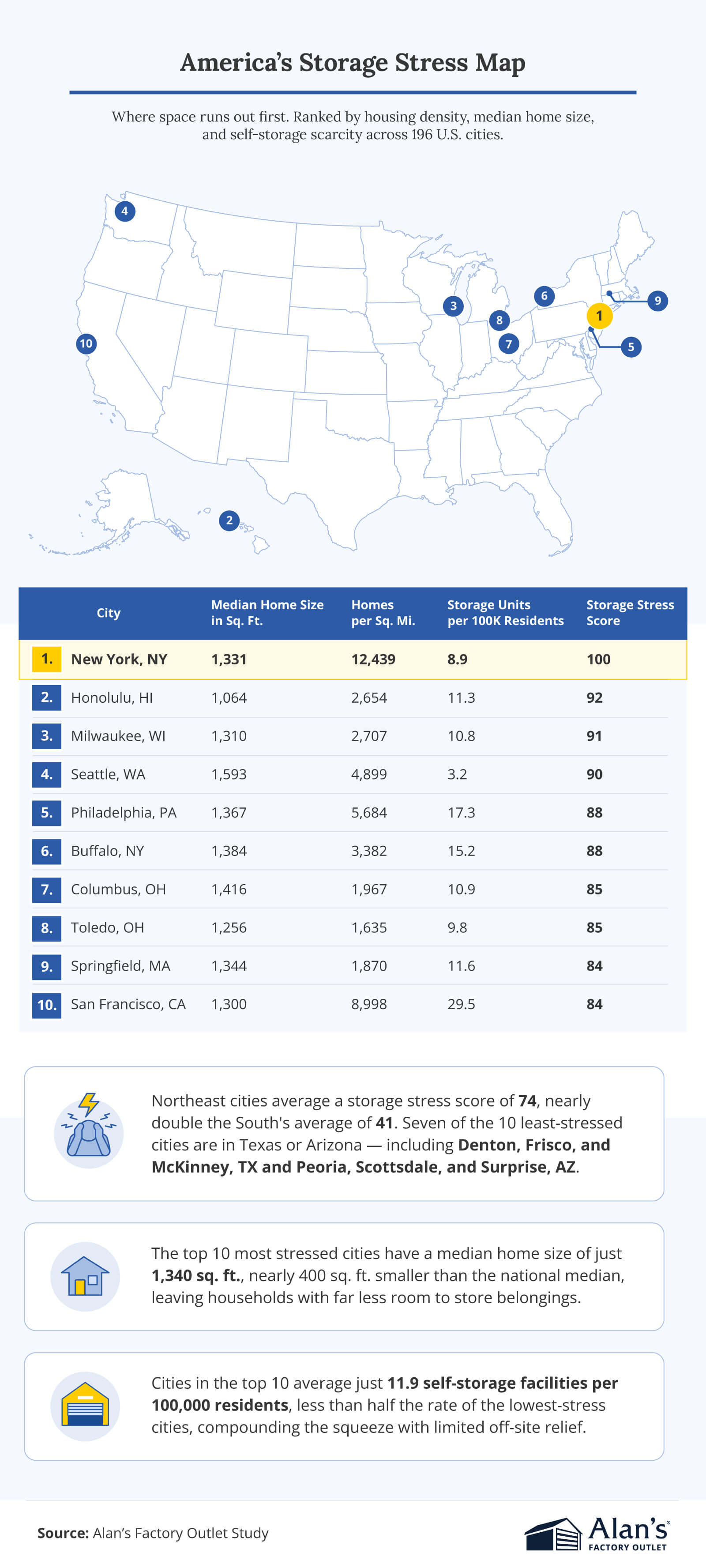
New York City ranked No. 1 on the Storage Stress Index, driven by the highest housing density of any city analyzed at 12,439 units per square mile. Honolulu came in second, with the smallest median home size at just 1,064 square feet, followed by Milwaukee. Fourth-place Seattle stands out for having the fewest self-storage facilities per 100,000 residents (3.2).
The top 10 most stressed cities averaged a median home size of 1,340 square feet, nearly 400 square feet smaller than the national median. Those same cities averaged 11.9 self-storage facilities per 100,000 residents, less than half the rate of the lowest-stress cities.
San Francisco landed at No. 10 with the third-highest housing density in the index (8,998 units per square mile), despite ranking among the best cities for self-storage availability. This suggests that dense housing alone could outweigh even strong access to off-site options.
Regionally, 7 of the top 10 most storage-stressed cities were in the Northeast or Midwest. Midwest cities claimed 10 of the top 25 spots despite representing just 14% of all cities in the index. Northeast cities averaged a stress score of 74, compared to just 41 in the South. The bottom 10 least-stressed cities were almost entirely Sun Belt metros in Texas and Arizona.
The Cost of a Cluttered Home
Storage stress isn’t just about a lack of square footage. For many respondents, it changes how they use their homes, how they spend their time, and even who they invite over.
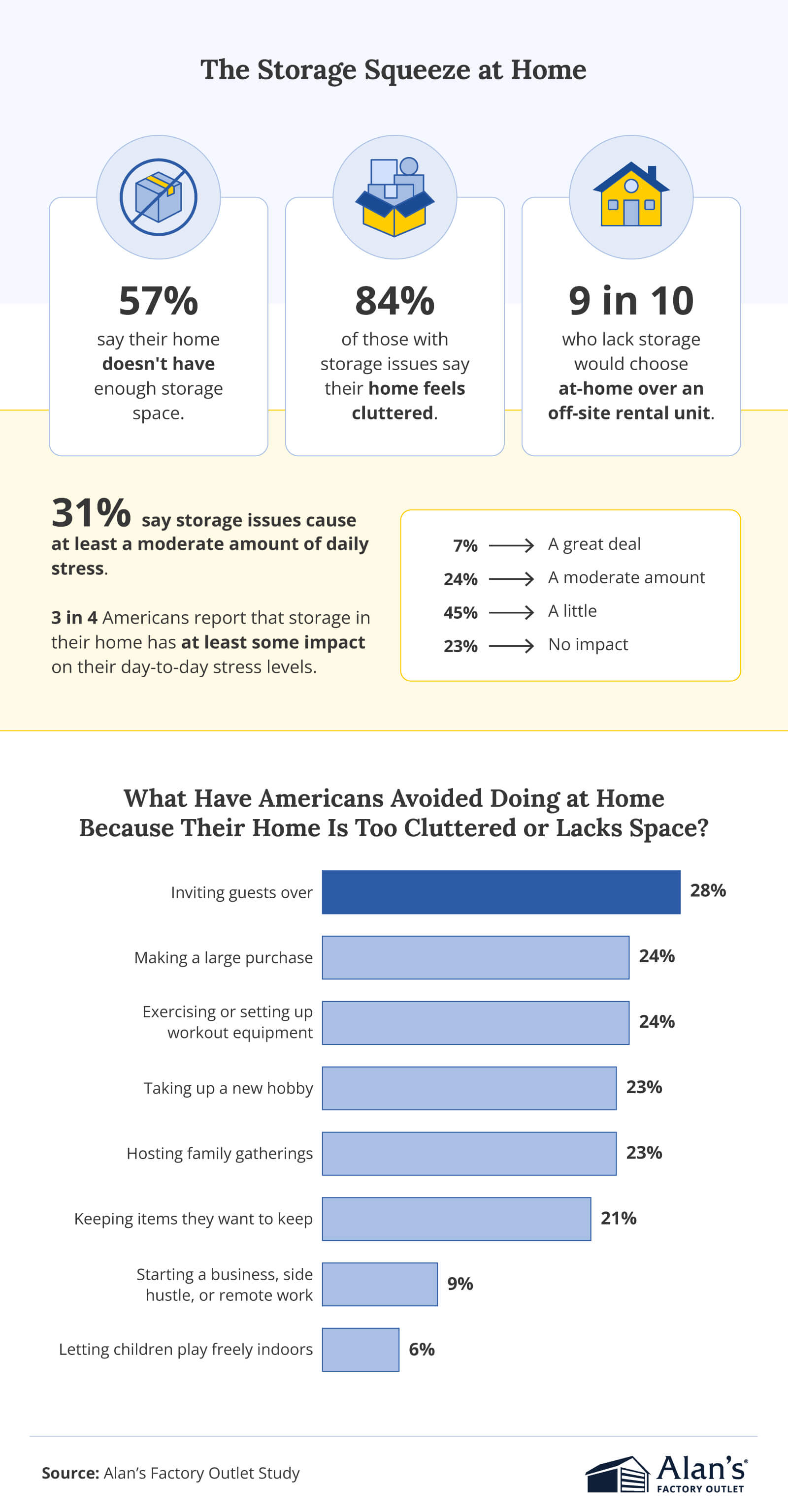
Overall, 75% of Americans said home storage affects their stress levels, including 31% who reported a moderate or major impact. More than half of Americans surveyed (57%) said their home doesn’t have enough storage space. Among those who reported a lack of storage, 84% said their home feels cluttered, and 90% said they would choose an at-home solution over renting an off-site storage unit.
Clutter is also changing daily habits. Inviting guests over was the most commonly avoided activity at 28%, followed by:
- Making a large purchase (24%)
- Exercising at home (24%)
- Taking up a new hobby (23%)
- Hosting family gatherings (23%)
Women are significantly more likely than men to skip these activities. The gap was widest for inviting guests (34% vs. 21%) and held across hosting family gatherings (30% vs. 17%) and making large purchases (30% vs. 19%).
Work-from-home life amplifies the issue for some. Apartment dwellers who work from home reported difficulty focusing at a rate 28% higher than those in single-family homes (32% vs. 25%), pointing to a compounding effect when small spaces and clutter overlap.
Generationally, millennials feel the squeeze most. Among those who lack storage, 59% had considered moving to a new home primarily to gain more space. That compares to 56% of Gen Z, 42% of Gen X, and 31% of baby boomers.
When respondents were asked where the overflow ends up, closets (20%) and bedrooms (20%) topped the list. Living rooms and family rooms accounted for 15%, followed by kitchens/pantries (13%), garages (11%), and basements (9%).
The Storage Solutions Americans Want
Despite the growth of the self-storage industry in recent years, most Americans who need more space prefer to solve the problem closer to home.
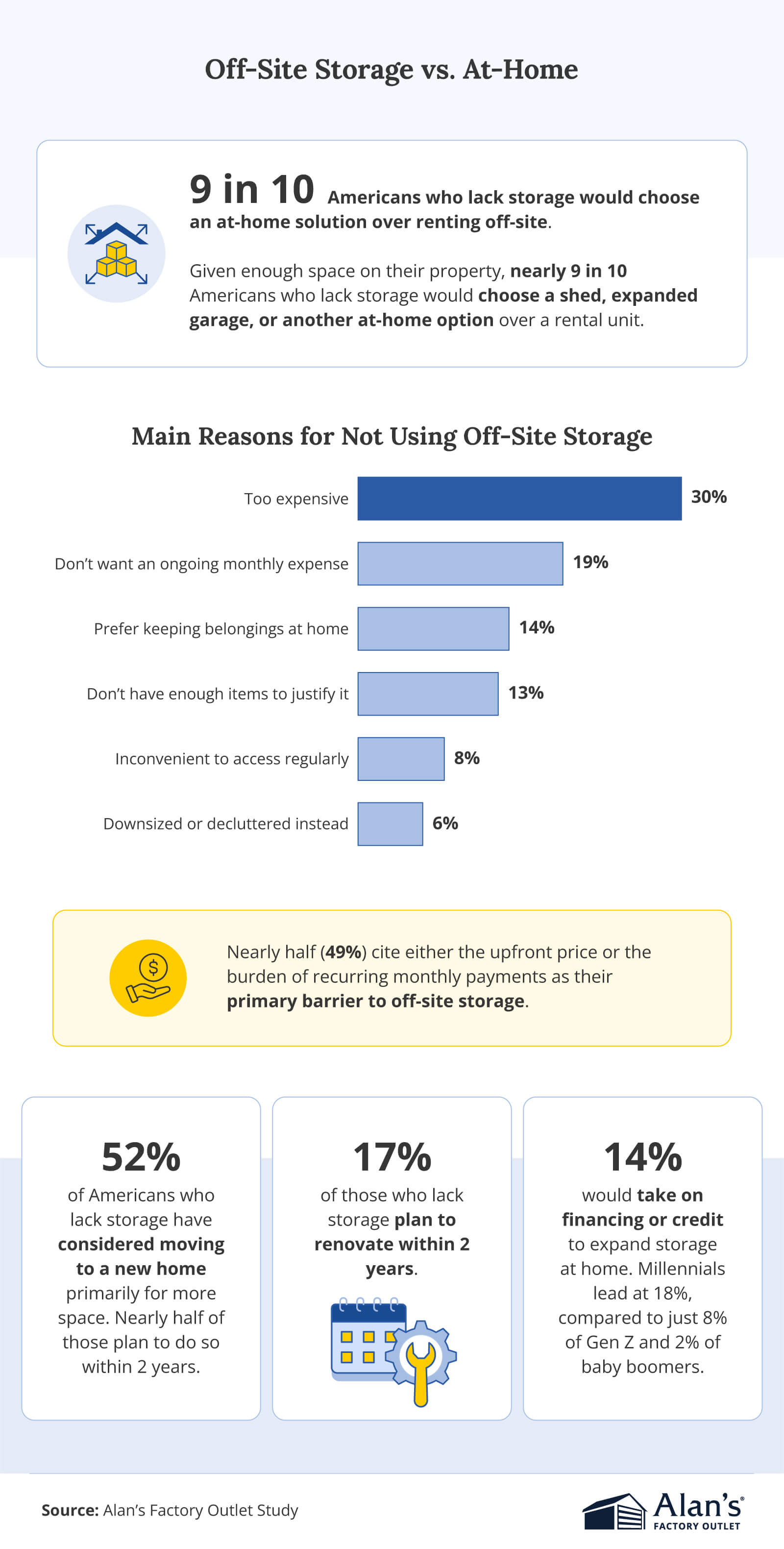
Nine in 10 respondents who lacked storage said they would choose an at-home solution over renting off-site. Cost was the main reason, as 30% said off-site storage is too expensive, and 19% said they just don’t want an ongoing monthly expense. Yet, 14% said they would take on financing or credit to expand at-home storage. Millennials led the group at 18%, followed by Gen X (12%), Gen Z (8%), and baby boomers (2%).
Moving is on the table for many. More than half of those who lacked storage (52%) had considered relocating primarily for more space, and 48% of that group plan to do so within 2 years. Fifty-nine percent of millennials who lack storage had thought about moving for more space, compared to 56% of Gen Z, 42% of Gen X, and 31% of baby boomers.
Baby boomers were the least likely generation to have ever considered off-site storage (58% had never considered it), while millennials were the most likely to have used it in the past (33%). Among apartment renters, 13% currently use off-site storage, the highest among all residence types. But 84% of apartment renters who lack storage said they would still prefer an at-home solution.
Renovation is another popular path forward: 1 in 6 of those who lacked storage (17%) planned to renovate for more space within 2 years, including 21% of single-family homeowners and 9% of apartment renters.
Making the Most of the Space You Have
Many Americans are running out of room, and the impact goes far beyond clutter. Limited storage is shaping how people live, from avoiding guests to reconsidering where they call home.
For many, the solution is creating more usable space at home. Adding a metal shed or detached garage can help homeowners reclaim square footage without taking on a recurring monthly cost. Even a small addition can make a meaningful difference, turning crowded rooms back into functional, livable spaces.
When storage works better, everything else at home does too.
Methodology
This study combined two complementary data sources to examine storage stress across the United States: a city-level index built from publicly available data and a national consumer survey.
To build the Storage Stress Index, we focused on U.S. cities with a population of 100,000 or more, yielding a final set of 196 cities. Each city was ranked across three equally weighted factors:
- Self-storage availability was sourced from the U.S. Census Bureau’s County Business Patterns data (2023), which provides establishment counts for self-storage businesses normalized per 100,000 residents.
- Housing density was calculated using housing unit counts from the American Community Survey (ACS) 1-year estimates and land area figures from the Census Gazetteer files.
- Median home square footage was drawn from 185,254 Zillow residential listings over the past 12 months, including currently listed and recently sold single-family homes, townhomes, and condos.
Each city received a rank across all three factors, which were averaged and normalized on a scale of 0 to 100, with 100 assigned to the highest-scoring city.
To complement the index, we surveyed 1,004 U.S. adults to understand how storage space, clutter, and the limits of home capacity affect daily life, stress, and major life decisions. The average age of respondents was 40. The gender breakdown was 50% women and 49% men. Millennials made up the largest share of respondents (53%), followed by Gen X (24%), Gen Z (16%), and baby boomers (8%). By residence type, 65% of respondents live in a single-family home, 23% in an apartment, 5% in a condominium, 3% in a mobile or manufactured home, and 4% in another type of residence. The survey was conducted online in March 2026.
About Alan’s Factory Outlet
Alan’s Factory Outlet has been helping homeowners across the country find durable, affordable metal buildings, garages, carports, and storage sheds for more than 20 years. We make it easier to add the space your property needs, whether that means sheltering vehicles, organizing tools, or creating a flexible area for work and storage.
Ready to see what fits? Try our free 3D Carport and Metal Garage Builder to design and price a custom structure online.
Fair Use Statement
The data and insights in this article may be used for noncommercial purposes. When citing this study, please provide proper attribution and include a link to Alan’s Factory Outlet.