


Alan’s Factory Outlet analyzed more than 20,000 active Realtor.com listings across 50 of the largest U.S. cities and surveyed 1,004 American homeowners to measure both sides of the garage equation: what the market actually pays and what homeowners say a garage is worth to them. The two answers don’t always match, and the gap tells an interesting story.
Key Takeaways
- Homes with a garage list for an average of $39,858 more than comparable homes without one, a 10% market premium across 50 of the largest U.S. cities.
- Milwaukee homes with a garage list for 62% more than comparable homes without one, the biggest premium of any major U.S. city, followed by Chicago (+53%), San Jose (+35%), Wichita (+32%), and San Francisco (+27%).
- Over 2 in 5 U.S. homeowners surveyed (41%) say they wouldn’t buy a home without a garage, calling it a dealbreaker.
- Over 1 in 2 U.S. homeowners surveyed (57%) would rather have a two-car garage than an extra 400 square feet of indoor living space.
- U.S. homeowners without a garage say they’d pay an average of $11,790 to add one, but the market rewards that investment with a premium of $39,858, roughly 3.4x the up-front spend.
Location Is Everything: The Garage Premium by Market
Listing data showed that the financial value of a garage depends heavily on location and home size, with some markets paying a much steeper premium than others.
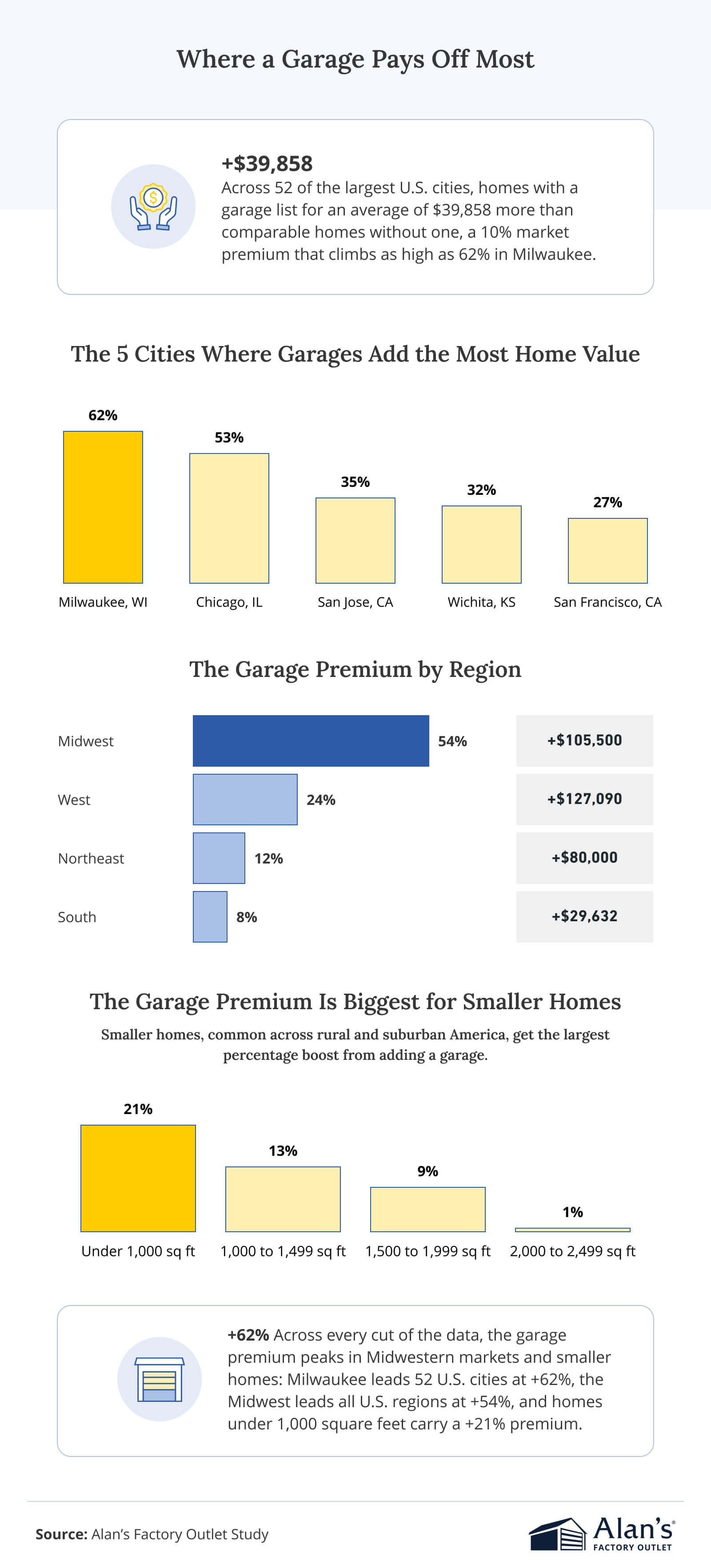
Across 50 of the largest U.S. cities, homes with a garage were listed for an average of $39,858 more than comparable homes without one, a 10% market premium. The cities where buyers paid the steepest premium were:
- Milwaukee, WI (+62%)
- Chicago, IL (+53%)
- San Jose, CA (+35%)
- Wichita, KS (+32%)
- San Francisco, CA (+27%)
Regional differences were even more pronounced. The Midwest led the country with a 54% garage premium (an extra $105,500 on average), followed by the West at 24% (+$127,090), the Northeast at 12% (+$80,000), and the South at 8% (+$29,632). Cold-weather markets, where covered parking is closer to a necessity than a perk, clearly reward homes that have a garage.
Smaller homes saw the biggest percentage boost from adding a garage, which is meaningful for buyers in rural and suburban areas where compact homes are common:
- Under 1,000 sq ft (+21%)
- 1,000 to 1,499 sq ft (+13%)
- 1,500 to 1,999 sq ft (+9%)
- 2,000 to 2,499 sq ft (+1%)
Garage size also moved the needle. A three-car garage commanded a 17% premium over homes without a garage, compared to 12% for both one-car and two-car garages. One thing that didn’t seem to matter: when controlling for home size and market, attached and detached garages carried roughly similar price premiums, which is good news for homeowners considering a standalone build.
What a Garage Is Really Worth
Homeowner sentiment painted a clear picture of just how much a garage shapes buying decisions and resale expectations, even when those expectations don’t quite match the market.
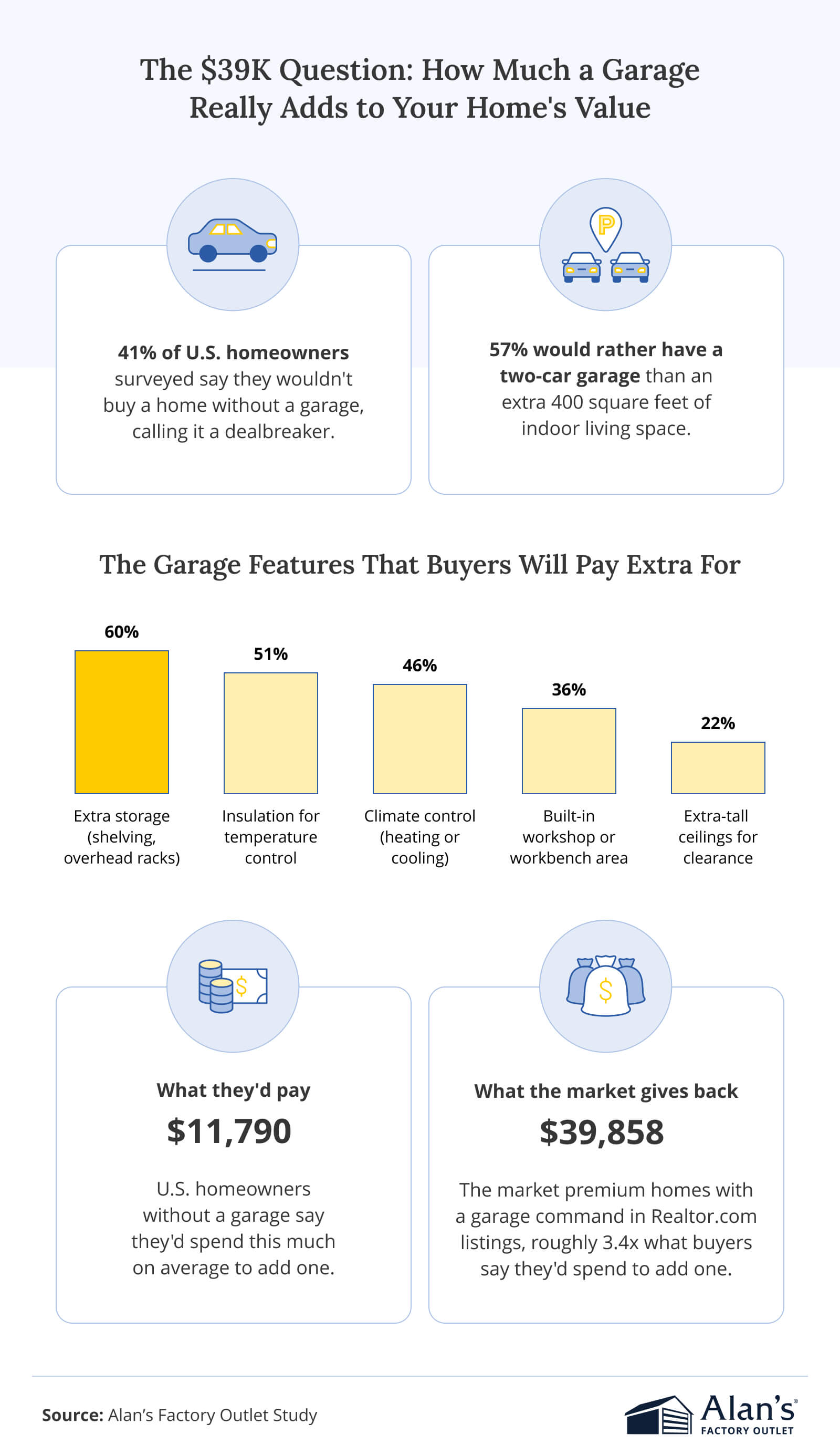
Over 2 in 5 U.S. homeowners surveyed (41%) said they wouldn’t buy a home without a garage at all, calling it a dealbreaker. That stance varied sharply by factors like location and income.
Here’s the share of homeowners who called it a dealbreaker, by location:
- Suburban homeowners (52%)
- Urban homeowners (27%)
- Rural homeowners (25%)
Below is the share of homeowners who called it a dealbreaker, by income:
- Higher earners, $150,000+ (55%)
- Lower earners, under $50,000 (29%)
Garage square footage also outranked indoor space for many buyers. Over 1 in 2 U.S. homeowners surveyed (57%) said they’d rather have a two-car garage than an extra 400 square feet of indoor living space, with the strongest preferences coming from baby boomers (68%) and Midwesterners (64%). Homeowners ranked a garage as the #2 home feature for resale value (38%), trailing only a renovated kitchen (49%) and ahead of finished basements (35%), extra bedrooms (24%), and swimming pools (14%).
The #1 garage upgrade buyers would pay extra for had nothing to do with parking. Homeowners cared more about how the space could function day to day:
- Extra storage like shelving and overhead racks (60%)
- Insulation for temperature control (51%)
- Climate control for heating or cooling (46%)
- A built-in workshop or workbench area (36%)
- Extra-tall ceilings for clearance (22%)
Homeowners surveyed estimated a garage adds $26,728 to a home’s sale price on average, roughly $13,000 less than the $39,858 premium reflected in Realtor.com listings. And homeowners without a garage said they’d spend an average of just $11,790 to add one, meaning the market rewards that investment at about 3.4x the projected cost. Buyers are underestimating both what a garage is worth on paper and what it returns at resale.
The data also surfaced a few less obvious findings. Nearly 3 in 10 U.S. homeowners surveyed who live with a partner or family (28%) have argued with them over what’s allowed to be stored in the garage, a reminder that this space is as much about household negotiation as it is about resale value. And despite the work-from-home boom, just 12% of homeowners said remote work has made a garage more important to them, while 60% said it’s changed nothing.
So, Is a Garage Worth It?
Garages have long been one of the more underrated parts of a home, but the data suggests buyers and sellers should pay closer attention. The market is rewarding garages with a premium that’s roughly three times what most homeowners think it costs to add one, and in smaller homes, colder regions, and Midwestern markets, that return climbs even higher. For homeowners weighing whether a garage is worth it, the answer in dollars is usually yes, and the answer in everyday quality of life is even harder to put a number on.
Methodology
To quantify the real and perceived value a garage adds to American home prices, Alan’s Factory Outlet analyzed active Realtor.com listings scraped in April 2026. Fifty city-level search queries were used to surface single-family home listings from some of the largest U.S. cities by population.
The resulting dataset comprised over 20,000 active single-family home listings after outliers were removed using interquartile range (IQR) filtering at the city level. The garage premium was calculated as the median list price difference between homes with and without a garage, with an additional size-matched analysis performed within each city and square-foot bracket to control for home size.
Alan’s Factory Outlet also conducted an online survey of 1,004 U.S. homeowners via CloudResearch Connect in April 2026 to explore how homeowners value, use, and would pay for garages. Respondents ranged across generations, including Gen Z (7%), millennials (51%), Gen X (30%), and baby boomers (11%), and included both women (57%) and men (42%). The average age of respondents was 43.
About Alan’s Factory Outlet
At Alan’s Factory Outlet, we offer durable, affordable metal buildings, garages, and carports to meet a variety of needs. With customization options to fit different lifestyles, we help homeowners like you make the most of your property, whether that means adding extra storage, shelter, or even creating new spaces like a garage office.
Fair Use Statement
The survey findings in this report can be shared for noncommercial purposes only. Please provide proper attribution and a link back to Alan’s Factory Outlet when referencing this content.