



Anyone who’s ever assembled furniture with a partner knows DIY can bring out the best — and worst — in a relationship. One missed screw or unclear instruction can quickly turn teamwork into tension, while a finished project can feel like a shared victory.
Alan’s Factory Outlet surveyed more than 1,000 people in relationships to find out whether DIY projects help couples bond or push them apart. The results suggest that building together often strengthens connection, boosts communication, and may even rival traditional relationship therapy.
Key Takeaways
- Nearly 7 in 10 couples (68%) feel closer to their partner after completing a DIY project together.
- Among couples who’ve tried both DIY projects and couples therapy (40%), DIY helped their relationship more than therapy 2-to-1 (47% vs. 23%).
- About 1 in 4 couples (26%) have secretly redone their partner’s DIY work rather than address it directly.
- 4 in 5 Gen Z couples (80%) feel closer after completing a DIY project together.
- Nearly 2 in 5 couples (38%) would recommend DIY projects as a form of relationship therapy.
- Gen Z favors DIY over therapy: 59% said DIY helped their relationship more than therapy, while just 12% said therapy helped more, a 5-to-1 ratio.
Building (and Rebuilding) Together
DIY projects can bring couples closer, but they also reveal a lot about how partners communicate and collaborate.
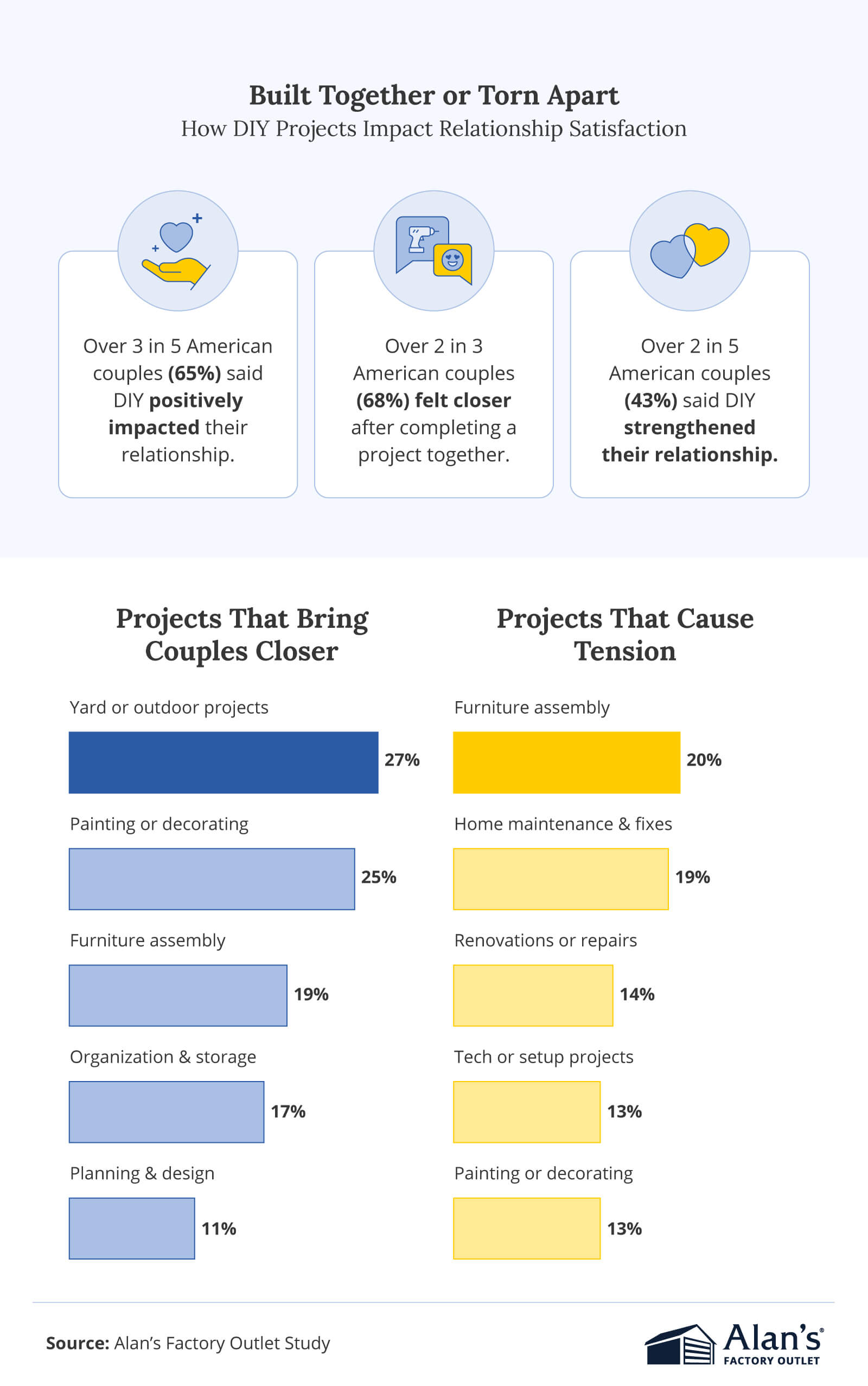
Nearly 7 in 10 couples (68%) said they felt closer to their partner after completing a project together. Gen Z couples were especially positive about the experience. More than half (55%) said DIY improved their communication, compared to just 25% of Gen X and older couples. For Gen Z, furniture assembly was both the top bonding project and the biggest source of tension.
While many projects went smoothly, some couples shared a few DIY confessions:
- 26% secretly redid their partner’s work after it was “finished.”
- 18% got injured during a project.
- 6% faked being good at DIY to impress their partner.
- 6% quietly called a professional to fix a partner’s mistake.
Millennials were the most likely to redo their partner’s work (28%) and the most likely to get injured (20%). Gen X and older couples were almost four times more likely than Gen Z to say DIY strained their relationship (15% vs. 4%).
When it came to deciding who leads a project, couples were split:
- 33% said “mostly me.”
- 31% said “mostly my partner.”
- 21% shared leadership equally.
- 15% said it depends on the project.
Men were nearly three times more likely than women to say they take the lead, while women were more likely to report conflict. Still, both groups felt similarly close afterward, with about two-thirds (67–69%) saying DIY brought them closer.
How Couples Grow Together
Couples find many ways to stay connected, whether it’s a weekly date night, a planned getaway, or a weekend spent building something together. We compared DIY projects, couples therapy, and traditional bonding activities to see which experiences bring partners closer.
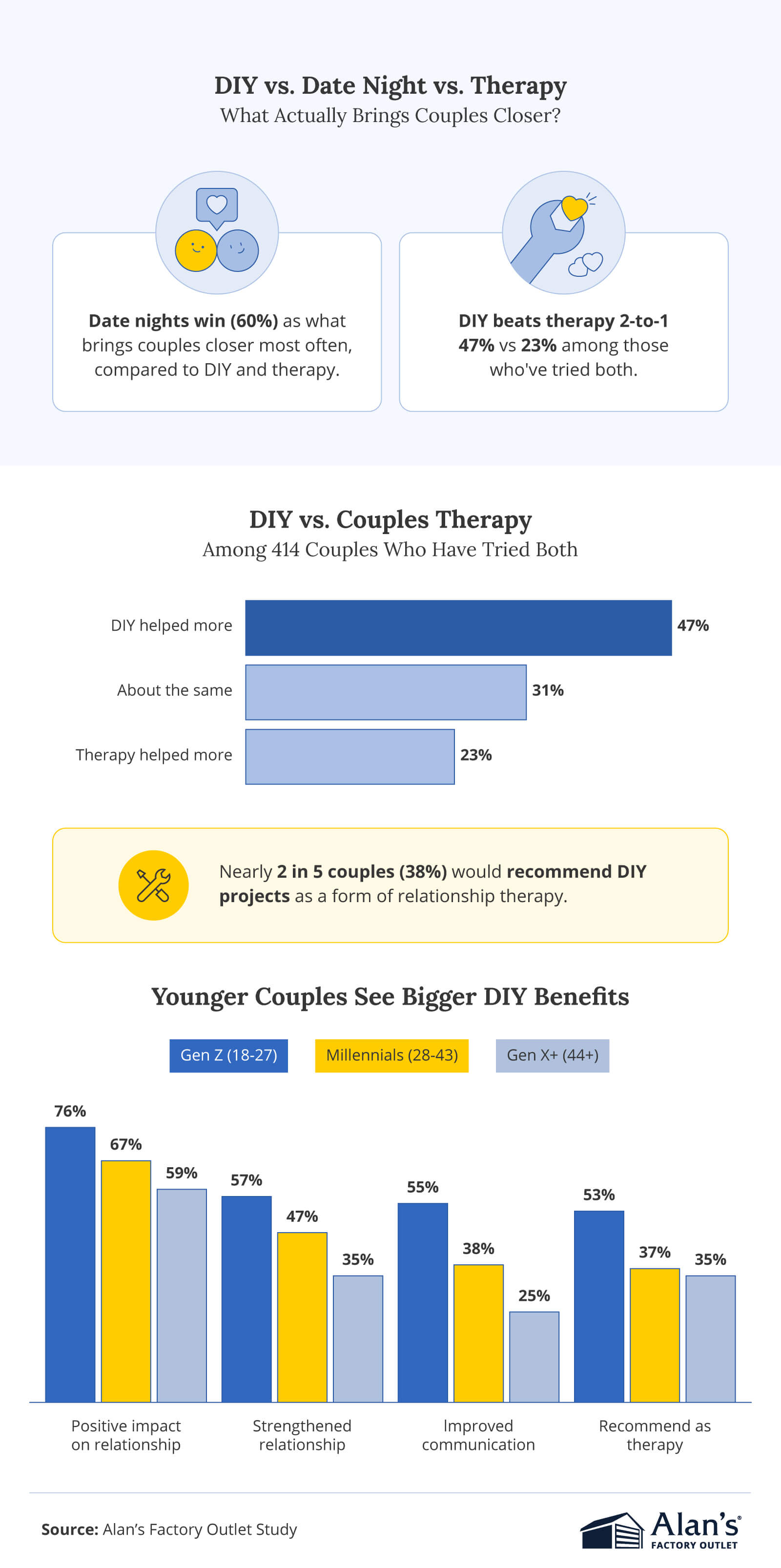
Among couples who had tried both DIY projects and couples therapy (40%), DIY came out ahead. Nearly half said DIY helped their relationship more than therapy — a 2-to-1 advantage (47% vs. 23%). Another 31% said both worked about the same. Nearly 2 in 5 couples (38%) said they’d recommend DIY projects as a form of relationship therapy.
Generational differences stood out clearly.
- Gen Z: 59% said DIY helped more than therapy, while only 12% said therapy helped more, a 5-to-1 ratio.
- Millennials: 41% favored DIY vs. 26% for therapy, showing the smallest gap.
- Gen X and older adults: Just over half favored DIY (52%) compared to 20% for therapy.
DIY’s relationship benefits were strongest among younger couples:
- 80% of Gen Z couples felt closer after completing a DIY project, compared with 71% of millennials and 61% of Gen X+ couples.
- Gen Z was more likely than Gen X+ to report a positive impact on their relationship (76% vs. 59%).
- More than half of Gen Z (53%) would recommend DIY as relationship therapy, compared to 37% of millennials and 35% of Gen X+.
Even with those findings, date nights still reigned supreme for many couples. Gen Z was the most attached to date nights (68%), followed by Millennials (61%) and Gen X+ (56%). While DIY may not replace the classic night out, it clearly offers another meaningful and sometimes more rewarding way for couples to connect and communicate.
Love in the Workshop
DIY projects often reveal how couples truly work together. Small frustrations can surface along the way, but finishing a project side by side creates a shared sense of accomplishment. For many couples in this study, those moments strengthened connection, improved communication, and even felt more helpful than traditional therapy. Whether the work happens in a garage workshop, the backyard, or inside the home, DIY offers hands-on collaboration, problem-solving, and the satisfaction of building something together that lasts.
Methodology
We surveyed 1,041 Americans currently in romantic relationships to explore how working on DIY or home projects together impacts their relationships. The average age of respondents was 42. The generational breakdown of respondents was as follows: Gen Z (ages 18-27), 11%; millennials (ages 28-43), 52%; Gen X and older generations (ages 44+), 37%. Due to rounding, some percentages in this study may not sum exactly to 100%.
About Alan’s Factory Outlet
Alan’s Factory Outlet offers durable, affordable metal buildings, garages, and carports to meet a variety of needs. With customization options to fit different lifestyles, Alan’s Factory Outlet helps homeowners make the most of their property, whether that means adding extra storage, shelter, or even creating new spaces like a garage office.
Fair Use Statement
The survey findings in this report can be shared for noncommercial purposes only. Please provide proper attribution and a link back to Alan’s Factory Outlet when referencing this content.