



Discover how steel tariffs and inflation would impact the cost of rebuilding the world’s most iconic structures.
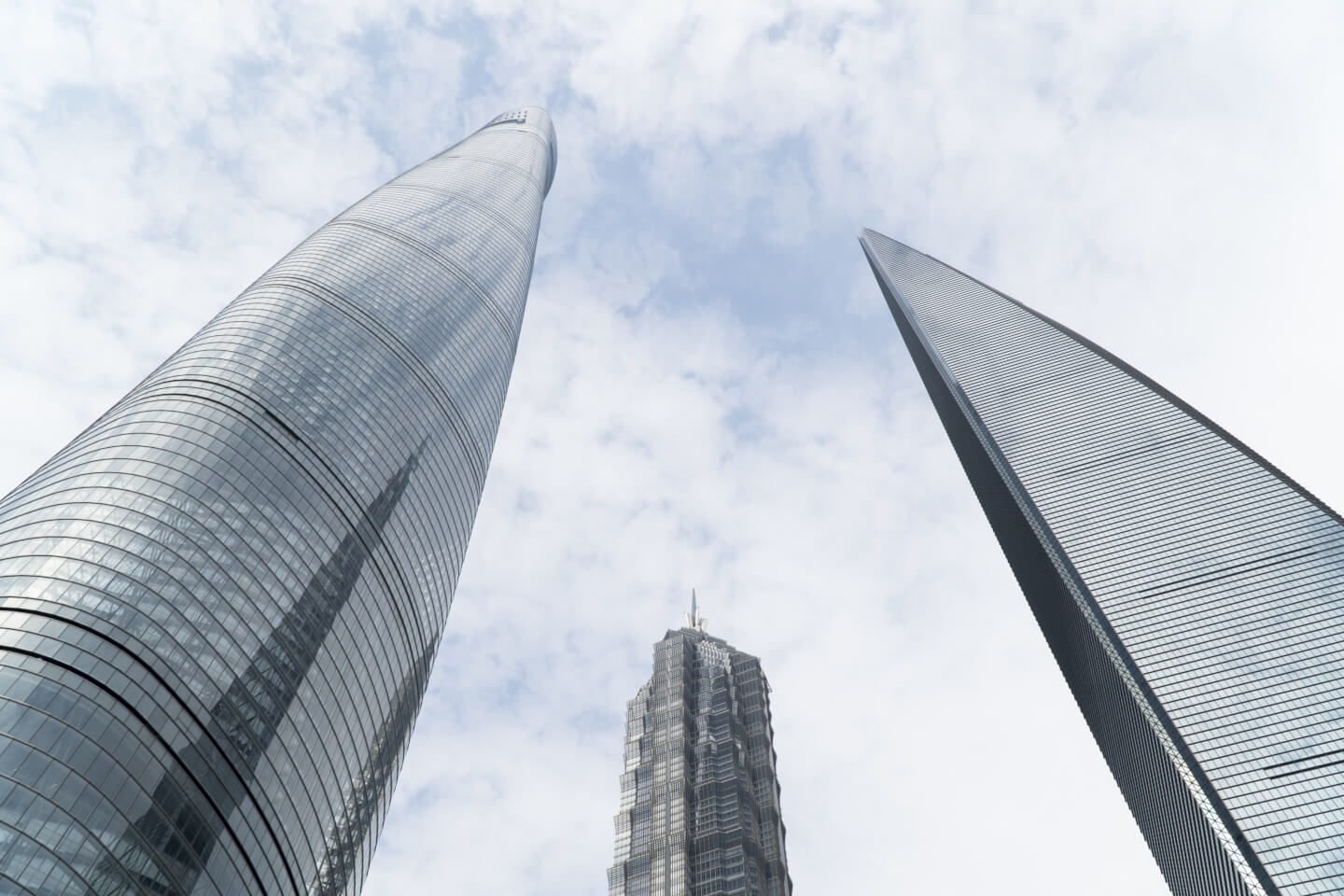
If famous structures like the Golden Gate Bridge or the Shanghai Tower were built today, what would they cost in an era of modern steel tariffs and high material prices? To find out, Alan’s Factory Outlet estimated how inflation, steel costs, and currency conversion would affect the price of rebuilding 20 iconic landmarks in the U.S. today.
To make the estimates consistent, we converted each structure’s original construction budget into U.S. dollars and standardized its reported structural weight into metric tons, assuming the entire structure was made of steel. With U.S. structural steel priced at $56.25 per cwt and a 50% tariff surcharge added to reflect current trade conditions, these hypothetical rebuilds show how today’s pricing environment could affect construction budgets.
Key Takeaways
- The most expensive structures to rebuild today, after accounting for tariffs and inflation, are the Lotte World Tower and the Petronas Towers.
- The Golden Gate Bridge shows the largest percentage jump from its original cost to its estimated rebuild cost today (+6,252%).
- The Louvre Pyramid would cost 160% more to construct today.
- The Empire State Building would cost 35x times more if built today.
Towering Costs: The World’s Priciest Rebuilds
The following estimates are not exact forecasts, but they show how today’s trade and pricing environment could change the cost of rebuilding major landmarks.
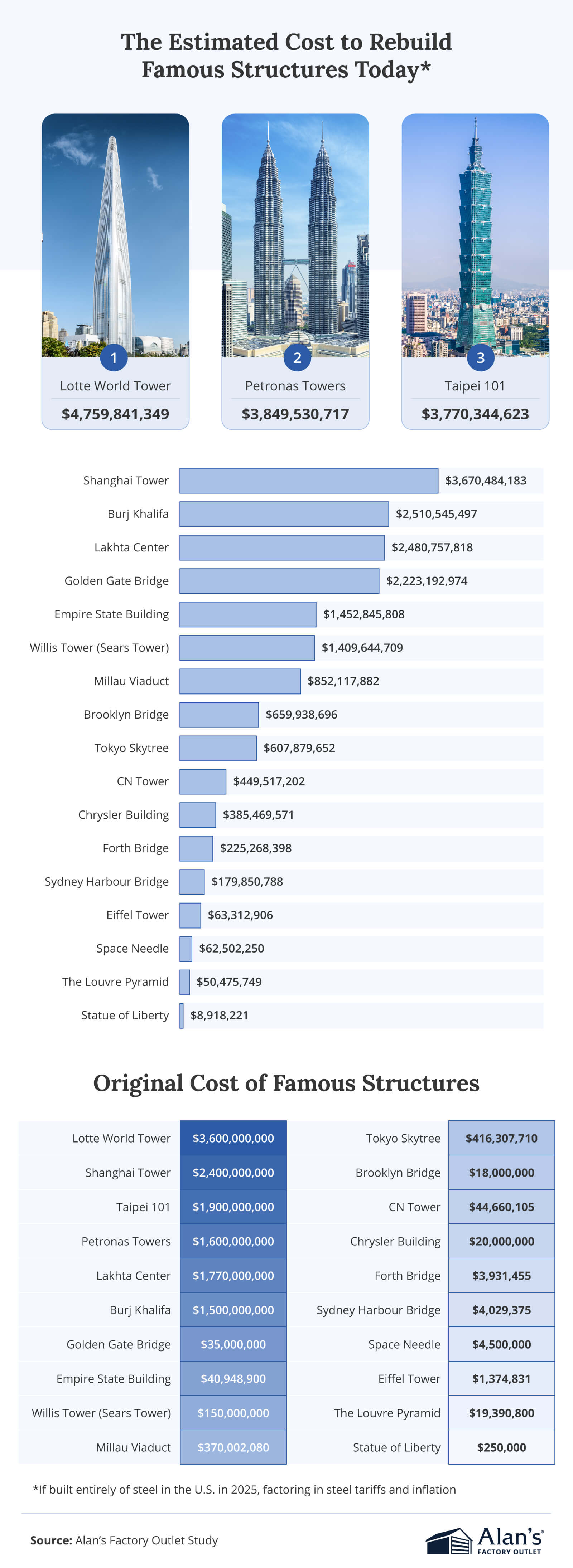
The Lotte World Tower in Seoul, Korea, and the Petronas Towers in Malaysia would be the most expensive landmarks to rebuild under today’s market conditions. In contrast, lighter and smaller landmarks such as the Statue of Liberty and the Louvre Pyramid would be the least expensive to reconstruct today. The smaller structural footprints make them far less vulnerable to cost swings driven by material tariffs.
Skyrocketing Increases: The Impact of Inflation and Tariffs
Here’s how the estimated rebuild costs compare to each structure’s original budget.
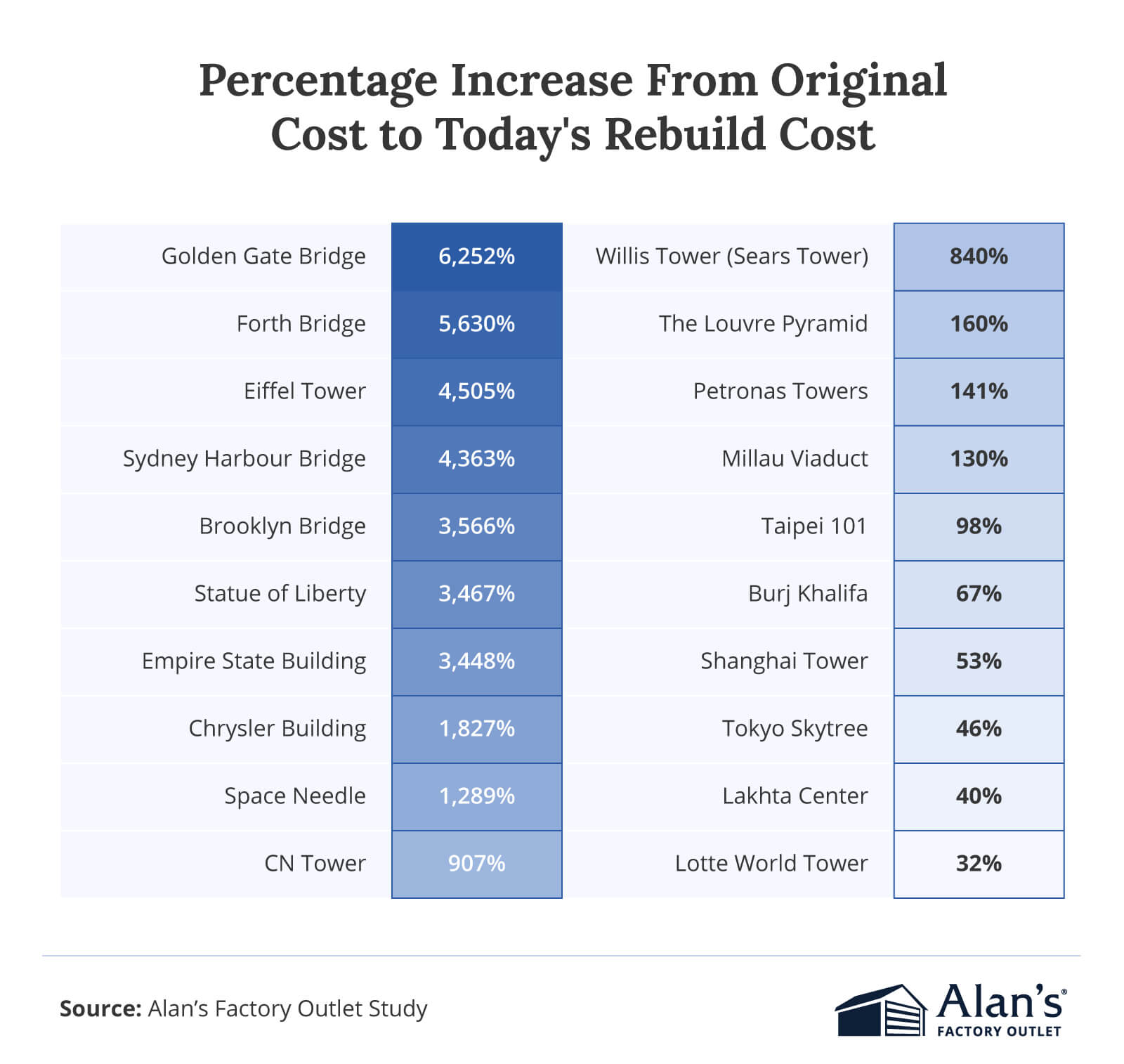
The Golden Gate Bridge in San Francisco would experience the steepest cost increase, with an estimated 6,252% jump in rebuild price compared to its original budget. Scotland’s Forth Bridge ranked next with the second-highest increase (5,630%), followed by the Eiffel Tower (4,505%).
New York City’s Empire State Building, once a marvel of early 20th-century engineering, would be 35 times more expensive to construct. The Lotte World Tower, by comparison, would see only a 32% increase.
Reflecting on the Price of Progress
These estimates show how much today’s material costs, tariffs, and inflation can change the price of rebuilding well-known landmarks. While the numbers are not exact predictions, they help illustrate how modern steel prices and trade conditions can raise construction budgets of any size. Understanding these cost drivers offers a useful perspective for anyone planning a project—large or small—as the price of steel continues to play a major role in what it takes to build in today’s market.
Methodology
To estimate the 2025 rebuild cost of each structure, original construction budgets and structural weights were standardized and adjusted using consistent economic assumptions as follows:
- Original construction costs: We used current exchange rates to convert all original construction costs from CAD, GBP, AUD, EUR, JPY, and French francs into U.S. dollars. This assumes that modern rates represent 2025 values, not the values of each currency at the time of construction.
- Reported structural weights: To keep all weights in metric tons, short tons were multiplied by 0.907185, long tons were multiplied by 1.016047, and weights already reported in metric tons were left unchanged. Each building’s full structural weight was treated as “steel-equivalent” for estimating steel-driven rebuild costs. This simplification may overstate steel usage for concrete-heavy structures.
- Steel price: We converted the U.S. steel price of $56.25 per hundredweight (cwt) into metric tons. To reflect higher steel costs in 2025, we added a 50% surcharge. This increase represents the broader impact of tariffs, not a specific country’s tax. The same adjustment was applied to all structures to show how modern steel prices would affect their costs today.
- Inflation: We adjusted the numbers for inflation using CPI data from the Bureau of Labor Statistics for 1913 to today, and historical CPI estimates from the Minneapolis Fed for years before 1913.
Benchmark cost data for full rebuilds at this scale and global scope is limited. These estimates are comparative and illustrative, not definitive, as they don’t account for local labor costs, material variety, or modern engineering efficiencies.
About Alan’s Factory Outlet
Alan’s Factory Outlet offers affordable, customizable metal buildings, garages, and carports built to withstand the test of time. Whether customers need a sturdy steel carport or a fully enclosed garage, Alan’s Factory Outlet provides quality structures that make steel construction accessible even as prices fluctuate.
Fair Use Statement
Information from this article may be shared for noncommercial purposes only. If you reference or share this study, please provide proper attribution and a link back to Alan’s Factory Outlet.