


Americans are running out of space inside their homes, and a growing share are turning to the one room that’s already paid for: the garage. With housing costs high and remodel budgets tight, converting a garage into living space costs a fraction of a full home addition, and in the right market it can pay for itself in just a few years.
At Alan’s Factory Outlet, we wanted to know where homeowner interest is highest, which cities make a garage conversion easiest, and where the numbers actually work. We surveyed 1,000 U.S. homeowners about their renovation plans, scored the top 50 U.S. cities on garage-to-accessory dwelling unit (ADU) zoning rules, and ran the math on rent versus build cost to find the markets where a garage conversion pays for itself fastest.
Key Takeaways
- 42% of homeowners have considered converting their garage into a living space, with Gen Z showing the strongest renovation interest at 59%.
- 44% of homeowners would rent out a converted garage to help pay their mortgage.
- Austin, Portland, Raleigh, Seattle, and Tucson tie as America’s most garage-conversion-friendly cities.
- Search interest for garage transformations has jumped 23% since 2023, with California leading all states in total search volume.
- San Jose offers the fastest garage-to-ADU payback at just over three years, followed closely by San Francisco, then New York (three years, five months) and Boston (three years, eight months); Tulsa is the slowest at nine years, three months, to break even.
How Homeowners Are Rethinking Their Living Space
Americans want more out of the square footage they already own, and a growing share are turning to the garage to get it.
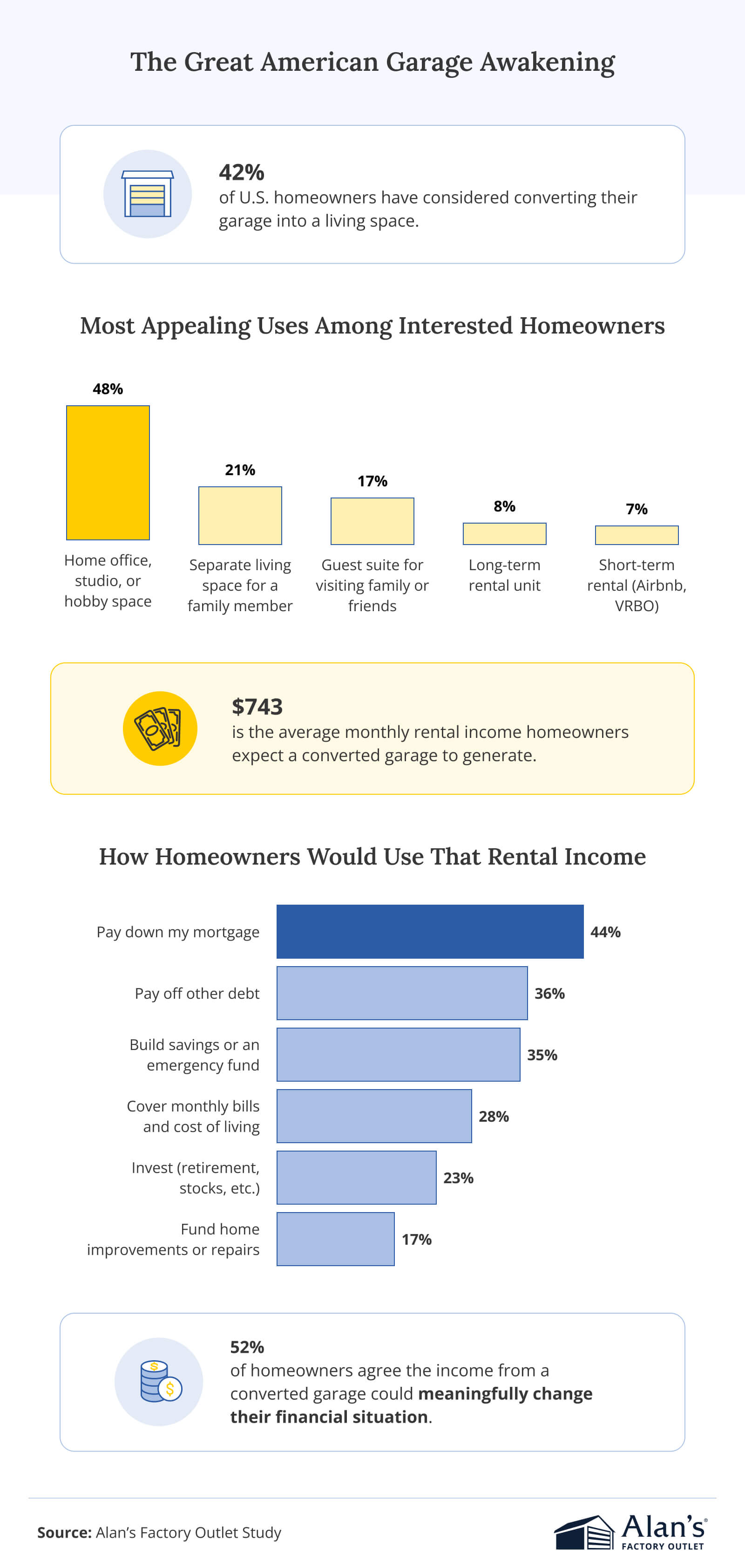
When we asked 1,000 homeowners whether they’d considered converting their garage into a living space, 42% said yes. Gen Z led every other generation at 59%, followed by millennials at 49%, Gen X at 35%, and baby boomers at 24%. Younger homeowners see the car garage as untapped square footage; older homeowners still see it as where the cars and boxes go.
Rental income is part of the appeal. Forty-four percent of homeowners said they’d rent out a converted garage to help pay their mortgage, treating the conversion as both an upgrade to the home and a side income source. As for the timeline, 31% of respondents pointed to the next one to two years as their target window for a potential garage conversion project.
What would actually push homeowners over the line?
- 36% want a clear up-front cost estimate
- 25% want affordable financing
- 23% need the income to justify the cost
- 22% want tax incentives or rebates
- 21% want a guaranteed renter lined up before they start
Price clarity beats incentives by a wide margin. Homeowners want someone to tell them what a garage conversion will actually cost before they touch the garage door.
Which Cities Make Garage Conversions Easy?
Local rules decide whether a converted garage is a legal ADU, a guest suite you can actually use, or a code violation waiting to be flagged.
We scored the top 50 U.S. cities on a 0 to 8 scale across five zoning factors that matter most to a real garage-to-ADU conversion: whether ADU conversion is permitted, whether approval is by-right (no special hearing required), no owner-occupancy mandate, no parking replacement requirement, and whether short-term rentals are allowed.
Five cities tied at the top, all with a Zoning Climate score of 7.5:
- Austin, TX
- Portland, OR
- Raleigh, NC
- Seattle, WA
- Tucson, AZ
Three cities tied at the bottom with a 1.0:
- El Paso, TX
- Jacksonville, FL
- Virginia Beach, VA
The permissive cluster isn’t a coincidence. Each of the top-5 cities has spent the last several years rewriting its zoning code to allow ADUs by-right, drop owner-occupancy rules, or both. The restrictive cluster looks the opposite: garage-to-ADU conversion is either not permitted outright or requires a special hearing that most homeowners abandon before they start.
Zoning permissiveness shows up in property values, too. In our analysis, homes in same-state cities with more permissive garage-to-ADU rules sold for an average of about $103,500 more than homes in cities with more restrictive rules, using Zillow Home Value Index data from March 2026. The figure reflects correlation rather than causation, but the pattern is consistent enough across paired markets that the policy direction matters.
Demand is rising right alongside the policy shifts. Search interest for garage-transformation keywords has jumped 23% since 2023, and California leads every other state in total search volume, followed by Massachusetts, Texas, Florida, and New York.
Where a Garage Conversion Pays for Itself Fastest
A garage conversion only “pays” if rent can cover the build. To find where it works, we modeled a mid-tier garage-to-ADU build at the typical two-car garage footprint of 440 square feet using a published per-square-foot rate from Angi for a total of $110,000. Then we used HUD’s FY2026 Fair Market Rent for 1-bedroom units (the closest proxy for what a 440-square-foot converted-garage unit actually rents for) and divided build cost by annual rent to find each city’s gross payback.
The expensive coastal cities pay back the fastest. San Jose tops the list at 3.07 years, followed by San Francisco at 3.08, New York at 3.45, and Boston at 3.70. Six of the 10 fastest-payback cities are in California, where high rents do most of the heavy lifting.
The top 10 fastest-payback cities (mid-tier $110,000 build) include:
- San Jose, CA: $2,982/mo rent, 3.07 years
- San Francisco, CA: $2,977/mo rent, 3.08 years
- New York, NY: $2,655/mo rent, 3.45 years
- Boston, MA: $2,476/mo rent, 3.70 years
- San Diego, CA: $2,459/mo rent, 3.73 years
- Oakland, CA: $2,385/mo rent, 3.84 years
- Seattle, WA: $2,146/mo rent, 4.27 years
- Long Beach, CA: $2,085/mo rent, 4.40 years
- Los Angeles, CA: $2,085/mo rent, 4.40 years
- Washington, DC: $2,015/mo rent, 4.55 years
At the other end, the slowest-payback cities are concentrated in the Midwest and South, where rents are lower. Tulsa, Oklahoma takes 9.29 years to break even on the same $110,000 build. That means the math leans on owner-use savings (a guest suite, in-law suite, home office, or home gym) rather than rental income.
The bottom 10 slowest-payback cities (mid-tier $110,000 build) include:
- Memphis, TN: $1,154/mo rent, 7.94 years
- Omaha, NE: $1,148/mo rent, 7.98 years
- Bakersfield, CA: $1,140/mo rent, 8.04 years
- Detroit, MI: $1,122/mo rent, 8.17 years
- Milwaukee, WI: $1,119/mo rent, 8.19 years
- Tucson, AZ: $1,081/mo rent, 8.48 years
- Louisville, KY: $1,047/mo rent, 8.76 years
- Oklahoma City, OK: $1,017/mo rent, 9.01 years
- El Paso, TX: $1,013/mo rent, 9.05 years
- Tulsa, OK: $987/mo rent, 9.29 years
Most American cities fall in the Average bucket of 5 to 7 years, a solid timeline for a homeowner who wants a guest suite, family room, or extra bedroom and is happy to recover the cost across a longer horizon.
Ready to Build a Garage With Living Space? Here’s Where to Start
If you’re thinking about a garage conversion project, work through three questions before you swap out the garage door for a wall:
- Is conversion legal in your city? Pull your local zoning code and confirm that ADU conversion is permitted, what building permits run, and whether your garage size meets the local living-area minimum.
- What’s the intended use? A rental unit, guest suite, in-law suite, home office, home gym, art studio, family room, playroom, game room, studio apartment, or simply a new room to spread out in. The intended use sets the rest of the remodel: building codes, ceiling height, egress windows, the HVAC system, electrical wiring, drywall, kitchenette plumbing, and whether you need a mini-split.
- Does the math work? If you want rental income, compare your local Fair Market Rent to typical garage conversion costs in your market. The average cost of a basic conversion stays budget-friendly and cost-effective, while a high-end ADU conversion with new windows, skylights, a kitchenette, proper insulation, an upgraded garage floor (laminate or polished concrete), and luxury finishes will sit at the top of the range. For personal-use projects (a hangout for the kids, an art studio, an extra bedroom, a home gym), the math is about quality of life, not payback.
A few patterns we’ve seen across thousands of homeowners working a garage conversion project are:
- A detached garage is easier to convert into a true accessory dwelling unit than an attached garage, especially when you want separate utilities and privacy. An attached garage is the faster path to a family room, home office, or extra living room off the house.
- A two-car garage gives you roughly 440 square feet for a studio apartment or one-bedroom guest suite with a kitchenette and meaningful storage space. A one-car garage or single-car garage works better as an office space, art studio, home office, playroom, or extra bedroom.
- Year-round comfort comes from proper insulation, a mini-split HVAC system, and natural light through skylights or new windows. The gap between a converted garage and a finished new living space is usually insulation, drywall, and what you do with the concrete floor.
If your existing garage isn’t worth converting (settled concrete floor, low ceiling height, undersized footprint, or no clear path through local building codes), a new metal garage is often a more cost-effective alternative to a full home addition. It gives you the ceiling height, square footage, and footprint a general contractor needs to make a future conversion straightforward, and it can be sized as a detached garage for ADU work or an attached garage for an extra room off the house. Whatever the route, a converted garage delivers more usable living area, more functionality, and a meaningful bump to your home’s value when it’s done right.
Methodology
We surveyed 1,000 U.S. homeowners to understand how Americans feel about converting their garages into living spaces. Respondents were distributed across genders (56% women, 42% men, and 2% who preferred not to answer or self-described) and generations (millennial 49%, Gen X 33%, baby boomers 13%, and Gen Z 5%). The survey was conducted online in May 2026.
We also analyzed the top 50 most populous U.S. cities (U.S. Census Bureau 2024 estimates) to identify where garage-to-ADU conversions are most realistic and where local rules still stand in the way.
Search demand was measured using Google Trends across 11 garage-conversion keywords from April 2025 through March 2026, normalized per 100,000 residents.
Each city’s Zoning Climate was scored on a 0 to 8 scale across five policy factors extracted from city Planning Department websites in May 2026: whether garage-to-ADU conversion is permitted (+2), whether approval is by-right (+2), no owner-occupancy requirement (+2), no parking replacement requirement (+1), and whether short-term rentals are allowed (+1). Cities scoring 6 or higher were classified as Permissive, 3.5 to 5.5 as Mixed, and 0 to 3 as Restrictive. We then combined demand and zoning into a Market Type for each city: Trapped Demand, Best Fit, Realistic, or Quiet.
For the home-value figure, we paired top-50 cities with same-state comparators differing in zoning permissiveness, yielding 7 same-state pairs (Houston, San Antonio, Dallas, Fort Worth, Arlington, and El Paso each paired against Austin; Denver paired against Colorado Springs), and averaged the Zillow Home Value Index (single-family, March 2026) gap across the 7 pairs, arriving at the ~$103,500 estimate. The figure reflects correlation between zoning permissiveness and home values within state markets, not causation, and doesn’t control for unmeasured factors such as tech employment, in-migration, or age of housing stock.
For the payback figure, build cost was estimated as 440 square feet (a typical two-car garage footprint) at Angi’s published mid-tier rate of $250 per square foot, totaling $110,000. Payback was calculated as build cost divided by annual rental income, using HUD’s FY2026 Fair Market Rent for 1-bedroom units as a proxy for converted-garage rental income. Cities with payback under 5 years were classified as Fast, 5 to 7 years as Average, and over 7 years as Slow. The figure is gross payback and doesn’t deduct vacancy, operating costs, or financing. Local zoning rules are current as of May 2026 and subject to change.
Figures may not sum to 100% due to rounding.
About Alan’s Factory Outlet
For more than 23 years, Alan’s Factory Outlet has helped over 100,000 homeowners and small business owners design, order, and install custom metal carports, metal garages, and metal buildings.
Fair Use Statement
This study is free to share and reference. If you use our data or findings, please credit Alan’s Factory Outlet with a link to this page so your readers can explore the full research.