

If you own an RV, you’re already paying to store it. Either you write a check to a storage facility every month, or you pay later — in faded paint, dried-out seals, and a lower trade-in number when you’re ready to upgrade.
There’s no free option. The only real question is whether you keep handing money to a self-storage company or build something on your own property and stop paying rent on a parking space forever.
Below, I’ll walk through what monthly RV storage actually runs at a facility, what your RV is losing every year it sits in the sun, the three shelter configurations to pick from if you build, and the practical stuff (sizing, foundation, hookups, HOA, and zoning) that comes up before any project gets off the ground.
What Renting Covered RV Storage Actually Costs
RV storage pricing isn’t standardized; every storage facility sets its own rates based on location, amenities, and how full the lot is. But the ranges below are the 2025–2026 national averages, and they hold up pretty well across most U.S. markets.
| Storage type | Monthly cost | What you get |
|---|---|---|
| Outdoor uncovered parking | $35–$150 | An open parking space at an RV storage facility. No cover, no climate control. Gate access and basic surveillance cameras at most places. |
| Covered RV storage | $45–$200 | A roof over the parking space. Open-sided shelter that blocks sun, rain, and hail. Most common middle-tier covered option. |
| Indoor/climate controlled storage | $150–$450+ | Fully enclosed indoor storage with climate control. Best protection, highest price. Often comes with 24-hour access, wash bays, and an on-site manager. |
Premium spots like wide drive aisles, an on-site RV wash bay, dump station access, even a dog park for when you’re loading up usually sit at the top of each range.
Now look at what those numbers do over time:
- Covered storage at the midpoint, $125 a month. $1,500 a year. $7,500 over 5 years. $15,000 over 10.
- Indoor climate-controlled at $300 a month. $3,600 a year. $18,000 over 5 years. $36,000 over 10.
- Even uncovered parking at $90 a month. $1,080 a year. $5,400 over 5 years.
That’s the math that drives RV owners to build their own. A one-time investment in a metal RV shelter on your own property usually pays for itself in a few years of saved fees. After that, your storage solution is free. No more month-to-month contracts. No more office hours to deal with on move-in day. No more hassle.
What an Uncovered RV Loses Every Year It Sits in the Sun
The fees you pay are the visible cost. The damage your RV takes from outdoor parking is the invisible one, and it adds up faster than most people think.
 UV damage Direct sun fades paint, decals, and the dashboard. It cracks vinyl, dries out the rubber seals around your windows and slide-outs, and breaks down fiberglass over years of exposure. If you live somewhere like Arizona, paint and decals can lose visible color in a single summer. |  Moisture and hail Rain finds its way into deteriorated seals. By the time you notice, it’s already showing up as soft spots in walls, mold in the ceiling, and electrical issues. Hail dents aluminum siding and cracks roof panels, and a single storm can write off thousands in repairs. |  Temperature swings Hot-then-cold cycles in summer and winter expand and contract every sealant on the rig. Joints fail faster, slide-out gaskets give out sooner, and the appliances inside take a beating. |
The financial side of all this is real. RVs stored under cover hold 10% to 20% more of their value over 5 to 7 years than RVs left outside. On a $50,000 trailer, that’s $5,000 to $10,000 in preserved resale value. On a $150,000 motorhome, it’s $15,000 to $30,000.
That’s the case for covered storage in dollar terms. Stack the saved monthly fees on top and the math gets one-sided fast.
Three Covered RV Shelter Options Compared
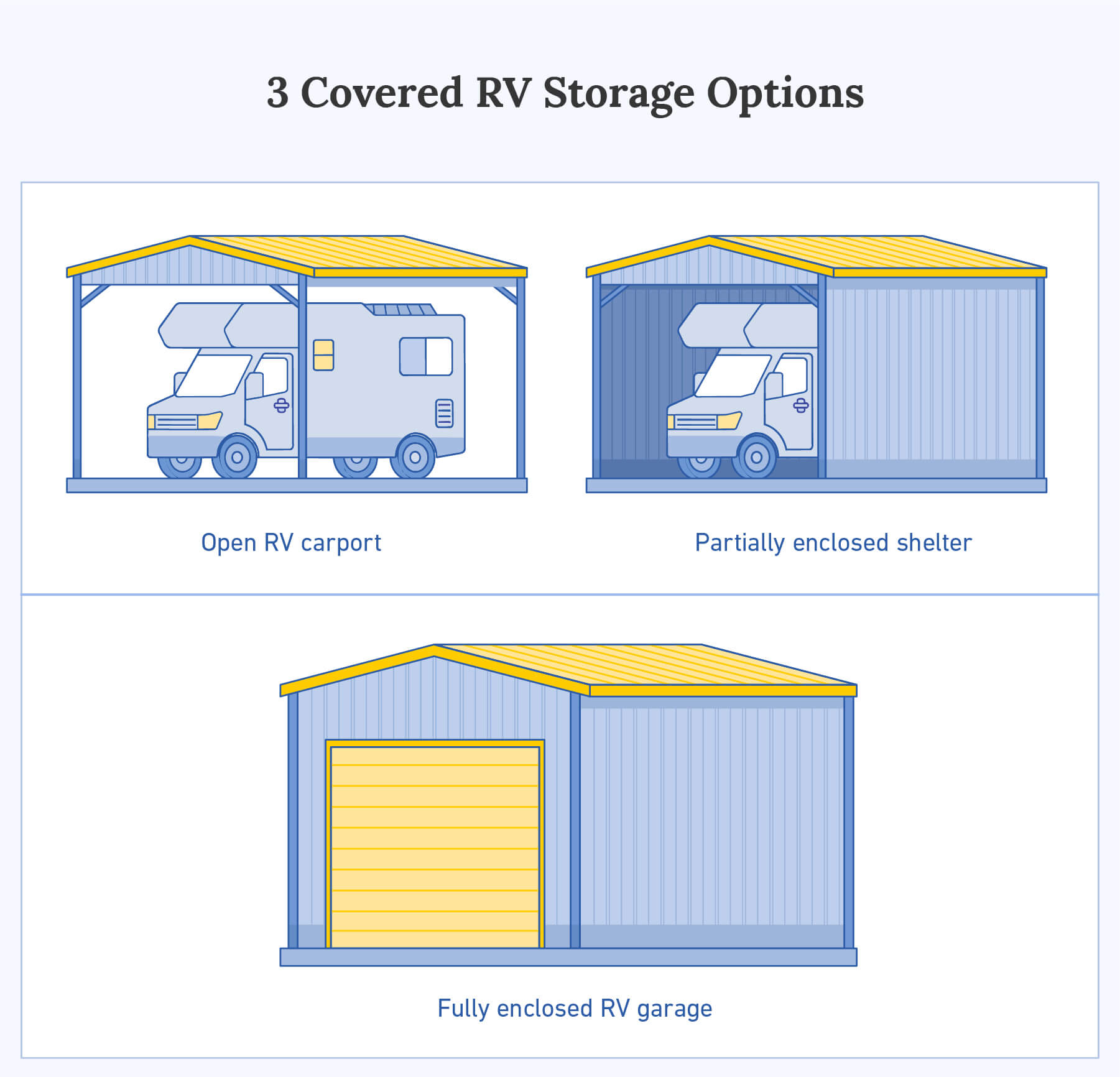
If you’re going to build, you’ve got three configurations to pick from. Each one trades cost against protection.
| Shelter type | Details | Best for | Trade-offs |
|---|---|---|---|
| Open RV carport | Roof-only structure with open sides. Steel frame, metal roof, no walls. | RV owners who need rain, hail, and UV protection at the lowest build cost. Mild and moderate climates. | No protection from wind-driven rain or sideways UV. Doesn’t keep dust or pests off the rig. |
| Partially enclosed shelter | Roof plus 1, 2, or 3 sidewalls. Open at the front (or wherever you pull in). | Properties with prevailing wind from one direction, snowy climates, or anyone who wants more side protection without going to a full enclosure. | Mid-range build cost. Balances airflow with protection. |
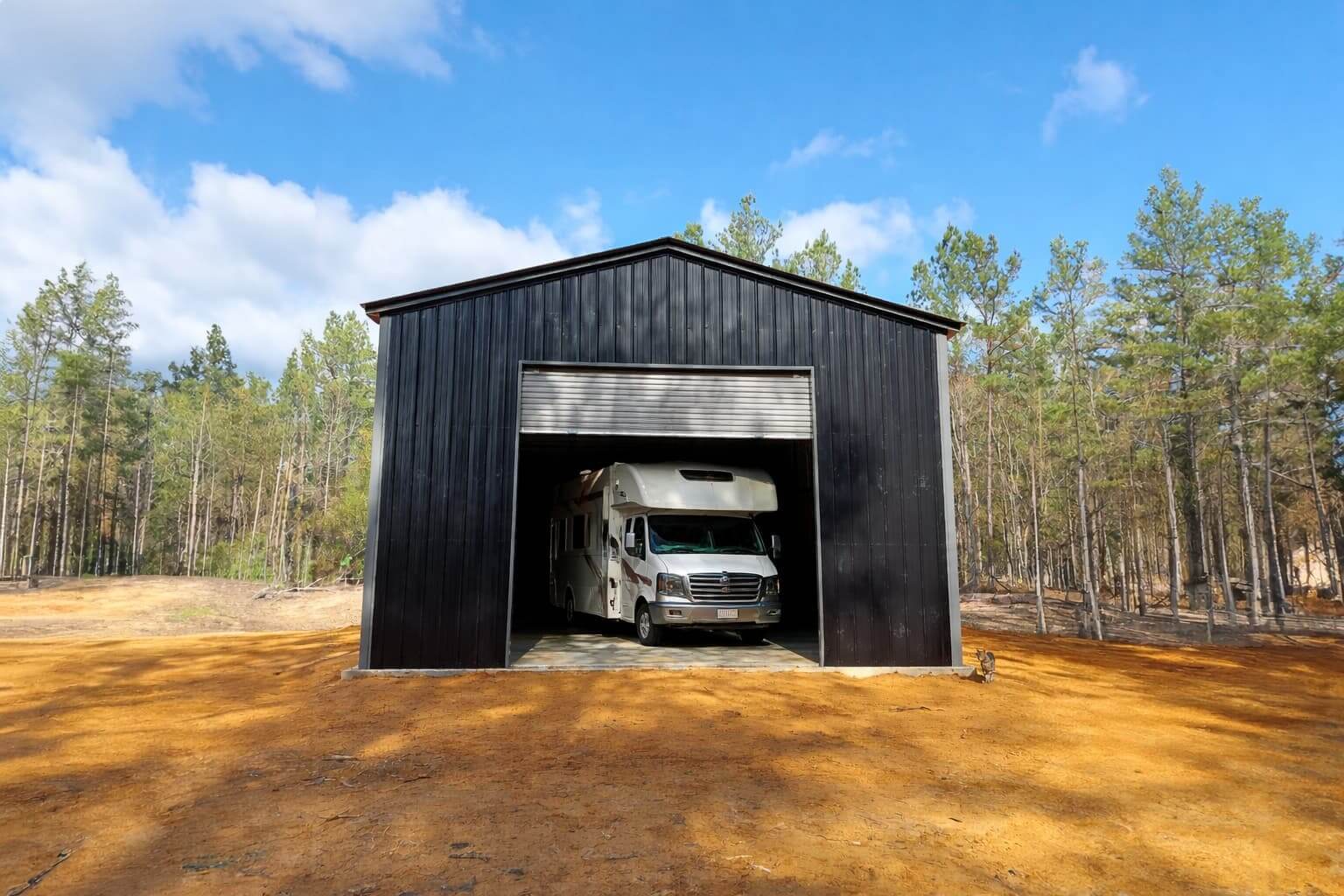
| Fully enclosed RV garage | 4 walls, a roof, and an overhead door tall and wide enough for the rig. | Maximum protection. Year-round use, climate-controlled if you want it, and secure indoor storage for tools and gear alongside the RV. | Highest build cost. Needs taller sidewalls and an engineered overhead door. |
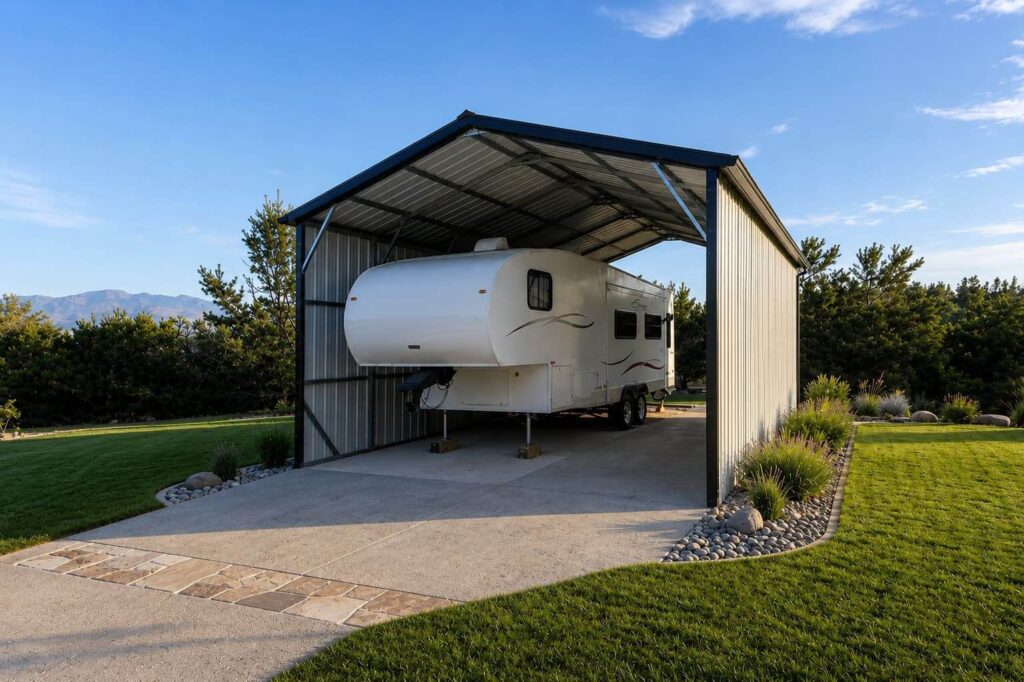
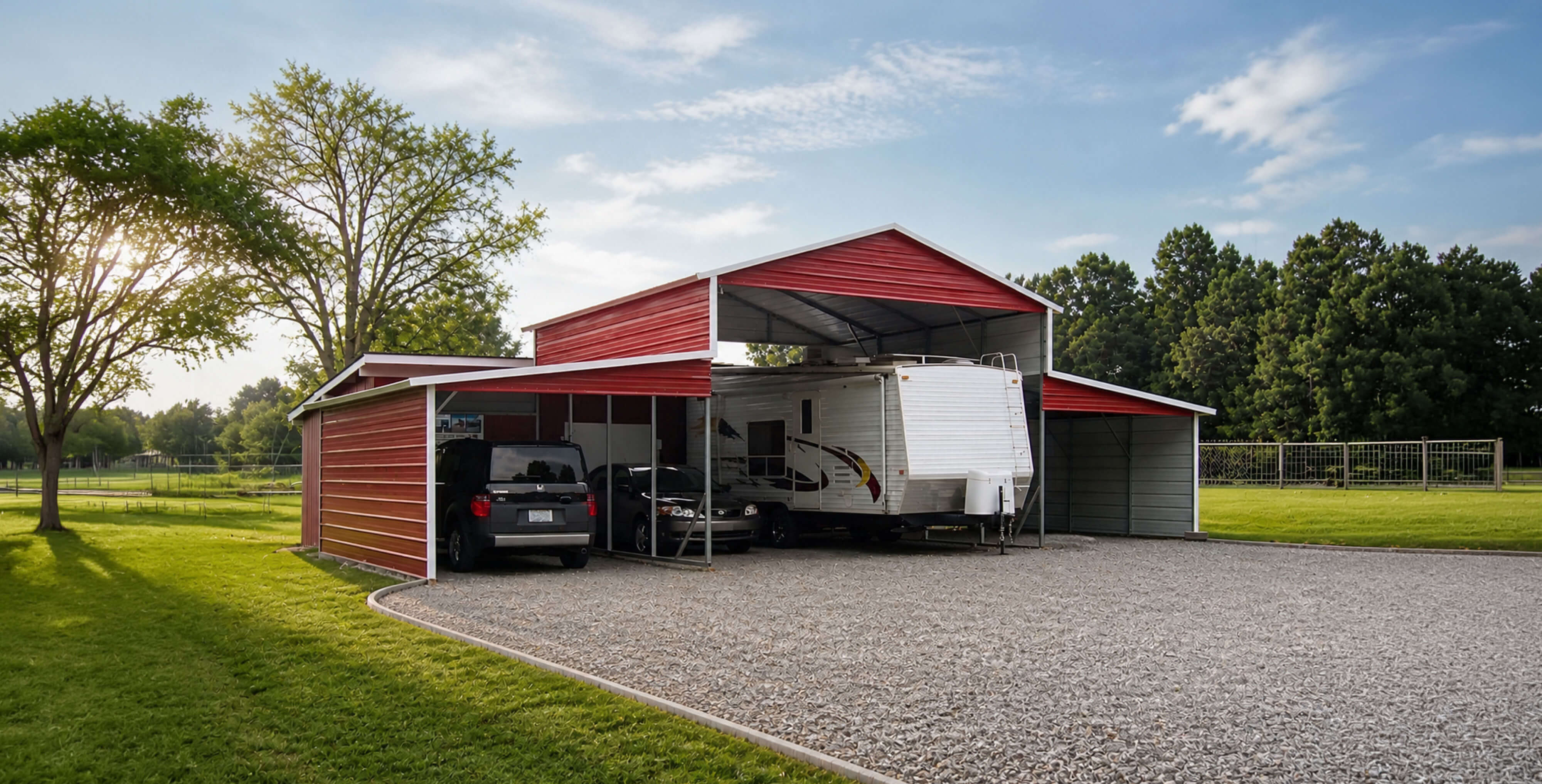
Open carports are our most popular vehicle storage option for RVs — see the RV carport product line at Alan’s Factory Outlet for sizes and roof styles. For a fully enclosed build, our RV garage line covers the configurations with overhead doors and full sidewalls.
For a walk-through on RV storage decisions in general, check out our guide to RV storage.
Sizing Guide by RV Class
Match the shelter to your rig. Size it for the longest, tallest RV you’ll park under it and leave room for the next one if you’re planning to upgrade.
| RV class | Typical length | Typical height | Recommended shelter |
|---|---|---|---|
| Class A motorhomes | 30–45 ft | 12–13 ft | 14×45 minimum, 14 ft sidewall (legs) |
| Class C motorhomes | 25–35 ft | 10–11 ft | 12×40, 12 ft sidewall |
| Travel trailers | 20–35 ft | 10–11 ft | 12×35, standard 9–12 ft sidewall |
| Fifth wheels | 30–40 ft | 12–13 ft | 14×45, 14 ft sidewall |
| Camper / pop-up / Class B van | 16–25 ft | 8–10 ft | 12×30, standard sidewall |
Add 2 to 3 ft of clearance around the rig on every side. You’ll need it for door swing, slide-outs, and walking around the RV with hookup hoses in your hand.
Also, motorhomes and 5th wheels with rooftop AC units, satellite domes, or solar panels gain a foot or more of effective height. Spec the shelter taller than what’s printed on the manufacturer’s spec sheet, and measure your actual rig with all the gear in place before you finalize the dimensions.
Foundation, Hookups, and Site Prep
The shelter is half the project. The slab and the hookups are the other half. Here are three calls to make before the structure shows up on the truck:
- Concrete vs. gravel pad. A reinforced concrete slab is the most durable option, distributes the weight of a heavy RV evenly, and gives you a clean working surface. A compacted gravel base is cheaper, drains better in heavy-rain regions, and works fine for lighter trailer storage and 5th wheels. For Class A motorhomes and big 5th wheels, concrete is the safer bet.
- Slope and drainage. A slight slope (about 1/8 inch per foot) keeps water moving off the pad instead of pooling. Critical under an open carport in rainy regions.
- Electrical hookups for battery maintenance. A 120V outlet at the parking spot lets you plug in a battery tender or trickle charger so the RV battery doesn’t die over the off-season. For larger rigs, a 30A or 50A hookup matches what you’d plug into at a campground and lets the rig run its onboard systems if you want to use it as a guest space.
If you wash the RV at home, run a hose bib to the pad, too. A simple gravel surround around the concrete catches runoff and keeps mud off the rig.
Rules and Zoning
Two questions decide whether you can build this thing on your property at all. Five minutes on the phone with the HOA office and the building department saves weeks of redesign.
HOA Covenants
Plenty of residential subdivisions restrict RV parking, and some prohibit on-site outdoor storage of recreational vehicles entirely. Pull your covenants before you spec the shelter. If your HOA allows the RV but limits where you can park it, a side-yard or backyard build usually clears the rule when a front-yard one wouldn’t.
Local Zoning and Setbacks
Counties set minimum distances from property lines for any permanent structure, and a 14×45 RV cover is big enough that those setback rules become a real constraint on a typical residential lot. Call your local building department before you finalize the footprint. Most counties also require a building permit for an RV cover structure of this size.
Renting Storage? Here’s What to Look For
If a build doesn’t fit your lot or your HOA, a rented covered space at an RV storage facility is the next-best storage option. A few things matter when you’re comparing storage facilities:
- Gate access and security cameras. Look for a controlled gate, video surveillance, and 24-hour access if you ever need to grab the rig on short notice. An on-site manager is a plus.
- Drive-aisle width. Wide drive aisles are the difference between a 5-minute pull-in and a 20-minute backing situation. Visit the facility before you sign anything.
- Amenities. The premium tier of RV storage facility comes with wash bays, a dump station, electrical hookups for battery tending, and sometimes boat storage if you’ve got one of those too. Most owners don’t need every amenity, but a wash bay and dump station are genuinely useful.
- Lease structure. Month-to-month gives you flexibility; an annual contract usually comes with a discount. Confirm move-in fees and office hours that work with your schedule.
- Climate. If you’re in the desert Southwest or somewhere with brutal winters, indoor storage or climate-controlled units are worth the premium. Year-round outdoor parking in Arizona ages an RV faster than the same outdoor parking in coastal California.
How much does it cost to build covered RV storage?
Total build cost depends on size, configuration (open carport vs. enclosed garage), foundation type, and regional labor rates. Plan around four buckets: the metal building shell, foundation and site prep, electrical hookups, and any optional finishing (lighting, gravel surround, and wash setup). Get itemized quotes from local contractors for the foundation and electrical and from your shell manufacturer for the structure.
How much does it cost to store a 40 foot RV?
A 40-foot RV usually falls into the largest covered or indoor pricing tier at most storage facilities. Outdoor uncovered runs $35 to $150 a month. Covered storage runs $45 to $200. Indoor climate-controlled jumps to $150 to $450 or more. Spaces with wide drive aisles, gate access, and on-site amenities push toward the top of every range.
Where can I store my RV for free?
Free RV storage almost always means parking on your own property — a driveway, side yard, or rural acreage you own. HOA rules and local zoning are the main constraints. Some RV owners arrange to park on a friend or family member’s rural lot, which is also free, but check local zoning before assuming long-term parking is allowed. Public parking lots, Walmart overnight, and similar setups aren’t viable long-term.
What size shelter do I need for a Class A motorhome?
For a Class A motorhome (typically 30 to 45 ft long, 12 to 13 ft tall before any rooftop gear), spec a 14×45 shelter with 14 ft sidewalls at a minimum. That gives you room for the rig itself plus 2 to 3 ft of side clearance and headroom for AC units, satellite domes, or solar panels mounted on the roof. Larger Class A motorhomes may need a 16×50 footprint.
Do I need a permit for an RV carport?
Most counties require a building permit for any permanent structure of an RV carport’s size, and many also enforce setback distances from property lines. Call your local building department before you order materials. They’ll tell you the permit requirements, the setback minimums, and whether your storage needs are something your HOA covenants allow on the property at all.