

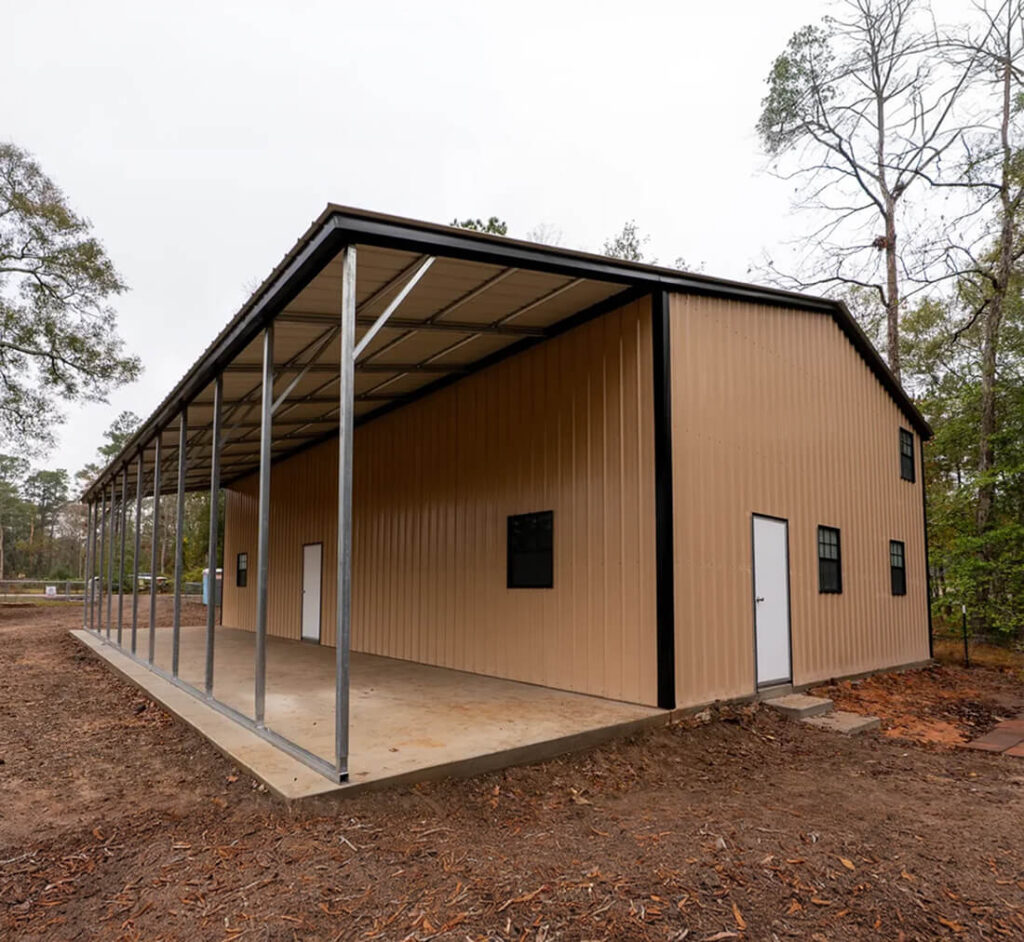
If you’ve outgrown your single-story shed but don’t have the lot space to spread out, going up is the next move. A two-story shed or metal building gives you twice the usable square footage on the same footprint, the same foundation, and the same roof. The only thing that gets bigger is the wall height and the framing, and that’s where the math starts working in your favor.
Below, I’ll walk through what configurations actually work, the sidewall heights and floor joist specs you need for two full stories, the use cases that make a two-story build pay off (workshop with a living space above, garage with an apartment, or man cave with a storage loft), and the permits and codes that come with adding habitable square footage on the second floor.
Why a Two-Story Build Is the Best Use of Your Footprint
The cost logic is plain when you lay it out. A single-story 30×40 shed sits on a 1,200 sq. ft. foundation, has a 1,200 sq. ft. roof, and gives you 1,200 sq. ft. of usable space. A two-story 30×40 sits on the same 1,200 sq. ft. foundation, has the same 1,200 sq. ft. roof, and gives you 2,400 sq. ft. of usable space. The shell costs more (taller walls, reinforced framing, floor joists, and a staircase add up), but you’re not pouring a second slab or shingling a second roof. The cost goes up by far less than the space doubles.
That’s why two-story configurations are the right call when:
- Your lot is small. Suburban properties, narrow rural lots, or anywhere setbacks limit how wide you can build.
- You want both functions. Workshop on the first floor, living space or storage above. Garage downstairs, apartment upstairs.
- You’re planning for the long haul. A two-story shell is harder to retrofit later than to build right the first time. If you might want a second floor in 5 years, build the wall height now.
Two-Story Shed and Building Sizes
Four configurations work well for most homeowners and small business builds.
Each pairs a footprint with a use case and the sidewall (leg) height you need to make it work.
| Footprint | Sidewall height | Total usable sq. ft. | Best for |
|---|---|---|---|
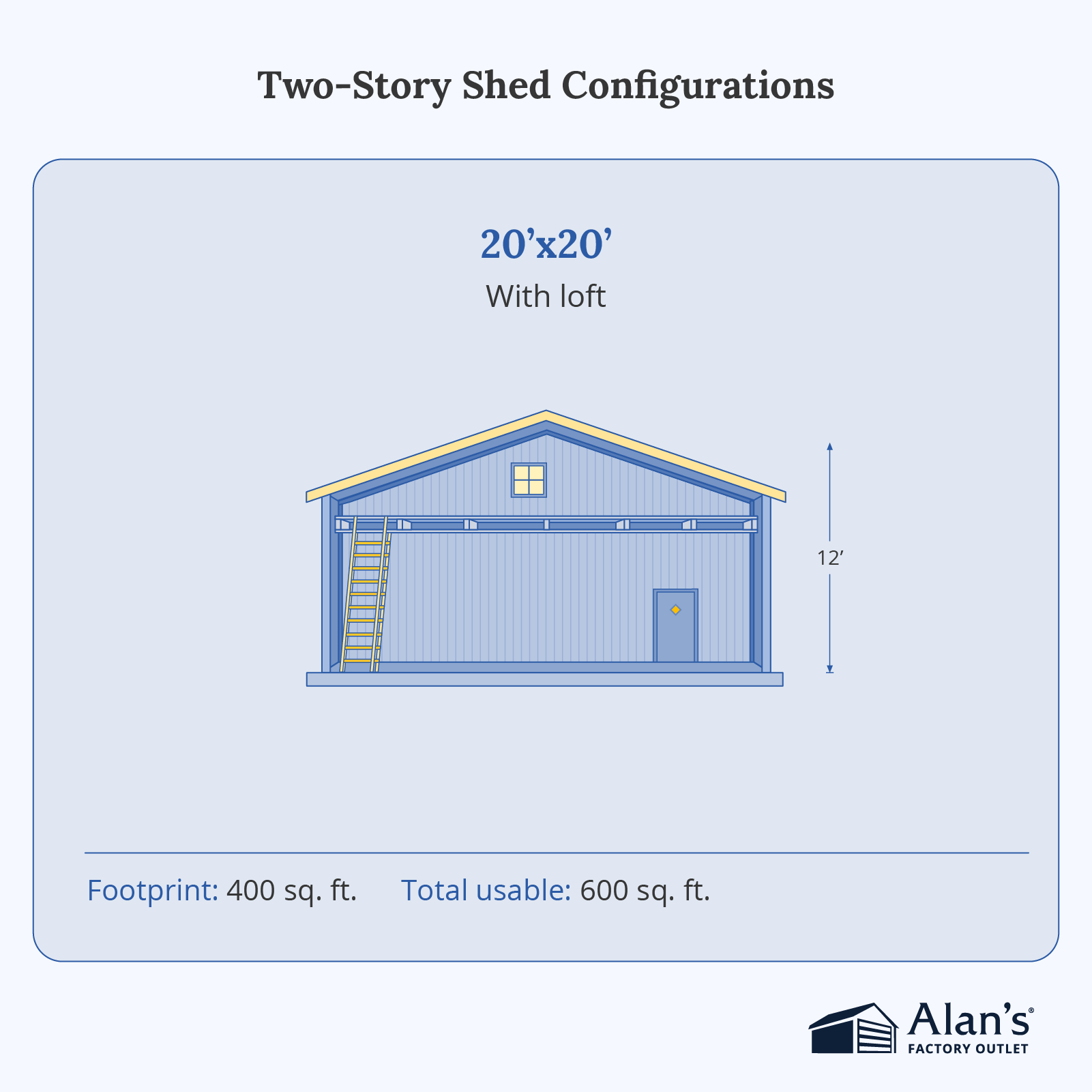
| 20×20 with loft | 12 ft | ~600 (400 main + 200 loft) | Small workshop with a storage loft above. Garden tools, lumber storage, seasonal gear. The loft is more like a mezzanine than a full second floor — head height drops at the eaves. |
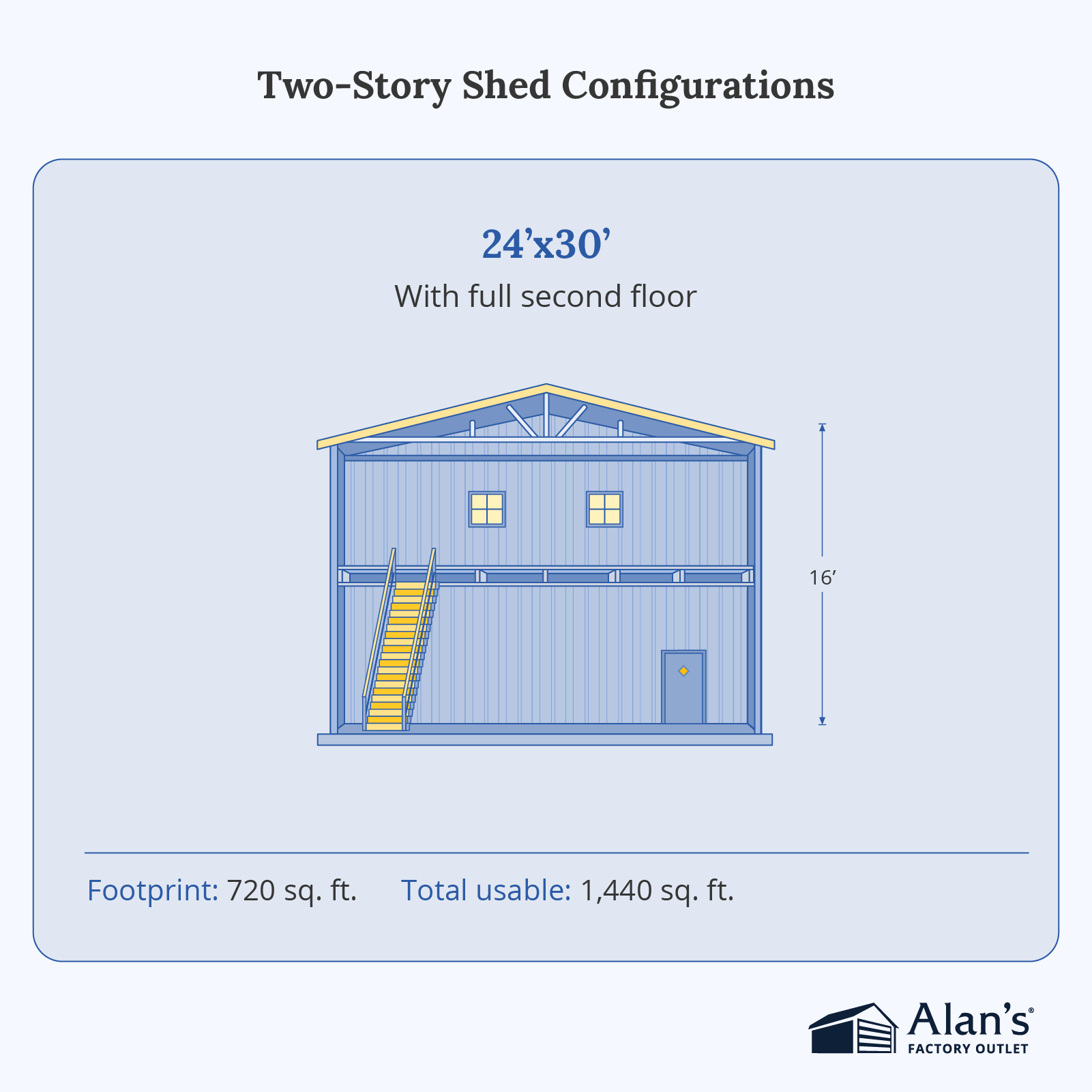
| 24×30 with full second floor | 16 ft | ~1,440 (720 + 720) | Single-bay car garage on the first floor, apartment or office on the second. Common configuration for an in-law suite or rental income. |
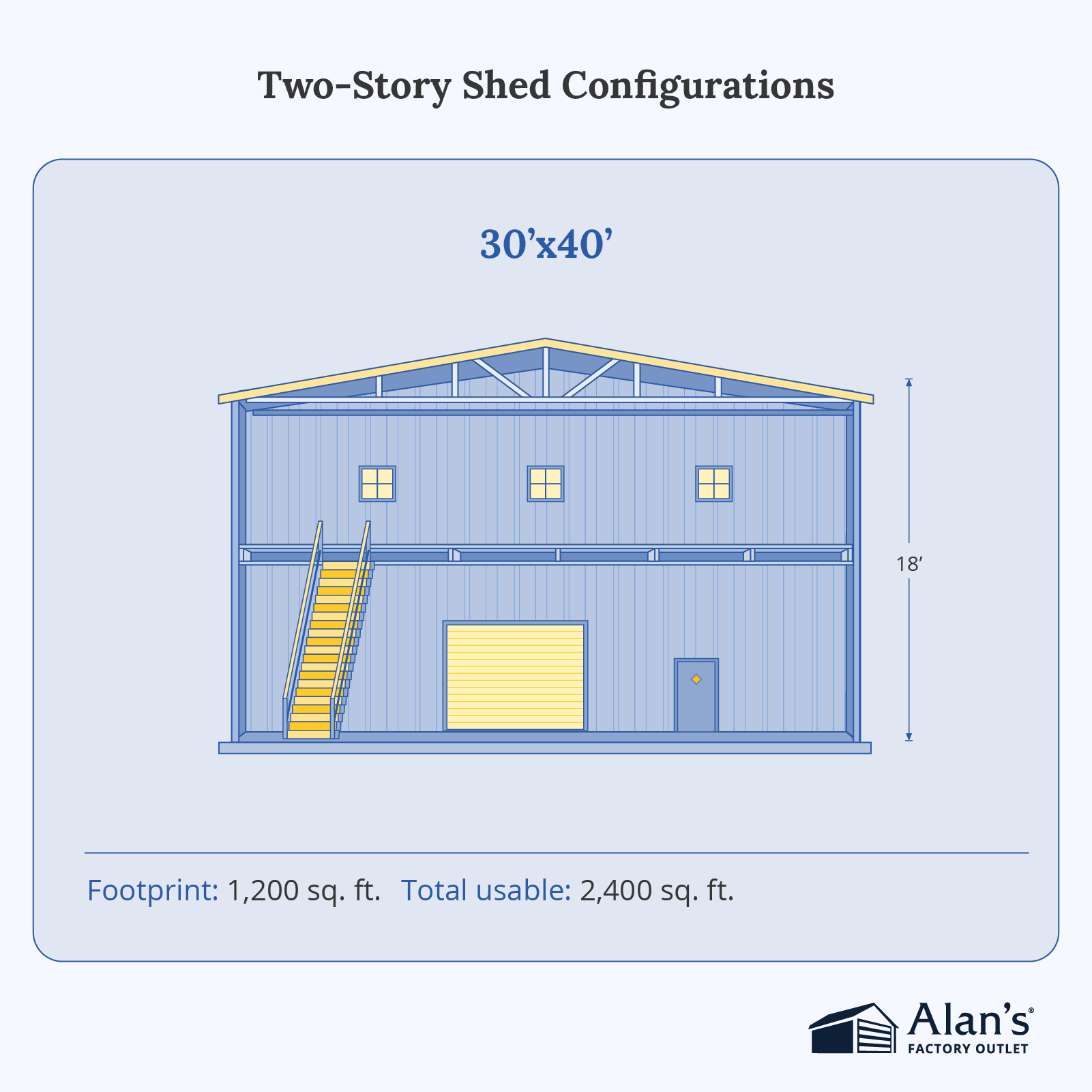
| 30×40 two-story | 16–18 ft | ~2,400 (1,200 + 1,200) | Workshop on the first floor with a full living space above — kitchen, bath, bedroom, sitting area. Or a 2-car garage downstairs with a 2-bedroom apartment upstairs. |
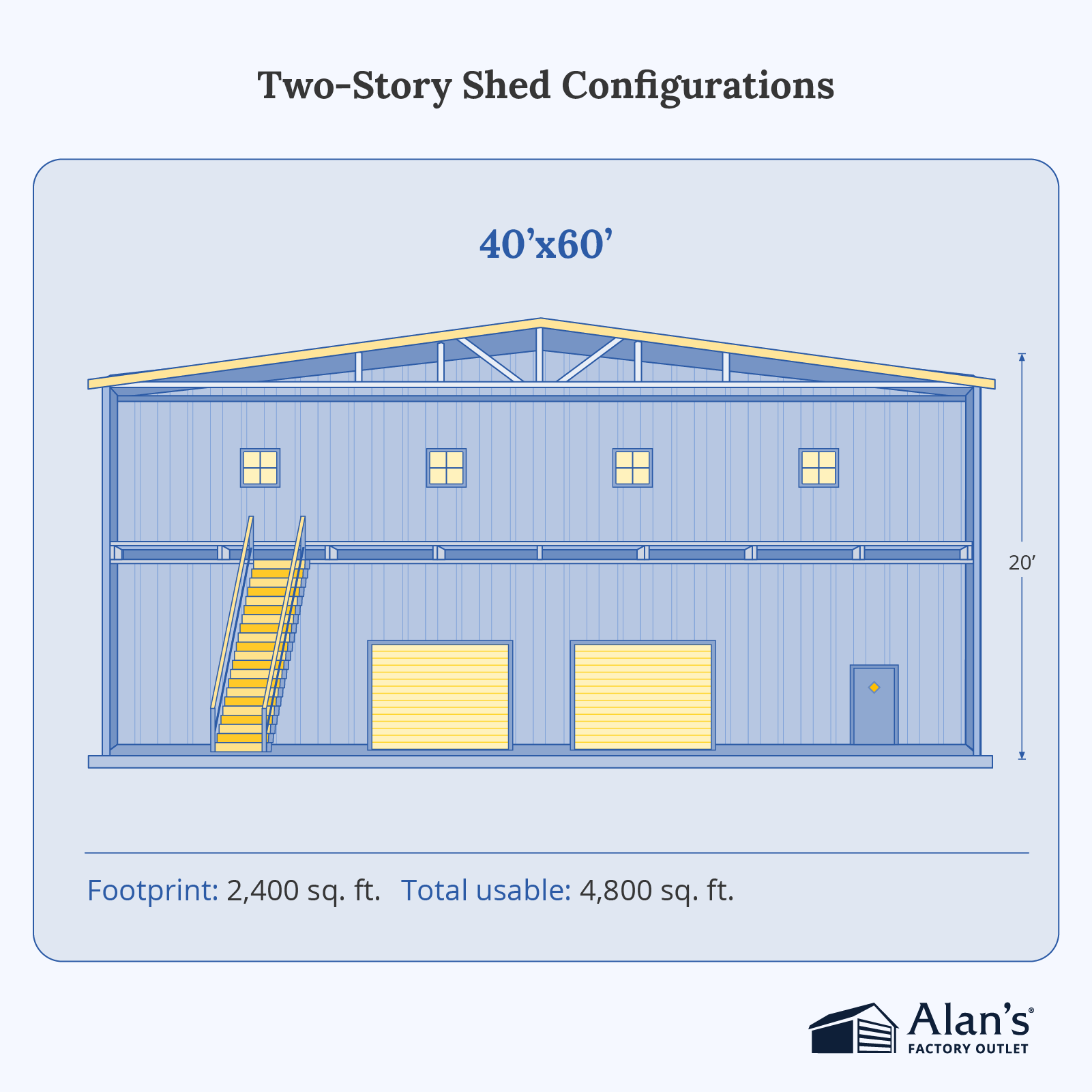
| 40×60 two-story | 18–20 ft | ~4,800 (2,400 + 2,400) | Commercial applications. Light manufacturing, larger workshop with office space, multi-bay vehicle storage with finished living quarters above. |
Sidewall height (also called leg height) is the spec that decides whether you can fit two full standard-height floors or whether the upper level becomes a loft. For two floors with 8-foot ceilings each, you need at least 16 ft of sidewall once you account for the floor system in between. For a workshop loft where the upper space is used mostly for storage, 12 ft of sidewall is enough.
Click through these slides to see the examples:
Sidewall Heights, Floor Joists, and Structural Specs
Once you’ve picked a footprint and a sidewall height, the second floor itself needs to be engineered. Here are a few specs to nail down with your contractor and your shell manufacturer:
- Sidewall height (leg height). For two full standard-height floors, 16 ft is the minimum. 18–20 ft gives you headroom for taller ceilings, exposed beams, or a slight pitch in the upper-floor ceiling. Our metal buildings are available with leg heights up to 20 ft, which is what you want for a true two-story workshop or living space.
- Mezzanine vs. full second floor. A mezzanine is a partial second floor — a loft platform that doesn’t extend over the full footprint. It’s cheaper, easier to build, and usually doesn’t require the same code path as a full second floor. A full second floor extends edge to edge and has to be framed for full living loads.
- Floor joists. The floor between the first and second levels carries the static and live loads of everything above. Standard residential framing uses 2×10 or 2×12 floor joists at 16 inches on-center for spans up to about 14 ft, with engineered I-joists or LVL beams for longer spans. For commercial loads or heavy storage above, the joist size, spacing, and beam supports get bigger. Spec these with a structural engineer or a contractor familiar with two-story builds.
- Pressure-treated wood at any concrete contact. The bottom plate that sits on the slab and any wood in contact with concrete needs to be pressure-treated to prevent rot.
- Staircase placement. A staircase eats roughly 40 sq. ft. of first-floor footprint plus a matching cutout in the second floor. Plan it before you frame — moving stairs after the fact is expensive. Most builds put them along a long wall to minimize the lost workspace below.
- Foundation. A two-story load is heavier than a single-story load, so the slab and footings need to be sized accordingly. A 6-inch reinforced concrete slab is typical for a two-story shed up to 30×40; bigger commercial builds or sites with poor soil may need a thicker slab and engineered footings.
Ways to Use a Two-Story Build
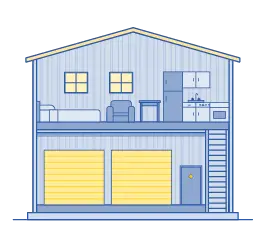 Two-story garage with apartment The strongest case for a two-story build. A 24×30 with 16 ft legs gives you a single-bay car garage with double doors on the first floor and a one-bedroom apartment with a kitchen, bath, and living space upstairs. Common as an in-law suite, an adult kid’s first place, or a rental unit on rural property where local zoning allows ADUs. | 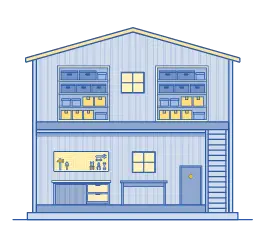 Two-story workshop with storage loft For hobbyists, woodworkers, and small business owners who need real workshop space on the first floor and overflow storage above. Mount the workbench, table saw, and dust collection on the first floor. Use the loft for raw materials, finished pieces, seasonal gear, and tools you don’t reach for every week. A 20×20 with a 12 ft sidewall and a loft works for a one-person workshop; a 30×40 two-story is a full small-business setup. |
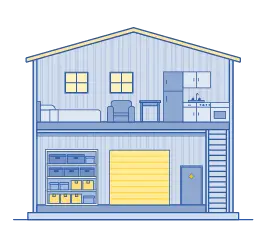 Two-story man cave or she-shed The recreation use case. Garage and shop space on the first floor with the man caves, she-sheds, or entertainment area on the second — bar, projector, seating, and separate HVAC. Storage stays downstairs near the garage doors; the upstairs is for living. A finished second floor with proper insulation and HVAC turns a metal building into the same kind of finished space you’d build into a basement. | 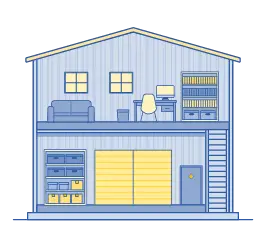 Two-story barn or workshop with office For small business owners running operations out of a metal building. Warehouse or workshop on the first floor with double doors and full vehicle access, and office and meeting space on the second. A two-story barn footprint also works well for small farms — equipment storage and animal pens below, hay and feed storage above. |
For a walk-through on finishing the upstairs as livable space, see our guide on a metal garage with living quarters.
Roof Styles, Overhangs, and Build Choices
A two-story metal building uses the same roof styles as any other metal building, but the taller walls give you more design flexibility for things like dormers, tall windows, and upper-floor overhangs.
- Roof pitch. A higher roof pitch on a two-story shed adds attic space above the second floor, which is useful for storage or for a ceiling that vaults into a peak. Steeper pitches also shed snow better in northern climates.
- Gable end design. The gable ends are where most two-story builds put their windows and doors. A tall gable with a window centered between the floors gives the upstairs natural light without competing for wall space with framing.
- Roof style choices. Standard A-frame (boxed eave), regular, and vertical roof styles are all available. Some builders also offer gambrel-style roofs (the classic barn shape with two slopes per side), which give you more headroom on the second floor without raising the sidewalls — though gambrel roofs aren’t a standard offering on every metal building line.
- Trusses vs. rafters. The roof framing approach affects how usable the attic space is. Trusses are pre-engineered and faster to install but limit the open space above the second floor. Stick-framed rafters give you a more open attic but cost more in labor.
- Overhang and trim. A 12-inch roof overhang shades upper-floor windows and protects the wall from rain. Optional shutters and dormer windows on the second floor break up the boxy metal building look and read more like a traditional two-story barn or shed.
For roofing material itself, metal panels are standard on Alan’s Factory Outlet buildings; some traditional shed builders use shingles or wood siding like SmartSide, and Amish-built two-story sheds typically use those materials. The metal-vs.-wood question comes down to maintenance: metal lasts longer with less work, wood looks more traditional but needs paint and seal cycles every few years.
Permits, Codes, and Habitable Space Requirements
A two-story shed used as a workshop or storage building goes through a different permit path than a two-story shed with finished living space upstairs. There are two big code items to know:
- Minimum ceiling height for habitable rooms. If you’re finishing the second floor as living space (bedroom, kitchen, sitting room, and office), the IRC requires a ceiling height of at least 7 feet in habitable rooms. Bathrooms and laundry rooms can drop to 6 ft 8 inches. For sloped or vaulted ceilings, at least 50% of the floor area has to clear 7 ft, with no portion below 5 ft. Plan sidewall heights so the finished ceiling (after floor framing and ceiling drywall) still hits these minimums.
- Egress windows in upstairs sleeping rooms. If any room on the second floor functions as a bedroom, code requires an emergency escape window with minimum opening dimensions and sill height. Spec these into the wall openings before the shell is delivered, not after.
Beyond habitable-space code, two-story sheds over a certain size or height typically require a building permit anywhere in the country. Maximum height limits vary by jurisdiction; most counties cap shed height at 14 to 20 feet for non-permitted builds, with anything taller requiring a permit. Pull the rules for your parcel before you finalize the build. Five minutes with the local building department saves weeks of redesign later.
Plan Your Two-Story Build
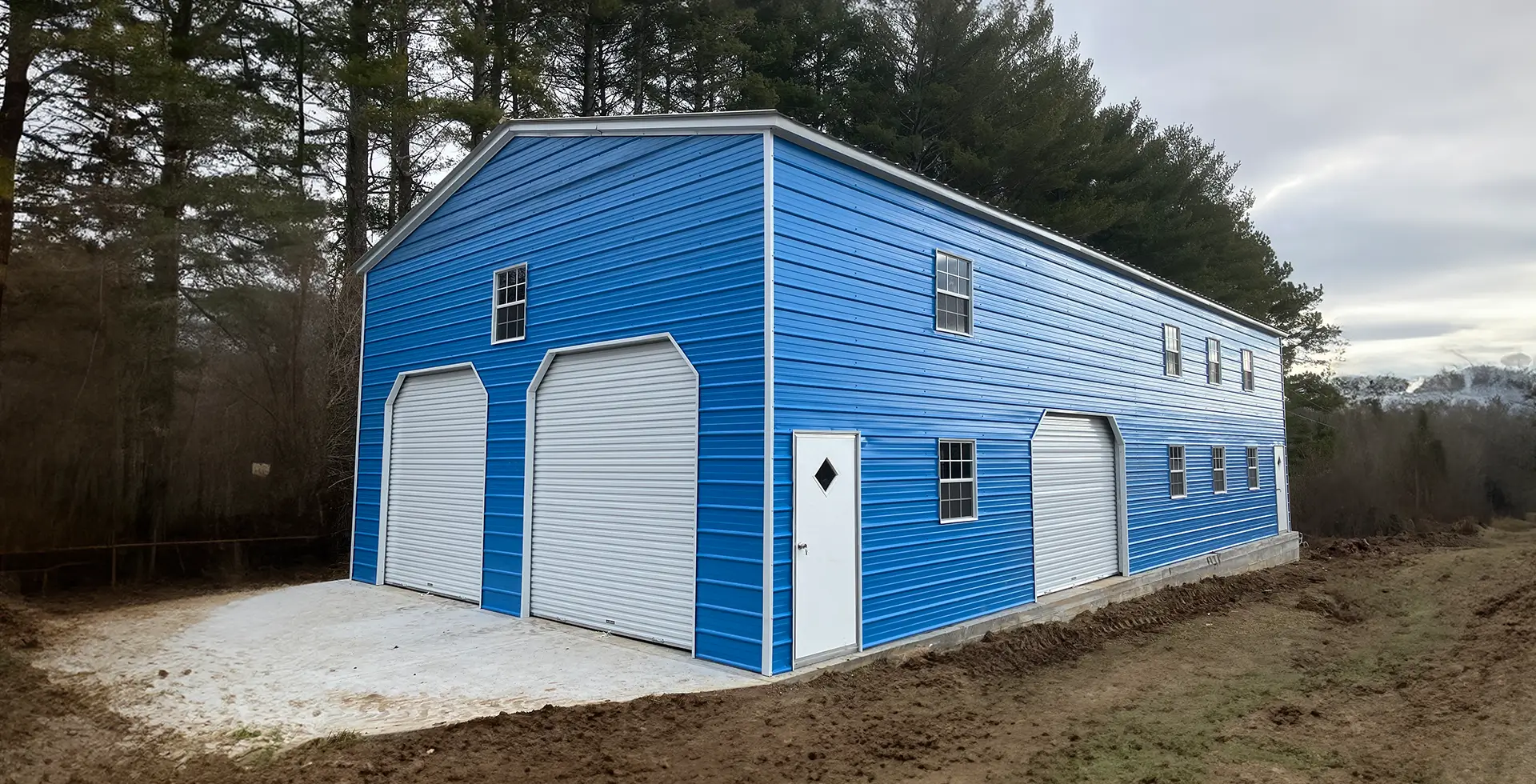
Start with the use case, not the footprint. Decide what each floor needs to do — workshop and apartment, garage and office, storage and recreation. That decision drives the sidewall height (12 ft for a loft, 16 ft minimum for two full floors), which drives the structural specs, which drives the foundation. Confirm permits and HOA approvals before you order materials.
To start sizing your build, browse footprints and leg heights for metal garages at Alan’s Factory Outlet for two-story garage configurations. For workshop and barn applications, take a look at our metal buildings.
Two-Story Shed FAQs
Here are the questions that come up most when people are weighing this decision.
How tall does a metal building need to be for 2 stories?
For two full standard-height floors, you need at least 16 ft of sidewall height (leg height) once you account for the floor system between the levels. 18 to 20 ft gives you more headroom or room for higher ceilings on the second floor. For a loft-style mezzanine with a partial second floor used mostly for storage, 12 ft of sidewall is enough.
Can you put a loft in a metal building?
Yes, easily. A loft is one of the most common upgrades on a metal shed or workshop. Spec at least 12 ft of sidewall height to give the loft real headroom (especially at the edges, where eaves limit clearance); use 2×10 or 2×12 floor joists at 16 inches on-center for the loft framing, and add a staircase or sturdy ladder. Lofts are simpler than full second floors because they don’t usually trigger the same residential code path.
Is it cheaper to buy a shed or build it?
For a single-story shed, the math depends on your DIY skill and how much your time is worth. For a two-story shed, buying a pre-engineered metal shell is almost always cheaper than building from scratch. The shell arrives ready to assemble, the engineering is already done, and the labor is contained to a single crew. A DIY two-story stick-framed build means months of weekend labor, multiple trade hires, and the structural engineering is on you.
What’s the maximum height of a shed?
Maximum shed height is set by local zoning, not a federal rule. Most U.S. counties cap shed height at 14 to 20 feet for non-permitted builds, with anything taller requiring a building permit. A two-story shed will almost always exceed the non-permitted threshold, so plan for the permit process from day one.
What is the largest shed without a permit?
Permit thresholds vary by county. The most common rule is that any shed over 100 to 200 sq. ft. of footprint or over a certain height (often 12 to 14 ft) requires a permit. A 20×20 (400 sq. ft.) two-story shed will require a permit in nearly every jurisdiction. Call your local building department for the exact thresholds in your area before you order materials.
Can I legally live in my shed?
If the shed is a non-habitable storage shed, no. If it’s built to residential code — minimum 7 ft ceilings in habitable rooms, egress windows in sleeping rooms, smoke alarms, and code-compliant HVAC and plumbing — and your zoning allows a metal building as a primary residence or accessory dwelling unit, yes. Check with your county building department before assuming the upstairs of a two-story shed can be lived in full-time.